
Listed on 
 Years active
 English (Arabic)
 Chinese Simplified - 中文 (简体)
 Chinese Traditional - 中文 (繁體)
 English
 Japanese - 日本語
 Korean - 한국어 (대한민국)
 Portuguese - Português
 Russian - Русский
 Spanish - Español
 Thai - ไทย
 English (India)
Don't have an account?
Register via AppHave an account?
Login 30/06/2026 - 07:21 UTC
The US Dollar Index experienced a slight pullback of 0.29% on Monday, though it maintained a strong footing above the 101.00 threshold, trading near 101.30. The greenback remains on track for its largest monthly gain in nearly a year, underpinned by robust optimism regarding American economic growth and rising expectations of federal rate hikes after the central bank held its benchmark rate steady between 3.50% and 3.75% in June. Market participants are bracing for Thursday's crucial June employment report, where three consecutive months of stronger-than-expected payroll gains have already validated the central bank's hawkish shift. While a resilient labor market continues to support the dollar across the board, any unexpected signs of cooling in Thursday's data could prompt a dovish reassessment of the monetary path.
The global markets experienced significant volatility on Monday as geopolitical tensions and monetary policy expectations shifted investor sentiment. Gold prices plummeted by 1.18%, tumbling toward the $4,050 level during European trading hours. This sharp decline in the non-yielding bullion was triggered by a mix of uncertainty surrounding potential United States and Iran talks and an increasingly hawkish outlook from the Federal Reserve, led by new Chair Kevin Warsh. Investors are heavily weighing the upcoming US Nonfarm Payrolls data, scheduled for Thursday, which is expected to show an addition of 114,000 jobs in June while the unemployment rate holds steady at 4.3%. Current market pricing via the CME FedWatch Tool shows nearly a 59.7% probability of a Fed interest rate hike as early as September 2026, reducing the appeal of safe-haven gold as higher interest rates loom.
Meanwhile, the energy market managed a modest rebound on Monday, with West Texas Intermediate crude oil gaining 0.55% to hover around the $70.00 per barrel mark despite conflicting signals out of the Middle East. While a fragile interim ceasefire regarding the critical Strait of Hormuz waterway initially eased supply anxieties, geopolitical confusion deepened after United States officials claimed both nations would "stand down for now" to meet in Doha, Qatar. However, Tehran quickly contradicted reports of a scheduled meeting, asserting that responsibility for the waterway lies solely with Iran and warning that any attempts to bypass its preferred routes would trigger further escalation. Complicating the oil supply outlook, internal OPEC friction intensified as Iraq aggressively pushed for a higher production quota to recoup lost revenue, testing cartel unity following the recent shock departure of the UAE.
U.S. stocks experienced a powerful rebound on Monday, driven by a sharp recovery in the technology sector that lifted both the Nasdaq Composite and the S&P 500, signaling robust, ongoing confidence in semiconductor and artificial intelligence firms following the previous week's steep sell-off. Market sentiment was further bolstered by a Supreme Court ruling that legally protected a Federal Reserve policymaker from executive dismissal, helping investors look past recent volatility.
Individual mega-cap stocks saw significant inflows, pushing major indices higher. Nvidia gained 1.51% amid steady demand for AI infrastructure, while Alphabet surged 4.91% during its debut trading day as a Dow Jones Industrial Average component, helping lift the blue-chip index to a record high. Additionally, recently public SpaceX staged a major turnaround, climbing 7.36% on the Nasdaq as buyers stepped in following a severe post-IPO pullback.
The Japanese yen tumbled to its lowest level against the U.S. dollar since 1986, continuing a months-long decline that has kept markets on high alert for currency intervention despite fresh verbal warnings from Tokyo officials. While the weak yen has boosted Japanese exporters and record-high stock prices, it has simultaneously driven up the cost of dollar-denominated energy and transport imports, squeezing households and creating a political headache for Prime Minister Sanae Takaichi's administration.
Looking ahead, market participants will focus on corporate health and critical macroeconomic indicators, starting with Nike's quarterly earnings later today for insights into consumer spending. Attention then shifts to Thursday's high-impact economic data, headlined by the ISM Manufacturing PMI's reflection of industrial stability. Most critically, the holiday-shortened week culminates in Thursday's crucial June employment report—featuring Non-Farm Employment Change, Average Hourly Earnings, and the Unemployment Rate—which will offer definitive clues regarding labor market strength and the Federal Reserve's future interest rate path.
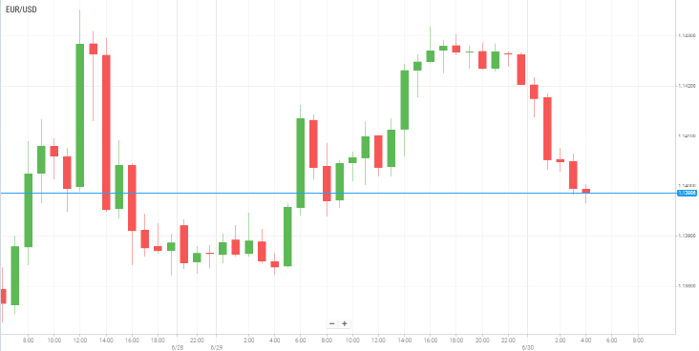
The EUR/USD pair traded lower during Tuesday’s early Asian session, with the euro weakening against the US dollar as traders reduce expectations for further European Central Bank (ECB) rate hikes this year.
ECB President Christine Lagarde said during the opening of the central bank’s annual retreat on Monday that Europe has become more resilient to external economic shocks, supported by a stronger financial framework and progress in the green transition.
Lagarde also noted that geopolitical tensions could ease if a peace agreement is reached, although she stressed that such an outcome remains uncertain. Policymakers continue to assess whether additional monetary tightening is required.
Market expectations for future ECB rate increases have declined as energy prices fall. Meanwhile, expectations for the US interest rate outlook have moved higher, with markets now pricing in nearly a 60% chance of a Federal Reserve rate hike by September, according to the CME FedWatch tool.
Investors will closely watch upcoming US labor market data, including the ADP employment report and Nonfarm Payrolls (NFP) figures, for further clues on the Fed’s policy direction. Strong employment data could support the US dollar and create additional pressure on the EUR/USD pair.
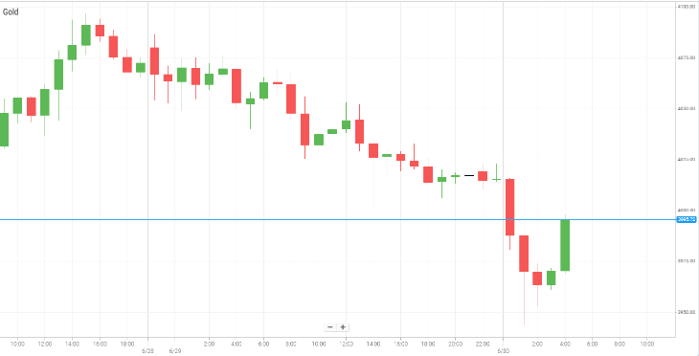
Gold is attempting a mild rebound after falling to its lowest level since November 2025 during Tuesday’s Asian session, though the precious metal remains under pressure for a second consecutive day. A broadly stronger US dollar, rising expectations for Federal Reserve rate hikes, and renewed geopolitical uncertainty continue to weigh on bullion.
The US dollar has attracted fresh buying interest as uncertainty surrounding US-Iran relations has increased demand for safe-haven assets. Mixed signals from ongoing talks between Washington and Tehran have kept geopolitical risks elevated, limiting the dollar’s recent decline from its highest level since May 2025 and adding pressure on gold prices.
Reports indicated that the US and Iran had agreed to de-escalate tensions following recent exchanges of strikes near the Strait of Hormuz, although both sides accused each other of breaching the ceasefire. US President Donald Trump also stated on Truth Social that Iran had requested a meeting, which was expected to take place in Doha, Qatar. However, Iranian Deputy Foreign Minister Kazem Gharibabadi denied that technical discussions were scheduled for the week, keeping uncertainty around the situation intact.
Renewed concerns over potential inflationary pressures from geopolitical tensions, combined with a more hawkish Federal Reserve outlook, have strengthened expectations for higher US interest rates.
Additional pressure on precious metals came from a sharp decline in the Japanese yen, which dropped to a fresh four-decade low against the US dollar. Traders are now awaiting key US economic releases, including the Conference Board’s Consumer Confidence Index and JOLTS Job Openings data, for further direction.
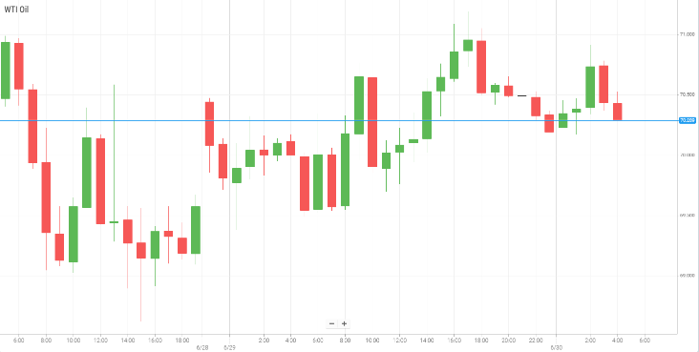
Oil prices moved slightly lower in early Asian trading on Tuesday as investors balanced optimism over potential renewed US-Iran negotiations with ongoing concerns about possible supply disruptions following recent military exchanges between the two countries.
Oil markets remain cautious after Washington and Tehran exchanged fresh attacks over the weekend, keeping attention focused on the Strait of Hormuz. Sentiment was briefly supported by US President Donald Trump’s announcement that the two sides would hold peace talks in Doha on Tuesday, although uncertainty remains as Tehran has yet to confirm its participation in further discussions.
Iran’s Deputy Foreign Minister Kazem Gharibabadi said the country would continue efforts to jointly manage maritime traffic through the Strait of Hormuz, even if Oman decides not to take part. The comments added to uncertainty surrounding the future operation of the strategically important waterway.
Oil prices closed higher on Monday after rebounding from last week’s sharp decline, although both Brent and WTI remain more than 9% below recent highs after falling back toward levels seen before tensions between the US, Israel, and Iran escalated.
The Strait of Hormuz remains a major focus for energy markets, as the waterway handles roughly one-fifth of global crude oil and liquefied natural gas shipments.
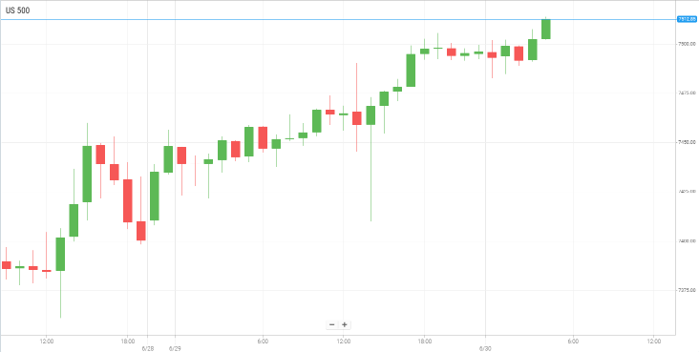
US stocks started the holiday-shortened trading week on a positive note Monday, supported by a strong rebound in technology and communication services shares after both sectors suffered steep losses last week.
Technology remained a key focus for investors, while renewed geopolitical concerns also influenced market sentiment after fresh military exchanges between the US and Iran over the weekend pushed oil prices higher. Tensions eased somewhat after US President Donald Trump said Iran had requested a meeting with Washington in Qatar.
Investors are now looking ahead to Thursday’s May jobs report for further signals on the Federal Reserve’s monetary policy outlook. Technology and communication services shares recovered after being oversold following last week’s declines, although market breadth remained mixed, with declining stocks slightly outnumbering gainers and several sectors still under pressure.
Among individual stocks, Alphabet gained 4.89% as the company officially began trading as a member of the Dow Jones Industrial Average, replacing Verizon. The move marks Alphabet’s inclusion in one of the most closely followed US stock indexes, which tracks 30 major companies across various industries.
Palantir Technologies rose 2.5% after announcing a strategic partnership with Nvidia to deploy open artificial intelligence models in secure government environments.
The materials contained on this document should not in any way be construed, either explicitly or implicitly, directly or indirectly, as investment advice, recommendation or suggestion of an investment strategy with respect to a financial instrument, in any manner whatsoever. Any indication of past performance or simulated past performance included in this document is not a reliable indicator of future results. For the full disclaimer click here.
Join iFOREX to get an education package and start taking advantage of market opportunities.
 A beginner's e-book
 $5,000 practice demo account
 A 12-part video course
 Trusted partner
 Featured partner
 By
By 


