
Listed on 
 Years active
 English (Arabic)
 Chinese Simplified - 中文 (简体)
 Chinese Traditional - 中文 (繁體)
 English
 Japanese - 日本語
 Korean - 한국어 (대한민국)
 Portuguese - Português
 Russian - Русский
 Spanish - Español
 Thai - ไทย
 English (India)
Don't have an account?
Register via AppHave an account?
Login 16/03/2026 - 07:50 UTC
In the past week, the USDX climbed 1.25%, maintaining its position above the 100.00 threshold even as it retreated from a nearly ten-month high of 100.54. The Greenback experienced a slight softening during early Monday hours as risk aversion eased following reports from U.S. Energy Secretary Chris Wright and other officials suggesting the conflict with Iran could conclude within the next few weeks. While the currency has benefited from its safe-haven status, investors are now recalibrating their expectations ahead of Wednesday’s Federal Reserve policy meeting, where policymakers are expected to address inflation risks tied to recent energy price volatility.
In the energy sector, WTI Oil prices surged 8.29% over the last week, though the commodity faced intraday selling pressure on Monday after failing to breach the psychological $100.00 mark. While efforts by the U.S. and European allies to reopen the Strait of Hormuz have provided some relief to supply concerns, tensions remain elevated after U.S. forces targeted military sites on Kharg Island, a critical Iranian oil hub. Despite President Trump’s assurances that oil infrastructure was not hit, the market remains on edge over potential Iranian retaliation against regional energy facilities, keeping the technical outlook for crude largely bullish.
Conversely, Gold prices fell 2.59% over the past week, with the precious metal steadying around the $5,000 level during the Monday Asian session. Although the ongoing geopolitical strife typically supports the yellow metal, the recent spike in oil costs has fueled significant inflation concerns, leading markets to believe the Federal Reserve will maintain higher interest rates for a longer period. This hawkish monetary outlook for non-yielding assets has dampened the demand for bullion, as traders shift their focus toward a busy week of central bank decisions from the U.S., Japan, Europe, and the UK.
Most Asian stock markets experienced a cautious start to the week as the regional trade session processed a combination of positive domestic data and persistent geopolitical headwinds from the Middle East. Investor sentiment remains anchored by the third week of the U.S.-Israeli conflict with Iran, which has kept global oil prices elevated above $100 a barrel. The ongoing risk of supply disruptions near the Strait of Hormuz continues to fuel inflation concerns across energy-importing nations. While U.S. stock index futures showed modest gains, the broader mood remains one of "wait-and-see" ahead of the Federal Reserve's policy meeting on March 17-18, where officials are expected to weigh the impact of higher energy costs on the long-term interest rate trajectory.
In China, the latest economic figures provided a significant upside surprise, suggesting a robust start to 2026. Industrial output grew by 6.3% year-on-year in the January-February period, significantly outpacing forecasts, while retail sales increased by 2.8%. This momentum was largely driven by a surge in high-tech manufacturing and strong holiday spending during the Lunar New Year. Despite these fundamental gains, equity markets remained under pressure; as of 05:53 AM Monday, the China SSE fell 0.49%, while the China SZSE edged up 0.03%.
The Japanese market faced selling pressure as the rise in import costs continues to squeeze corporate margins. By 05:53 AM Monday, the Japan 225 rose slightly by 0.04%, paring earlier losses as investors digested the regional implications of the $100+ WTI Oil environment. While the domestic manufacturing sector remains resilient, the focus in Tokyo is shifting toward how the Bank of Japan will navigate the inflationary pressure caused by the sustained energy shock.
The Korea 200 surged 1.56% by 05:53 AM Monday, buoyed by the strong performance of major tech exporters following China's upbeat industrial data. Conversely, the Hong Kong 50 gained 1.24%, recovering from earlier volatility as dip-buyers moved into heavily discounted sectors. In corporate news, attention remains on the technology supply chain, as Samsung and SK Hynix continue to benefit from their exclusive AI component deals with Nvidia.
Markets are focused on a heavy slate of central bank decisions and U.S. data this week. On Wednesday, the Federal Reserve is expected to hold rates at 3.50% to 3.75% while providing new projections for 2026, followed by steady rate holds from the Bank of Japan and Bank of England on Thursday. Key U.S. releases include Wednesday’s Core PPI and Thursday’s unemployment claims, both of which will be used to assess inflation risks and labor market strength.
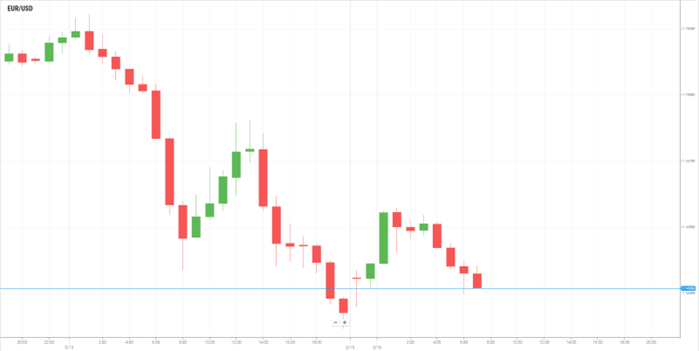
The EUR/USD pair traded with a cautious tone near 1.1430 during Monday’s early Asian session, remaining below the 1.1450 level. Upside momentum for the currency pair may remain limited as escalating geopolitical tensions in the Middle East continue to support demand for safe-haven assets.
Over the weekend, US forces reportedly targeted multiple military sites on Kharg Island, a key Iranian oil export hub. Meanwhile, US President Donald Trump stated that oil infrastructure had not been directly struck. Iran has warned it may retaliate against oil facilities linked to the United States in the region.
In Europe, French President Emmanuel Macron emphasized the need to restore freedom of navigation through the Strait of Hormuz as soon as possible. Macron also urged Iran’s leadership to immediately halt what he described as unacceptable attacks targeting countries across the region, including Lebanon and Iraq.
Heightened geopolitical risks in the Middle East tend to strengthen safe-haven currencies such as the US Dollar, which could continue to weigh on EUR/USD in the near term.
Investors are also turning their attention to key central bank decisions later this week. The Federal Reserve is widely expected to leave interest rates unchanged within the 3.5%–3.75% target range at its policy meeting on Wednesday. Meanwhile, the European Central Bank is also anticipated to keep its benchmark rates steady when it announces its decision on Thursday.
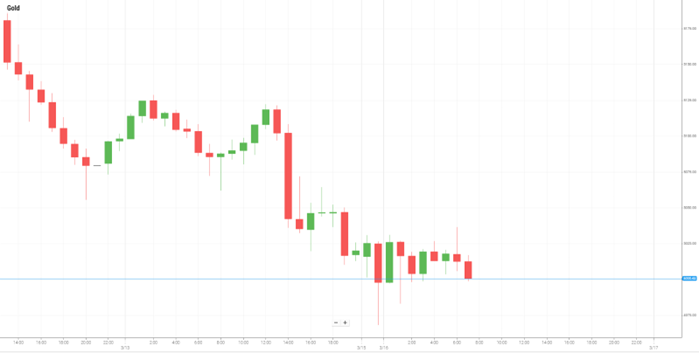
Gold prices hovered close to the $5,000 mark during Monday’s early Asian trading session, as investors weighed escalating geopolitical tensions against expectations for key central bank policy decisions later this week.
Despite heightened conflict in the Middle East, the precious metal faced some selling pressure as traders adopted a cautious stance ahead of monetary policy announcements from several major central banks. Market participants are closely tracking developments surrounding the conflict involving the United States, Israel, and Iran, which typically increases demand for safe-haven assets such as gold.
Officials from the administration of US President Donald Trump indicated that the conflict with Iran could come to an end within the next few weeks, or possibly sooner. However, Israel’s military has suggested its operations may continue for at least another three weeks.
While geopolitical tensions often support gold prices, the current escalation has also pushed oil prices higher, raising concerns about persistent inflation. Elevated inflation expectations could lead the Federal Reserve to delay interest-rate cuts, a factor that typically weighs on non-yielding assets such as gold.
Beyond the Federal Reserve, several major central banks are scheduled to announce policy decisions this week, including the Reserve Bank of Australia, Bank of Japan, European Central Bank, and Bank of England.
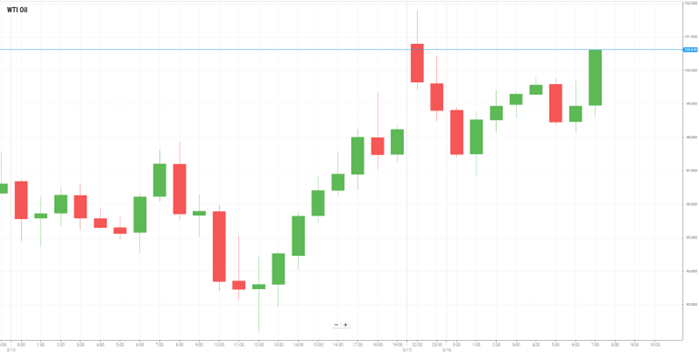
Oil prices advanced on Monday as investors refocused on risks to energy infrastructure in the Middle East, even after US President Donald Trump called on global partners to help secure the Strait of Hormuz, a critical route for international oil shipments.
Both benchmarks have surged more than 40% this month, reaching their highest levels since 2022. The rally followed US-Israeli strikes on Iran, which prompted Tehran to halt shipping through the Strait of Hormuz, disrupting roughly one-fifth of global oil supply in what analysts describe as the largest supply interruption on record.
While the reported strikes appeared to target military infrastructure rather than energy facilities, analysts noted that supply risks remain elevated because Iranian crude is currently the primary oil moving through the Strait of Hormuz.
Over the weekend, Trump warned of potential additional strikes on Kharg Island—responsible for about 90% of Iran’s oil exports—after earlier attacks on military targets there triggered a defiant response from Tehran.
Shortly after the Kharg strikes, Iranian drones reportedly hit a key oil terminal in Fujairah in the United Arab Emirates. Oil loading operations at the terminal have since resumed, according to several sources, though it remains unclear whether activity has fully returned to normal levels.
On Sunday, Trump said the United States was urging other countries to contribute to safeguarding the strategic shipping corridor and confirmed that Washington remains in contact with Tehran, although he expressed skepticism that Iran is ready for serious negotiations to end the conflict.
Meanwhile, the International Energy Agency announced that more than 400 million barrels of strategic oil reserves will soon be released to the market in a record coordinated drawdown aimed at stabilizing prices amid the ongoing conflict.
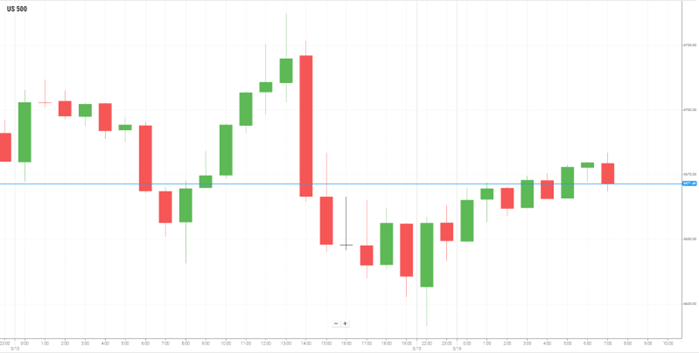
U.S. equities closed lower on Friday, capping a difficult week for Wall Street as investor sentiment remained pressured by the ongoing conflict in the Middle East.
Although recent inflation data largely matched expectations, it did little to improve market sentiment. Investors noted that the figures were backward-looking and did not fully reflect the surge in oil prices that followed U.S. and Israeli strikes on Iran in late February.
Wall Street’s major indexes weakened as the conflict with Iran showed little indication of ending. The military campaign has now entered its second week, with U.S. President Donald Trump stating that Washington’s operations are “totally destroying” Iran’s military capabilities and economic infrastructure.
Economic data released Friday painted a mixed picture of the U.S. economy. According to the Bureau of Economic Analysis, real gross domestic product expanded at an annualized rate of 0.7% in the fourth quarter of 2025, sharply revised down from the initial estimate of 1.4%. Meanwhile, the core Personal Consumption Expenditures Price Index—the Federal Reserve’s preferred inflation gauge—rose 0.4% month-over-month in January and 3.1% year-over-year, both in line with expectations but still well above the Fed’s 2% inflation target.
Among individual stocks, shares of Adobe dropped more than 7% after the software company announced that its long-time chief executive, Shantanu Narayen, will step down after 18 years in the role.
Narayen joined Adobe in 1998 and became CEO in 2007, overseeing a major transformation of the company’s business model, including the shift toward cloud-based software subscriptions. During his tenure, Adobe’s annual revenue expanded to $23.77 billion from $3.58 billion.
Despite the leadership transition, Adobe reported quarterly earnings that exceeded expectations and issued forward guidance largely above analyst forecasts.
The materials contained on this document should not in any way be construed, either explicitly or implicitly, directly or indirectly, as investment advice, recommendation or suggestion of an investment strategy with respect to a financial instrument, in any manner whatsoever. Any indication of past performance or simulated past performance included in this document is not a reliable indicator of future results. For the full disclaimer click here.
Join iFOREX to get an education package and start taking advantage of market opportunities.
 A beginner's e-book
 $5,000 practice demo account
 A 12-part video course
 Trusted partner
 Featured partner
 By
By 


