
Listed on 
 Years active
 English (Arabic)
 Chinese Simplified - 中文 (简体)
 Chinese Traditional - 中文 (繁體)
 English
 Japanese - 日本語
 Korean - 한국어 (대한민국)
 Portuguese - Português
 Russian - Русский
 Spanish - Español
 Thai - ไทย
 English (India)
Don't have an account?
Register via AppHave an account?
Login 29/06/2026 - 07:32 UTC
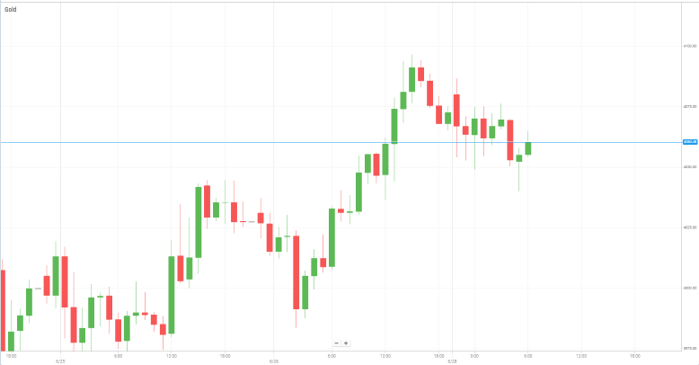
Gold prices faced ongoing downward pressure, sliding toward the $4,050 to $4,060 range in early Monday trading following a 2.01% drop over the course of last week. The safe-haven asset is retreating as geopolitical anxieties ease alongside tentative signs of a US-Iran truce, combined with rising hawkish sentiment surrounding the Federal Reserve. Because bullion is a non-yielding asset, its appeal has softened as traders price in a roughly 59.7% chance of a September interest rate hike under the Fed's data-driven approach led by Chairman Kevin Warsh. Investors are now turning their attention to Thursday's highly anticipated US Nonfarm Payrolls data, which is expected to show an addition of 114,000 jobs, to get a clearer picture of the central bank's next policy steps.
The US Dollar Index (USDX) opened the week on a steady note around 101.35, holding its ground after wrapping up the previous week with a 0.59% gain. Markets are preparing for a highly volatile period ahead as a massive wave of US economic indicators—including the JOLTS Job Openings and ISM Manufacturing and Services PMIs—leads up to the critical employment data on Thursday. This data has taken on extra weight for the greenback since Chairman Warsh explicitly scrapped traditional forward guidance, signaling that future interest rate hikes will be dictated entirely by incoming economic realities rather than central bank commentary.
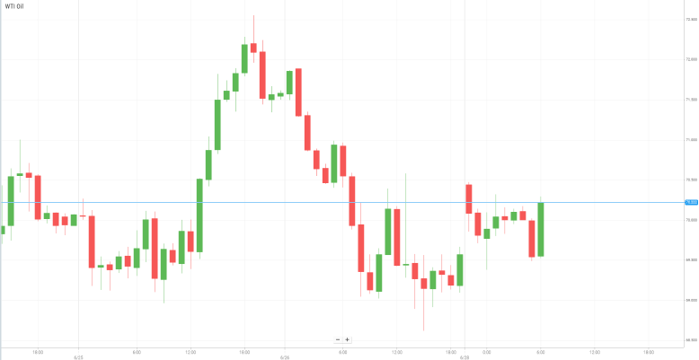
West Texas Intermediate (WTI) crude oil plummeted toward $69.60 on Monday morning, extending a massive sell-off that saw prices dive by 9.17% last week. The steep decline comes as Washington and Tehran agree to halt days of retaliatory military strikes around the Strait of Hormuz and instead convene for diplomatic talks in Doha, Qatar. While any definitive breakthrough in these negotiations could permanently secure global energy supply routes, the oil market remains on edge given warnings from Iranian officials that any attempts to bypass their authority in the critical waterway will trigger immediate escalation.
Asian equity markets delivered a highly mixed performance on Monday morning after Beijing restricted exports to 20 Japanese corporate entities. The tech sector bore the brunt of the cautious sentiment, remaining firmly on the backfoot following a wave of profit-taking. This hesitation reflects deeper market-wide valuation worries regarding artificial intelligence (AI) capital expenditures, with participants increasingly questioning whether rapid chipmaker rallies can still be justified by actual earnings growth timelines.
The tech sell-off heavily penalized key Asian heavyweights, which were highly sensitive to global semiconductor index shifts following sharp declines the previous week. South Korea's KOSPI led regional slides as industry giants Samsung Electronics tumbled 6.28% and SK Hynix dropped 4.23%. Japan’s tech ecosystem faced similar pressure, underscored by a steep 13.21% plummet for SoftBank. Portfolio rebalancing at the end of the quarter further exacerbated the broad rotation away from some of the year's biggest hardware and investment winners.
Despite the tech route across Asian supply chains, the broader global market saw a highly fractured performance. Tech exposure was not uniformly negative; US heavyweight Nvidia managed a 2.6% gain last week, defying the regional downtrend, while speculative tech took a heavy blow as SpaceX slid 17.44%. Global markets remain on edge as futures point to a mild reprieve following reports that Washington and Tehran are planning technical talks in Qatar to preserve a shaky ceasefire around the Strait of Hormuz.
For July, the market is bracing for a turbulent start, driven by a combination of high-profile corporate earnings and crucial macroeconomic data. Early in the week, financial results from heavyweights like Nike and Constellation Brands will capture investor attention, before focus pivots to critical monetary policy updates. Mid-week speeches from Bank of England Governor Andrew Bailey and Federal Reserve Chairman Kevin Warsh will set the macroeconomic tone, leading directly into Thursday’s major releases: the Non-Farm Payrolls report and the ISM Manufacturing PMI. Whether these indicators point to persistent inflation or a slowing job market, the upcoming data will be pivotal in shaping the Federal Reserve's next interest rate decisions and defining global market trends.
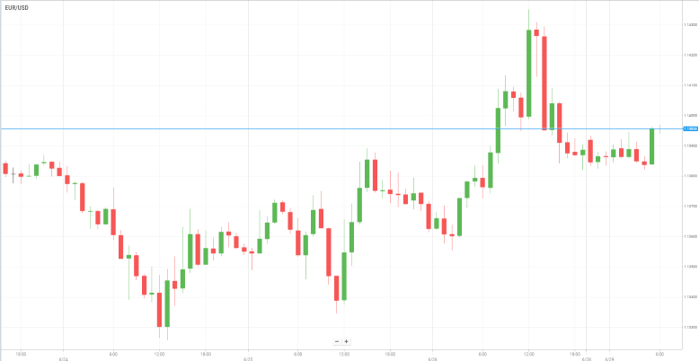
The EUR/USD pair continues to build on its recent recovery, advancing for a third consecutive trading session and hovering near 1.1390 during Monday’s Asian session. Despite the Euro’s positive momentum, further gains could face challenges as ongoing geopolitical uncertainty may trigger demand for safe-haven assets.
Traders continue to assess the developments surrounding talks to end the US war with Iran. The European Central Bank's (ECB) annual forum and the US June employment data will be the highlights later this week.
CNN reported on Monday that a US official said that the US and Iran will stand down for now after both sides traded fire near the Strait of Hormuz. Two countries plan to meet on Tuesday in Doha, Qatar.
Iran’s Foreign Minister Abbas Araghchi stated that responsibility for the Strait of Hormuz lies solely with Tehran and warned that any attempt to bypass its preferred route in the waterway will cause “tension and escalation.”
The Middle East tensions have continued to stoke inflation pressures, while a surprisingly hawkish debut from Kevin Warsh as a new Federal Reserve (Fed) chair earlier in the month has reversed market expectations for US rate cuts this year. This, in turn, could underpin the US Dollar (USD) against the Euro (EUR) in the near term.
ECB President Christine Lagarde will open the forum on Monday. Her speech could offer some hints about evolving central bank policies amid lower oil prices and stock market volatility. Any hawkish remarks from policymakers could provide some support to the shared currency.
Gold prices remain under pressure, falling toward $4,060 during Monday’s early European session as traders weigh developments surrounding US-Iran negotiations and shifting Federal Reserve policy expectations. Market attention is now turning toward the upcoming US Nonfarm Payrolls (NFP) report later this week for fresh clues on the interest rate outlook.
The United States and Iran have reportedly agreed to temporarily halt hostilities and are set to meet in Doha, Qatar, on Tuesday to discuss tensions surrounding the Strait of Hormuz. A US official said both sides would “stand down for now” following recent exchanges of fire near the strategic waterway.
However, uncertainty remains elevated after Iran’s Foreign Minister Abbas Araghchi reaffirmed that Tehran controls responsibility for the Strait of Hormuz.
Renewed geopolitical risks could intensify inflation concerns, encouraging markets to anticipate a more restrictive monetary policy stance. This dynamic may weigh on non-yielding Gold, which traditionally serves as an inflation hedge but becomes less attractive when interest rates remain elevated.
According to the CME FedWatch Tool, traders are pricing in a growing possibility of a Federal Reserve rate hike as early as September 2026. The upcoming US labor market data, including Thursday’s NFP report, will be closely watched for indications about the Fed’s future policy direction.
Crude oil prices moved higher on Monday as renewed exchanges between the United States and Iran highlighted the fragile nature of their temporary ceasefire agreement and raised concerns over disruptions to energy shipments through the Strait of Hormuz.
Despite the recent recovery in oil flows, market participants remain cautious due to ongoing geopolitical risks. Analysts noted that while traders are focusing on improving supply conditions, any delays in restoring production and exports could create additional upside pressure for oil prices.
Brent crude recorded a more than 10% weekly decline last week, marking its third consecutive weekly drop, after shipments through the Strait of Hormuz reached their highest level since the conflict between the US and Israel involving Iran began in late February.
However, shipping activity has slowed following renewed attacks on vessels in the region, including a Qatar-linked oil tanker. The incidents triggered further strikes between the US and Iran, representing the most serious escalation since the interim peace agreement was reached.
Meanwhile, Saudi oil producer Saudi Aramco resumed crude loadings at its Ras Tanura terminal after a nearly four-month suspension as producers increased output and exports ahead of the temporary agreement. Nevertheless, analysts highlighted that physical supply remains constrained by tanker delays, infrastructure damage, and production disruptions, with a return to pre-conflict levels potentially taking until the end of the year.
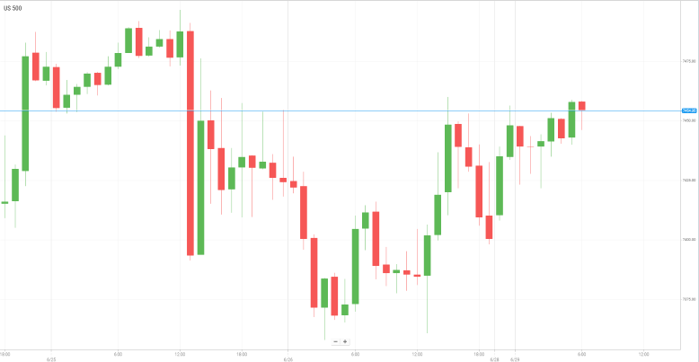
US stock index futures moved higher on Sunday evening as investors reacted to reports that the United States and Iran had agreed to pause recent hostilities around the Strait of Hormuz and resume diplomatic discussions, reducing concerns over a broader regional escalation.
Market sentiment improved after reports indicated that Washington and Tehran had agreed to halt fighting related to tensions in the strategic waterway and restart negotiations in Doha, Qatar. The developments followed a weekend escalation that saw renewed attacks on shipping activity and military targets in the region.
The latest diplomatic efforts follow an interim peace agreement reached on June 17, which had temporarily eased several weeks of rising tensions in the Gulf. However, investors remain cautious as geopolitical risks continue to influence global market sentiment.
Meanwhile, technology stocks remain in focus after a difficult week for Wall Street. Investors reduced exposure to high-growth technology companies amid concerns over elevated valuations and slowing momentum in artificial intelligence-related sectors.
Market sentiment was further pressured after Apple Inc. increased prices on several MacBook and iPad models, citing higher memory chip costs linked to strong demand from AI data centers.
Investors are now preparing for a busy week ahead, with key US labor market data and second-quarter corporate earnings updates expected to provide fresh direction. Trading volumes may remain lighter ahead of the US Independence Day holiday, while developments in the Middle East are likely to remain a major driver of risk appetite across global markets.
The materials contained on this document should not in any way be construed, either explicitly or implicitly, directly or indirectly, as investment advice, recommendation or suggestion of an investment strategy with respect to a financial instrument, in any manner whatsoever. Any indication of past performance or simulated past performance included in this document is not a reliable indicator of future results. For the full disclaimer click here.
Join iFOREX to get an education package and start taking advantage of market opportunities.
 A beginner's e-book
 $5,000 practice demo account
 A 12-part video course
 Trusted partner
 Featured partner
 By
By 


