
Listed on 
 Years active
 English (Arabic)
 Chinese Simplified - 中文 (简体)
 Chinese Traditional - 中文 (繁體)
 English
 Japanese - 日本語
 Korean - 한국어 (대한민국)
 Portuguese - Português
 Russian - Русский
 Spanish - Español
 Thai - ไทย
 English (India)
Don't have an account?
Register via AppHave an account?
Login 06/07/2026 - 06:39 UTC
Over the past week, the US Dollar Index (USDX) declined 0.50%, as investors reassessed the outlook for the US economy and monetary policy. The US dollar faced modest pressure amid expectations that the Federal Reserve could adopt a more patient approach following softer economic data, particularly signs of easing labour market conditions. At the same time, lingering geopolitical tensions continued to provide some safe-haven support for the greenback, helping to limit the extent of the decline despite weaker overall sentiment.
Gold gained 2.53% over the past week, benefiting from growing expectations that the Federal Reserve may refrain from further tightening monetary policy in the near term. The precious metal also continued to draw support from sustained purchases by central banks, which remain focused on diversifying reserve assets amid persistent geopolitical and economic uncertainty. Ongoing tensions surrounding the Strait of Hormuz further reinforced gold's appeal as a safe-haven asset, while expectations of lower interest rates improved the outlook for the non-yielding metal.
WTI crude oil fell 1.09% over the past week as concerns over expanding global supply outweighed the geopolitical risk premium. Although tensions in the Middle East remained elevated, shipping activity through the Strait of Hormuz largely stabilised, easing fears of prolonged disruptions to global energy flows. In addition, OPEC+ approved a production increase of 188,000 barrels per day, signalling confidence in regional stability, while reports that Iran has begun discussions to resume crude oil exports to Japan under a temporary US sanctions waiver added to expectations of increased supply. Together, these developments reinforced market concerns about a potential oversupply in the months ahead, placing downward pressure on oil prices.
Bitcoin gained 5.25% over the past week, supported by improving investor sentiment after weaker-than-expected US economic data reduced expectations of further Federal Reserve interest rate hikes. The rally was further aided by renewed inflows into US spot Bitcoin ETFs, signalling a recovery in institutional demand and helping the cryptocurrency climb above the $63,000 level. Investors will now focus on upcoming Federal Reserve communications and ETF flows for further direction.
Asian technology markets came under pressure in the latest trading session as investors took profits across the semiconductor sector following recent gains, even as broader risk sentiment remained relatively stable. In individual stock action, SK Hynix fell 3.36%, NVIDIA declined 1.46%, while Samsung Electronics rose 1.92%, reflecting a mixed but cautious tone across global AI-linked equities. The pullback came amid ongoing reassessment of valuations in the AI supply chain, with investors rotating out of some high-beta chip names after a strong recent rebound.
US equity markets remained supported as investors balanced optimism over the economic outlook with a reassessment of artificial intelligence-related investments. Attention is now focused on the release of the Federal Reserve's June meeting minutes, which are expected to provide further insight into the future direction of US monetary policy. Investors will also be closely watching the start of the second-quarter earnings season, with results from major companies expected to offer an early indication of corporate performance. While enthusiasm for AI remains strong, recent sector rotation has prompted investors to become more selective, favouring companies expected to benefit from broader AI adoption while reassessing valuations across parts of the semiconductor industry.
The EUR/USD pair remains confined to a narrow range below the 1.1450 level during Monday's Asian trading session, as investors balance geopolitical risks against evolving expectations for monetary policy. Although the pair continues to trade close to its highest level in nearly two weeks, gains remain limited by cautious market sentiment.
Concerns over the Strait of Hormuz continue to support demand for the US Dollar. While the United States and Iran have reached a fragile interim understanding, uncertainty persists as Tehran seeks greater control over the strategically important shipping route.
However, the Dollar's gains remain restrained after last week's weaker-than-expected US labor market data reinforced expectations that the Federal Reserve may adopt a more cautious policy stance. The softer employment data, combined with easing inflation pressures following the recent decline in crude oil prices, has prompted markets to scale back expectations for future Fed tightening. Investors now anticipate anywhere between no rate hikes and a single increase in 2026, compared with expectations of two hikes only a short time ago. A broadly positive tone across global equity markets has also limited safe-haven demand, preventing the US Dollar from extending its advance.
On the Euro side, softer inflation readings across the Eurozone have encouraged markets to temper expectations for additional European Central Bank rate hikes, limiting bullish momentum for the single currency.
Attention now turns to Monday's economic calendar, which includes German Factory Orders, Eurozone Sentix Investor Confidence, Producer Price Index (PPI), and Retail Sales data. Later in the day, traders will focus on the US ISM Services PMI report and comments from several Federal Open Market Committee (FOMC) officials for fresh clues on the Federal Reserve's policy outlook, which could drive the next move in EUR/USD.
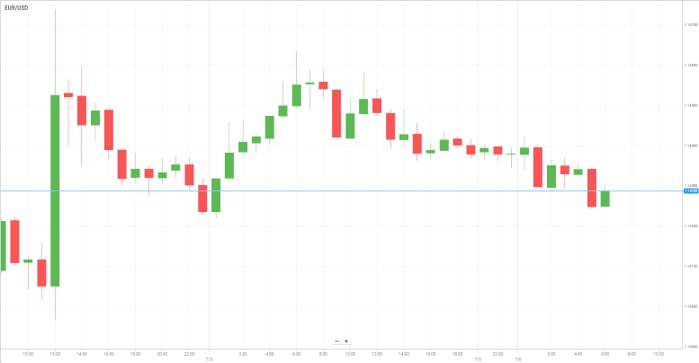
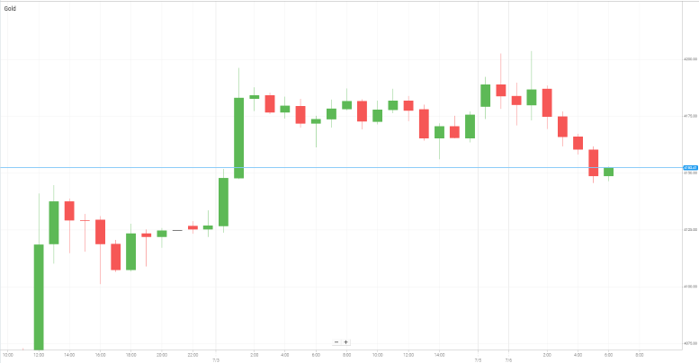
Gold prices eased during Monday’s Asian session after briefly climbing above the $4,200 level, a fresh two-week high. The retreat appears to interrupt a three-day winning streak as renewed demand for the US Dollar limits further gains in the precious metal.
Reports that Iran may introduce new service fees for vessels using the strait have helped maintain a geopolitical risk premium, encouraging some safe-haven flows into the greenback and weighing on Gold.
Still, the downside for bullion appears limited. Investors have scaled back expectations for additional Federal Reserve rate hikes following weaker-than-expected US employment data released last week. Softer labor market conditions, combined with easing inflation pressures amid lower crude oil prices, have reinforced the view that the Fed may adopt a more patient policy stance. As a result, markets are becoming less convinced that interest rates will remain higher for longer, which reduces support for the Dollar and helps underpin non-yielding assets such as Gold.
Another important source of support remains central bank demand. Recent findings from the World Gold Council showed that monetary authorities are increasingly using Gold as a hedge against inflation, financial instability, and geopolitical risks..
Looking ahead, traders will focus on the US ISM Services PMI and comments from several Federal Open Market Committee (FOMC) officials later in the North American session. These events could influence Dollar sentiment and provide fresh direction for Gold prices.
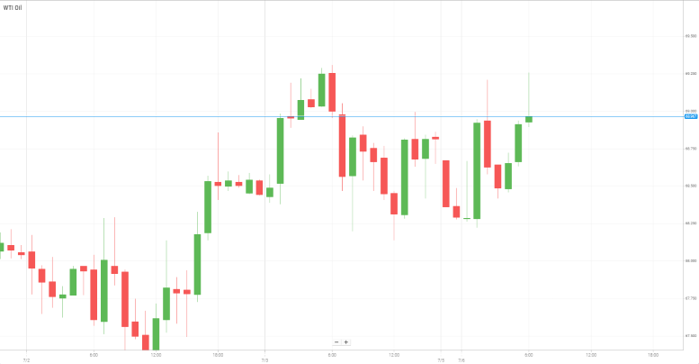
Oil prices edged lower during Monday's Asian session after OPEC+ agreed to raise production targets again from August, while improving crude exports through the Strait of Hormuz added to expectations of increased global supply. Market participants remain cautious as uncertainty surrounding the Strait of Hormuz continues to dominate sentiment.
On the supply side, the Organization of the Petroleum Exporting Countries and its allies (OPEC+), including Russia, agreed on Sunday to increase collective production targets by 188,000 barrels per day from August, following similar quota increases introduced for June and July.
Despite the announcement, analysts noted that the additional output may have only a limited near-term impact. Production from several Gulf producers—including Saudi Arabia, Kuwait, and Iraq—has yet to fully recover after the recent conflict involving Iran temporarily disrupted tanker traffic through the Strait of Hormuz.
Recent data restoring exports. A Reuters survey showed OPEC crude output rose by approximately 3.3 million barrels per day in June to 19.43 million barrels per day, rebounding from its lowest level in more than two decades. Gulf oil exports also increased by more than 3 million barrels per day from May, surpassing 10 million barrels per day, although shipments remain roughly 40% below pre-conflict levels.
Meanwhile, Russia continues to add to global supply. Crude exports from the country's western ports reached a record high in June and are expected to remain elevated in July, as drone attacks on Russian refineries have reduced domestic processing capacity and prompted Moscow to redirect more crude to international markets.
Overall, the combination of higher OPEC+ production targets, recovering Gulf exports, and strong Russian shipments has reinforced expectations of improving supply, placing modest downward pressure on oil prices despite ongoing geopolitical risks in the Middle East.
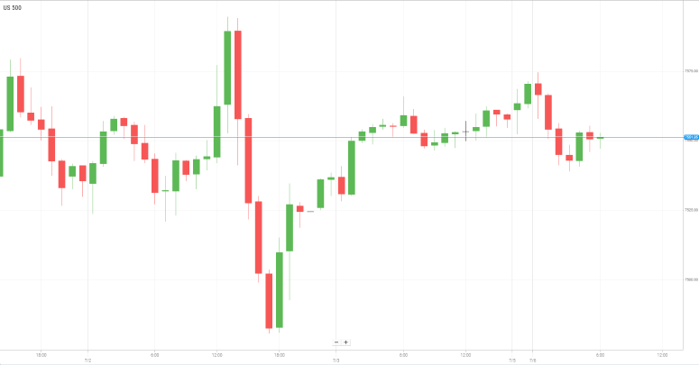
US stock index futures traded modestly higher during Monday's Asian session, extending gains after a positive, holiday-shortened trading week. Investors are reassessing the outlook for artificial intelligence-related stocks while looking ahead to the release of the Federal Reserve's June meeting minutes for fresh policy guidance.
Wall Street closed higher last week despite volatile trading conditions. The US 30 climbed around 2% to a record closing high, marking its fourth consecutive weekly gain. The US 500 and the US Tech 100 also advanced nearly 2%, reflecting continued resilience in US equities.
Investor focus has increasingly shifted toward the sustainability of the artificial intelligence-driven rally. Recent weakness in semiconductor stocks has prompted concerns that valuations across parts of the AI supply chain may have become stretched. At the same time, sentiment remains constructive toward software developers and platform companies expected to benefit from the broader adoption of AI technologies.
Attention this week will be firmly on the minutes from the Federal Reserve's June policy meeting, scheduled for release on Wednesday. Investors will scrutinize the report for additional clues on the central bank's interest rate outlook after recent economic data pointed to a cooling labor market.
The corporate earnings season also begins this week, with PepsiCo and Delta Air Lines among the first major companies set to release quarterly results. Their reports will offer an early indication of corporate performance and consumer demand during the second quarter.
Market participants will also be watching whether major technology companies can regain market leadership following recent sector rotation. Apple has attracted renewed buying interest on optimism surrounding its upcoming iPhone lineup, while continued weakness in AI-focused chipmakers has raised questions about whether the technology sector can sustain its strong performance for the remainder of the year.
The materials contained on this document should not in any way be construed, either explicitly or implicitly, directly or indirectly, as investment advice, recommendation or suggestion of an investment strategy with respect to a financial instrument, in any manner whatsoever. Any indication of past performance or simulated past performance included in this document is not a reliable indicator of future results. For the full disclaimer click here.
Join iFOREX to get an education package and start taking advantage of market opportunities.
 A beginner's e-book
 $5,000 practice demo account
 A 12-part video course
 Trusted partner
 Featured partner
 By
By 


