
Listed on 
 Years active
 English (Arabic)
 Chinese Simplified - 中文 (简体)
 Chinese Traditional - 中文 (繁體)
 English
 Japanese - 日本語
 Korean - 한국어 (대한민국)
 Portuguese - Português
 Russian - Русский
 Spanish - Español
 Thai - ไทย
 English (India)
Don't have an account?
Register via AppHave an account?
Login 13/07/2026 - 07:40 UTC
The US Dollar Index (USDX) extended its gains around 101.10 during Monday’s Asian trading session, building on a 0.16% increase for the USDX last week as escalating geopolitical conflicts in the Middle East sparked fierce safe-haven demand. Intense military confrontations—including US Central Command hitting over 300 targets and retaliatory Iranian missile strikes on Gulf bases—have crippled regional diplomacy and disrupted the Strait of Hormuz. This sudden threat to global energy supplies has driven crude oil prices higher, reviving energy-fueled inflation concerns and prompting traders to price in a nearly 90% chance of an additional Federal Reserve interest rate hike this year. Conversely, the combination of a stronger Greenback and elevated Treasury yields hammered non-yielding assets, causing Gold to slide -1.59% last week before continuing its descent on Monday to trade just above $4,050, down 1.40% intraday.
Asian equities retreated on Monday, led by a sharp selloff in South Korean shares, as renewed Middle East conflict sent oil prices surging and dampened investor appetite for risk, particularly across the technology sector. Futures tracking U.S. equities also pointed to a lower open, with tech-heavy Nasdaq futures leading the decline. The market downturn was triggered by a weekend escalation where Iran extended drone and missile attacks to Gulf states in retaliation for U.S. military operations and announced the closure of the critical Strait of Hormuz. Although U.S. President Donald Trump disputed this claim by asserting that commercial shipping remains open under American protection, Brent crude climbed significantly in Asian trade, reigniting fears that rising energy costs will fuel inflation and complicate the path for global interest rates.
High-valuation technology stocks, which have underpinned much of Asia's regional gains this year, faced the heaviest pressure as investors actively de-risked their portfolios. South Korea's benchmark KOSPI bore the brunt of the selling, dragged down by substantial losses from semiconductor heavyweights Samsung Electronics and SK Hynix. Japan's Nikkei 225 and TOPIX both declined, while mainland Chinese benchmarks, including the Shanghai Composite and the blue-chip CSI 300, edged lower. Elsewhere in the region, Hong Kong’s Hang Seng index remained flat, while equity indexes in Australia, Singapore, and India all drifted into negative territory.
Looking ahead to this week, global financial markets face a massive dual catalyst of top-tier economic data and high-profile monetary policy testimony. The US inflation landscape will be heavily micro-analyzed with Tuesday's release of the Consumer Price Index (CPI)—where headline CPI is projected at 4.2% year-over-year and core CPI is expected at 0.2% month-over-month—followed immediately by the Producer Price Index (PPI) metrics on Wednesday and critical UK GDP data. Market volatility is bound to spike mid-week as central bankers take center stage; Federal Reserve Chairman Kevin Warsh will deliver his highly anticipated, first official congressional testimony, while Bank of England Governor Andrew Bailey is scheduled to speak, with both leaders expected to clarify the global interest rate outlook amid stubborn inflationary pressures.
Simultaneously, the upcoming week unofficially kicks off the corporate earnings season, shifting Wall Street's focus toward the financial health of the banking sector. Institutional heavyweights including JPMorgan, Bank of America, Goldman Sachs, Wells Fargo, and Citigroup are all scheduled to report their quarterly results. Investors will be intensely analyzing executive commentary regarding loan-loss provisions, consumer credit health, and net interest margins to gauge whether the broader corporate economy can continue to withstand these higher-for-longer monetary policies.
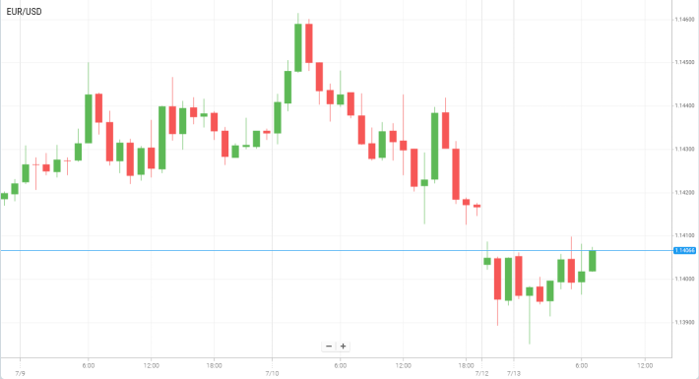
The Euro drifted lower against the US Dollar on Monday, extending its downward momentum following a 0.18% decline for the EUR/USD last week. A sharp contraction in global risk appetite and mounting inflationary pressures fueled the move, driven by a serious weekend escalation in hostilities between the US and Iran. The currency pair traded down toward the 1.1400 handle after facing rejection near 1.1460 on Friday.
Market sentiment soured rapidly at the weekly opening as both Washington and Tehran intensified military actions over the weekend. Following US strikes on Iranian military sites along the southern coast, Tehran retaliated with attacks targeting US bases across the Gulf region. Further complicating the geopolitical landscape, Iran’s Islamic Revolutionary Guard Corps announced the closure of the strategic Strait of Hormuz. Although US Central Command reported that some commercial vessels were successfully escorted through the waterway, the disruption sent crude oil prices surging over 4%, placing severe economic strain on the energy-importing Eurozone.
Market participants are closely watching scheduled commentary from European Central Bank and Federal Reserve officials for immediate policy clues. Later this week, the broader macroeconomic backdrop for the currency cross will be heavily shaped by the release of the US Consumer Price Index data for June, alongside Federal Reserve Chairman Kevin Warsh’s highly anticipated congressional testimony.
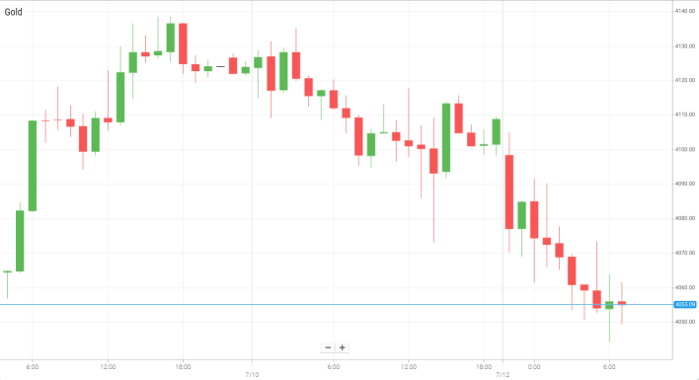
Building on last week's performance where Gold dropped by -1.59%, the precious metal started the new week on a distinctly weaker note, reversing its Friday attempt to stabilize above the $4,100 mark. The non-yielding asset slipped below the $4,050 level heading into Monday's European session, leaving it vulnerable to further losses. This downward shift follows a weekend escalation in the Middle East that completely overshadowed Friday's short-lived optimism regarding potential US-Iran diplomacy.
The brief calm evaporated after the US launched a major round of strikes on Iran, drawing retaliatory missile attacks from Tehran on US military bases in the Gulf. Compounding the crisis, Iran’s Islamic Revolutionary Guard Corps fired on another commercial vessel and announced the closure of the strategic Strait of Hormuz. This direct threat to global energy supplies triggered a fresh surge in crude oil prices, effectively dismantling the market's focus on the Fed's less hawkish June meeting minutes and replacing it with renewed fears of energy-driven inflation.
These compounding inflationary risks have heavily reinforced expectations for tighter monetary policy, driving flows directly into the safe-haven US Dollar at the expense of bullion. According to the CME Group's FedWatch Tool, traders are now pricing in a nearly 90% chance of a Fed rate hike by the end of the year, keeping US Treasury bond yields elevated. Markets now remain focused Federal Reserve Chairman Kevin Warsh’s upcoming congressional testimony and the latest US CPI and PPI data.
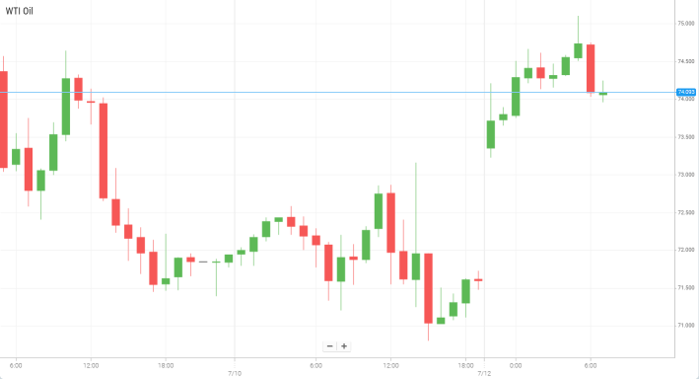
Oil prices surged in Asian trade on Monday as renewed conflict between the U.S. and Iran stoked fears of severe global supply shocks, especially following Tehran’s declaration that the Strait of Hormuz is closed. Brent Oil Futures for September delivery climbed toward $79.65 per barrel, while West Texas Intermediate (WTI) crude futures pushed up to $74.98 per barrel. The aggressive opening rally follows a strong prior week for energy commodities, highlighted by a 4.09% increase for WTI oil last week as hostilities initially reignited.
The latest spike was triggered by Iran expanding its drone and missile attacks to Gulf states over the weekend in response to U.S. military operations, alongside targeting a commercial vessel within the strategic waterway. While U.S. President Donald Trump publicly disputed Tehran's claims by asserting that shipping lanes remain open under American protection, regional maritime traffic slowed dramatically over the weekend.
Because the Strait of Hormuz serves as the vital transit point for crude exported by Saudi Arabia, Iraq, Kuwait, and the UAE, any prolonged closure threatens to force global refiners to seek costly alternative supplies while driving freight and insurance premiums higher. Consequently, market participants are keeping a close watch for potential emergency responses, including coordinated production adjustments from major oil producers or strategic petroleum reserve releases.
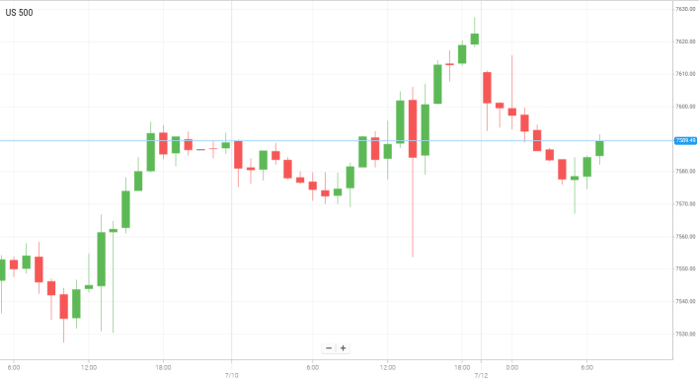
U.S. stock index futures deepened their losses early Monday as the escalating military conflict between the U.S. and Iran rattled investor sentiment, overshadowing the positive momentum that had pushed Wall Street indexes higher at Friday's close. S&P 500 Futures and Dow Jones Futures both trended lower, but the tech-heavy Nasdaq 100 Futures suffered the sharpest decline. The downturn followed a weekend of intense geopolitical friction, with U.S. Central Command and Iranian forces exchanging strikes and issuing conflicting statements regarding the closure of the strategic Strait of Hormuz. The resulting surge in crude oil prices has reignited Wall Street's fears of energy-driven inflation, which could pressure the Federal Reserve into maintaining a more hawkish monetary policy stance in the coming months.
Technology shares face particularly heavy selling pressure as a severe rout in major Asian semiconductor stocks appears poised to spill over into domestic trading. Market participants are engaging in profit-taking amid persistent anxieties over elevated artificial intelligence valuations. Highlighting this sector-specific stress, South Korea's SK Hynix saw its shares plunge in overseas trading, completely reversing the enthusiasm from its strong Nasdaq debut on Friday.
Beyond tech, the broader U.S. corporate landscape faces a critical test as the second-quarter earnings season officially begins. Wall Street's focus is rapidly shifting toward the financial health of the banking sector, with banking heavyweights JPMorgan Chase, Bank of America, Goldman Sachs, Wells Fargo, and Citigroup all scheduled to report their quarterly results on Tuesday.
The materials contained on this document should not in any way be construed, either explicitly or implicitly, directly or indirectly, as investment advice, recommendation or suggestion of an investment strategy with respect to a financial instrument, in any manner whatsoever. Any indication of past performance or simulated past performance included in this document is not a reliable indicator of future results. For the full disclaimer click here.
Join iFOREX to get an education package and start taking advantage of market opportunities.
 A beginner's e-book
 $5,000 practice demo account
 A 12-part video course
 Trusted partner
 Featured partner
 By
By 


