
Listed on 
 Years active
 English (Arabic)
 Chinese Simplified - 中文 (简体)
 Chinese Traditional - 中文 (繁體)
 English
 Japanese - 日本語
 Korean - 한국어 (대한민국)
 Portuguese - Português
 Russian - Русский
 Spanish - Español
 Thai - ไทย
 English (India)
Don't have an account?
Register via AppHave an account?
Login 25/05/2026 - 07:26 UTC
The USDX finished almost unchanged last week, holding steady near the 99.05 level as the market opened for Monday's early Asian session. The index lost its broader upward momentum as emerging risk appetite capped gains. Over the weekend, U.S. President Donald Trump announced that Washington and Tehran had "largely negotiated" a memorandum of understanding aimed at ending the conflict and reopening the critical Strait of Hormuz. However, a lack of clarity regarding the exact timeline for lifting the dual naval blockades kept market enthusiasm in check. Concurrently, expectations for a potential Federal Reserve rate hike before the end of the year remained a steady anchor for the Greenback. The CME FedWatch Tool currently prices in a 45.1% probability of a 25-basis-point tightening by year-end, with traders shifting their focus to the upcoming U.S. Personal Consumption Expenditures (PCE) price index report for further policy clues.
Gold fell -0.83% over the course of last week, ultimately failing to sustain its range-bound recovery as it faced mixed fundamental cues. The non-yielding bullion initially caught a minor bid on Monday, trimming intraday gains to trade in the $4,580 region as a softer U.S. Dollar provided brief support. Safe-haven demand experienced a slight reprieve following reports that the U.S. and Iran are close to signing a 60-day ceasefire agreement. This development triggered a steep decline in U.S. Treasury bond yields, which temporarily cushioned the precious metal. However, overall gains remained heavily capped by persistent disagreements over Iran's nuclear program and President Trump's firm directive that the naval blockade on Iranian ports will remain strictly in effect until a formal, certified agreement is officially finalized.
WTI Oil plummeted -8.83% last week, extending a severe four-day losing streak to trade near $90.80 per barrel during Monday's Asian hours. Energy markets aggressively unwound geopolitical risk premiums as supply fears drastically eased on news of the proposed 60-day ceasefire. Under the framework of the tentative deal, Iran would agree to clear deployed mines from the Strait of Hormuz and allow global shipping to pass freely, in exchange for the U.S. lifting its blockade on Iranian ports. Reopening this critical maritime artery—which handles roughly one-fifth of global oil and liquefied natural gas shipments, is expected to bring significant relief to energy markets. Nonetheless, the full extent of the sell-off was slightly tempered by state media reports indicating that Washington is still obstructing clauses regarding blocked Iranian assets, while U.S. Secretary of State Marco Rubio cautioned that a comprehensive nuclear deal cannot be rushed.
Most regional indices advanced on Monday, with Japanese benchmarks hitting fresh all-time highs as a potential U.S.-Iran peace agreement fueled risk appetite and investors rotated back into semiconductor shares. This upward momentum was strongly supported by a positive lead-in during Asian hours, where U.S. stock index futures strengthened, led by a firm gain in tech-heavy contracts, even though cash markets in the U.S. were closed for a public holiday.
In regional developments, mainland Chinese benchmarks gained ground as investors embraced the broader risk-on environment, fueled by reports that a memorandum of understanding to reopen the critical Strait of Hormuz had been “largely negotiated” to ease Middle East tensions. Concurrently, emphatic gains swept through Tokyo, pushing local equity benchmarks to record highs. This historic rally was heavily anchored by tech and AI-linked components, which drew confidence from last week's global sector momentum.
On the corporate front, despite the optimistic baseline for tech infrastructure spending, megacap chip elements experienced a mild cooling period during their latest trading session as investors locked in profits. Nvidia shares dipped following its recent stellar earnings run. Similarly, regional tech heavyweights Samsung Electronics and rival memory maker SK Hynix both edged lower, mirroring the consolidation seen across the broader global chip sector.
Looking ahead, the market focus pivots to crucial macroeconomic data and central bank commentary. Thursday’s key U.S. slate features the Core PCE Price Index—expected to hold steady at 0.3% month-over-year—and Preliminary GDP, forecasted to jump to 2.1% from the previous 0.7%. Any surprises will heavily steer late-year Fed rate hike bets. On Friday, Bank of England Governor Andrew Bailey delivers a highly anticipated speech, offering fresh clues on the UK's interest rate trajectory. Complementing the economic data, corporate earnings from tech bellwethers Salesforce, Dell Technologies, and Zscaler will draw close attention for insights into global IT infrastructure and software spending resilience.
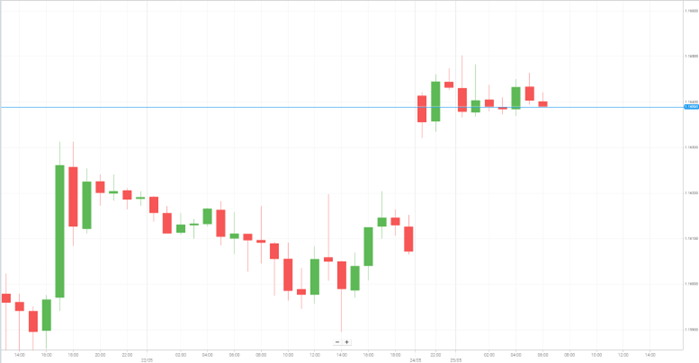
The euro maintained its early gains against the US dollar on Monday, with the EUR/USD pair trading near 1.1640 during the European session as optimism surrounding a potential US-Iran agreement boosted appetite for risk-sensitive assets.
Market sentiment improved after indications that Washington and Tehran are close to finalizing a deal, reducing demand for traditional safe-haven assets such as the US dollar.
Investor confidence strengthened after US President Donald Trump stated over the weekend on Truth Social that an agreement with Iran had been “largely negotiated.” According to Trump, the proposed deal would include the reopening of the Strait of Hormuz among other provisions, with final details still under discussion. However, in a later post, Trump added that there was “no rush for the deal,” noting that time remained on Washington’s side.
Hopes for a US-Iran agreement also triggered a sharp decline in oil prices, which in turn softened expectations for additional Federal Reserve interest rate hikes this year. Market participants have slightly reduced their hawkish outlook on US monetary policy, with traders reassessing the likelihood of further tightening by the Fed.
At the same time, expectations for tighter monetary policy in the Eurozone have increased after several European Central Bank officials warned of mounting inflationary pressures. ECB policymaker and Belgian central bank chief Pierre Wunsch recently said the ECB would eventually need to act, warning that the region may be “at the beginning of an inflation problem.”
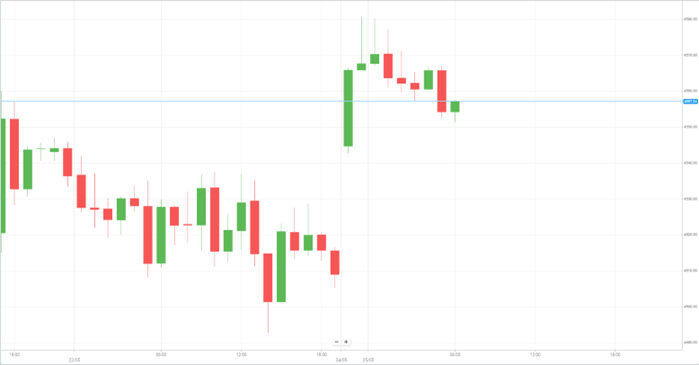
Gold prices gave up part of their early gains early on Monday but continued to trade firmly above the $4,550 mark as a weaker US dollar and ongoing geopolitical uncertainty supported demand for the precious metal.
The metal initially climbed toward the $4,580 region during Asian trading after renewed optimism over a possible US-Iran peace agreement weighed on the dollar. However, gains remained limited as investors balanced improving geopolitical sentiment against expectations that the US Federal Reserve could maintain a hawkish monetary policy stance.
Reports over the weekend suggested that Washington and Tehran are nearing an agreement that could include a 60-day ceasefire extension and the reopening of the Strait of Hormuz.
Lower oil prices helped ease inflation concerns, triggering a decline in US Treasury yields and placing additional pressure on the US dollar. The weaker greenback provided support for gold, which is priced in dollars and typically benefits when the currency loses value.
Despite the optimism, investors remain cautious as major disagreements between the US and Iran persist, particularly over Tehran’s nuclear program.
At the same time, expectations that the Federal Reserve could raise interest rates again in 2026 continue to support the dollar and limit stronger gains in non-yielding assets such as gold.
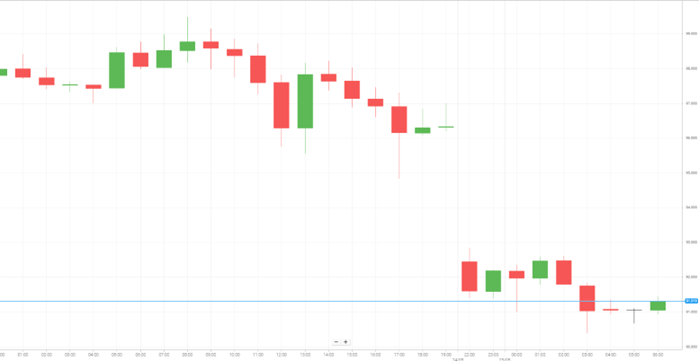
Oil prices plunged to two-week lows early on Monday, with both Brent crude and US West Texas Intermediate (WTI) falling as growing optimism over a possible US-Iran peace agreement eased concerns about global supply disruptions.
Market sentiment improved after US President Donald Trump said over the weekend that Washington and Tehran had “largely negotiated” the framework of a peace agreement that could lead to the reopening of the Strait of Hormuz.
The prospect of restored energy flows through the strait triggered a broad selloff in crude prices, with investors increasingly betting that supply risks could ease in the coming months. Analysts, however, warned that uncertainty surrounding the negotiations remains high.
Although diplomatic progress appears to be underway, the United States and Iran continue to disagree on several major issues. Trump also stated on Sunday that he had instructed US negotiators not to rush into a final agreement.
Analysts noted that even if a deal is reached, a full return to normal oil flows through the Strait of Hormuz could take months as damaged energy infrastructure would still require repairs.
In the United States, energy producers responded to previously higher domestic prices by increasing drilling activity. Baker Hughes reported that the number of active oil and gas rigs rose by seven to 558 in the week ending May 22, marking the fifth consecutive weekly increase and the highest level since June 2025. Despite the rise, the total rig count remains slightly below levels recorded a year ago.
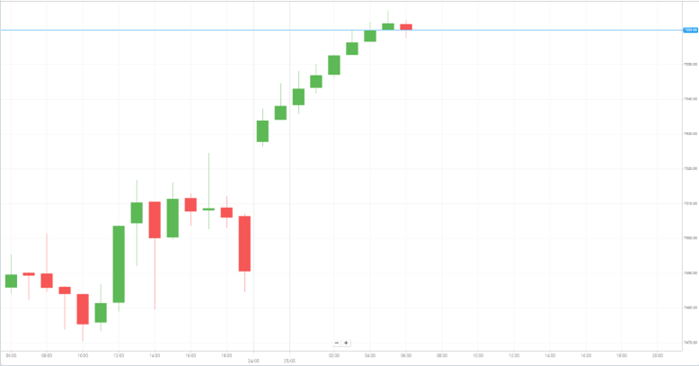
US stocks closed higher on Friday, with the US 30 reaching a record closing high as investors welcomed signs of diplomatic progress in the Middle East and another strong round of corporate earnings.
The upbeat sentiment helped extend Wall Street’s rally, with the US 500 posting its eighth consecutive weekly gain — its longest winning streak since late 2023.
Investor optimism was supported by developments surrounding negotiations between the United States and Iran. US Secretary of State Marco Rubio said Washington had made progress toward a potential agreement with Tehran, although significant work remained. Iranian officials, however, indicated that major differences between the two sides were still unresolved.
Market participants also continued to respond positively to corporate earnings, which have broadly exceeded expectations. Technology and semiconductor shares remained a major driver of market gains. The Philadelphia Semiconductor Index moved higher, led by a 12% surge in Qualcomm shares, while Nvidia slipped nearly 2%.
Among the major US 500 sectors, healthcare, utilities, industrials and technology stocks recorded the strongest gains, while communication services and consumer staples lagged behind.
Computer manufacturers also rallied sharply after China’s Lenovo Group reported stronger-than-expected quarterly results. Dell Technologies jumped almost 17% to a record high, while HP Inc gained 15%.
Bond markets also provided support for equities as Treasury yields retreated from recent highs. The yield on the benchmark 10-year US Treasury note fell to 4.558%, easing concerns about borrowing costs and financial conditions.
In another major development, Kevin Warsh was officially sworn in as chair of the Federal Reserve on Friday, taking charge at a time when policymakers are balancing inflation concerns tied to higher energy prices against signs of slowing consumer confidence.
The materials contained on this document should not in any way be construed, either explicitly or implicitly, directly or indirectly, as investment advice, recommendation or suggestion of an investment strategy with respect to a financial instrument, in any manner whatsoever. Any indication of past performance or simulated past performance included in this document is not a reliable indicator of future results. For the full disclaimer click here.
Join iFOREX to get an education package and start taking advantage of market opportunities.
 A beginner's e-book
 $5,000 practice demo account
 A 12-part video course
 Trusted partner
 Featured partner
 By
By 


