
Listed on 
 Years active
 English (Arabic)
 Chinese Simplified - 中文 (简体)
 Chinese Traditional - 中文 (繁體)
 English
 Japanese - 日本語
 Korean - 한국어 (대한민국)
 Portuguese - Português
 Russian - Русский
 Spanish - Español
 Thai - ไทย
 English (India)
Don't have an account?
Register via AppHave an account?
Login 18/06/2026 - 13:55 UTC

US markets have continued to remain resilient, buoyed by hopes of a more enduring peace in the wake of the 14-point draft memorandum between Iran and the US, as well as enthusiasm around the successful SpaceX IPO which is expected to lead Anthropic and OpenAI to follow suit.
The decline in oil prices to 3-month lows is also reducing expectations that central banks will be forced to raise rates in the months ahead, thus also helping to underpin the more positive mood.
Be that as it may the Straits of Hormuz is still not seeing the free flow of ships it was seeing prior to the outbreak in hostilities and ergo is unlikely too, in the near future given the continued heightened risk and uncertainty around the region.
The enthusiasm around SpaceX has continued this week with the shares surging above $200, driven mainly by limited number of shares available continuing to drive demand. The move higher has seen SpaceX valuation move above that of Amazon, a company that turns over 36 times more in revenue. Musk hasn’t sat on his laurels either moving to pay $60bn for Cursor, an AI coding company whose AI assistant allows programmers to write and debug code more effectively. Retail traders in particular have shown a heavy interest in owning the shares. With the Nasdaq due to admit SpaceX shares in the coming days there is also an element of forced buying from tracker funds driving demand as well. The bigger question is whether the current buying frenzy can be sustained in the longer term. While mechanical demand may well underpin the shares in the short term the real challenger will be in the longer term as lockups roll-off and more shares become available. At these sorts of nose bleed share price levels, it’s hard to imagine this ending well for those retail shareholders who want to own what they perceive is a piece of the future. If they were more tactical about it and want to own a piece of the future maybe they should consider buying Tesla shares. For start they are cheaper, trading on 15 times earnings and are likely to get absorbed into SpaceX sooner rather than later.

As we look forward to a new trading week, as well as the end of Q2 and look back at the first half of 2026 it’s probably a good time to reflect on where we started 2026.
US markets have managed to go from strength to strength, boosted by the US economy which has continued to outperform its peers, while Europe has stagnated, along with its stock markets.
The hope is that if energy prices remain at their current levels, and inflation shows signs of coming down in H2, European markets can recover the momentum that stalled at the start of this year, and start to kick on towards new record highs.
This week’s data is very much backward looking when it comes to the US economy, with the final iteration of Q1 GDP, along with personal spending and income for May. The most recent retail sales numbers for May showed that US consumers were still spending in a sign that Q2 GDP was likely to see a further improvement on Q1.
With the Fed set to remain on hold for the foreseeable future after the latest rate decision with Kevin Warsh as the new Fed chairman, the prospect of a rate cut by year end has started to diminish, given the recent fall seen in oil prices.
The latest numbers from FedEx will also offer a decent insight into US consumer spending patterns when it comes to ordering goods on line while Carnival Cruise lines is likely to benefit from people choosing to holiday away from routes in the Middle East.

At the most recent iteration of US Q1 GDP we saw economic growth downgraded to from 2% to 1.6%. This appeared to be driven by downgrades in consumer spending, as well as business investment, while the latest PCE price data came in at 3.3% which was in line with expectations. While these numbers are very much so called “rear-view mirror” the fact remains that despite some weakness at the end of last year the economy did pick up in Q1, with the US economy showing little inclination that is anything other than resilient. Business investment in equipment saw a huge 17.2% increase, in a trend that looks set to continue if the recent announcements about AI infrastructure spend are any guide. Despite the downward revision seen in the data at the end of May it wouldn’t be a surprise to see a modest uptick given the stronger consumer spending patterns seen in February and March retail sales numbers.
After a slow start to the year, US personal spending saw a big pick up in February and March, rising to 1% in the March numbers. While the increase was primarily driven by a sharp rise in gasoline sales, as well as sales of motor vehicles and parts, along with sales of food and beverages, we have seen a modest drop off since then. In April this spending trend slowed to 0.5%, with gasoline once again being one of the main contributors in a trend that is likely to continue as US driving season gets under way. Spending on services has also remained strong, primarily driven by healthcare services, followed by financial services. It was also notable that in recent months we’ve seen a pick-up in core PCE price pressures with the monthly number doubling from 0.2% to 0.4% at the end of last year, and only slowing modestly to 0.3% in March, with the annualised number rising to 3.3%, the highest level since November 2023.
While there have been signs that US consumer spending has started to slow a little, the recent weakness in fuel prices could signal some respite for hard pressed consumers. In any case until the dust has settled on events in the Middle East it does suggest that for now Fed policy is unlikely to change in the near term, with the latest Fed meeting seeing the central bank leave rates unchanged.
The recent May PMI numbers painted a mixed outlook for the UK economy. While manufacturing posted its best monthly number in over 3 years, this was down to manufacturers looking to lock in goods before higher prices increased their costs further.

Despite this input cost inflation still rose to its highest level in 4 years. Services on the other hand saw economic activity slide into contraction territory at 49.7, a modest improvement on the initial flash number of 47.9, but nonetheless still sharply lower from 52.7 in April. The main takeaways were a slide in new orders, employment and a sharp rise in costs due to higher wages, energy and transport costs. Given that services make up 80% of the UK economy that is a worry. Construction was even worse falling to its lowest level since May 2020, at 38.2. Housing has consistently remained the weakest-performing segment, while commercial and civil engineering also declined amid client caution linked to inflation and geopolitical tensions. New orders fell at the fastest pace in six years as project delays, deferred investment decisions, and budget cuts weighed on demand. On the price front, input cost inflation accelerated to its highest level since June 2022, driven by higher fuel and transport costs. Is June likely to be any different? On current trends, probably not, with the UK government currently paralysed by its own internecine struggles over policy and leadership.
There was little in the way of market reaction to the spinning off of FedEx freight division at the beginning of the month, with the shares continuing the rally that has been in place since the lows of September 2022. With FedEx Freight now trading as a separate company the thinking appears to be that each business will be able to focus solely on what it is good at without one business compromising the other. With each FedEx shareholder receiving one FedEx Freight share for every two they owned shareholders it is hoped will be able to get more bang for their proverbial buck. When FedEx reported in Q3 the company posted Q3 revenues of $24bn, an increase of 8%, driven largely by a 10% increase in its Federal Express division. Its Freight division posted a disappointing quarter with a 5% decline in revenue to $2bn. Profits came in at $5.25 a share an increase of 16%, driven largely by an improvement in adjusted operating margins to 6.7%. It also raised its full year guidance to 6% to 6.5% revenue growth and increased its EPS profit guidance to between $19.30 to $20.10 a share.

The outbreak of hostilities in the Persian Gulf created all of the usual problems for travel, as well as holiday companies with aircraft, as well as cruise ships left stranded at airports and ports in and around the Middle East. With the associated costs of getting stranded passengers back home, along with higher fuel costs, there will also be the costs associated with cancelled bookings due to ships and aircraft being in the wrong place. While UK based companies like Carnival and Saga are likely to see some impact on their margins largely due to higher fuel costs their exposure to the Middle East is seen as more limited relative to the likes of MSC Cruises, TUI Cruises and Celestyal. On the plus side the likes of Carnival and Saga could see an uplift through passengers choosing to go with them when set against the higher risk of the companies that operate in and around the Middle East. When Carnival reported in Q1 the cruise company reported a strong performance with record revenues of $6.2bn, and a 10% increase in margins. Net income was also better than expected at $275m, despite a $54m hit from higher fuel prices, as well as a 4.9% increase in cruise costs. Bookings for 2026 were up in the double digits, with an expectation of a $150m improvement in full year adjusted net income, compared to the guidance delivered at the end of last year. This improvement comes despite an increase in fuel costs across the board, however with the recent decline in both crude oil and natural gas prices on the back of a cessation of hostilities in the Gulf we could well see an upside tweak to the recent guidance, although looking at the company’s guidance in Q1 around fuel costs, this could already be in the share price.
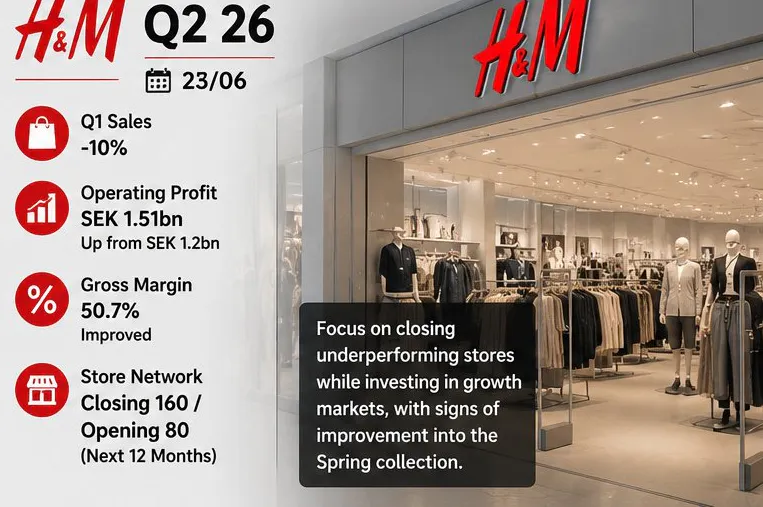
Its continued to be a tough trading environment for clothing retailers, although some are faring better than others, with H&M seeing a 10% decline in Q1 sales when it reported back in March. While some of this was down to a weak macro backdrop some of it was down to the fact that H&M has been closing some of its weaker stores. During Q1 163 stores were closed, cutting the number to 4,050, compared to a year ago. Putting that to one side, the closure of underperforming stores saw operating profits increase for the third quarter in succession, rising to SEK 1.51bn, up from SEK 1.2bn a year ago. Gross margins also improved to 50.7%, helped by a reduction in discounting, helping to improve profits after tax to SEK704m. The retailer also said that March had started to see things pick up, after a weak start to the year in a trend that it is hoped would continue into the rest of the quarter, as customers looked to buy into its Spring collection. This suggests that we could well see further weakness in sales against a backdrop of further store closures as it looks to close 160 and open 80 new stores over the next 12 months, with South America seen to be a key growth area.
With the shares selling off from record highs in June last year, Darden shares have been on somewhat of a roller coaster since then, sliding to 11-month lows at the end of last year, before rebounding to current levels. The bulk of their business comes through their LongHorn Steakhouse and Olive Garden businesses. Total sales in Q3 rose 5.9% to $3.3bn, with like for like sales in Olive Garden up 3.2% at $1.39bn. LongHorn saw a 7.2% increase in like for like sales to $854.2m. The company also repurchased $127m of its own stock. For 2026 Darden said it expects total sales growth of 9.5%, and for same store sales of 4.5%. 70 new restaurants are expected to complete with total cost inflation of 3.5%.
What are the most important economic events in the week of 22 June 2026?
The key economic releases include the final US Q1 GDP reading, US Personal Spending data for May, and the UK Flash PMI report for June. These indicators will help investors assess economic growth and consumer activity.
Why is US GDP data important for markets?
GDP measures the overall growth of the economy. Stronger-than-expected GDP figures can boost investor confidence, while weaker data may increase concerns about economic momentum and future corporate earnings.
What does the US Personal Spending report reveal?
The Personal Spending report provides insight into consumer behaviour and demand. Since consumer spending accounts for a large portion of US economic activity, it is a closely watched indicator for growth expectations.
Why are investors paying attention to UK PMI data?
The Purchasing Managers' Index (PMI) offers an early indication of business activity across manufacturing and services sectors. A reading above 50 suggests expansion, while a reading below 50 indicates contraction.
What can FedEx earnings tell us about the economy?
FedEx is often viewed as a bellwether for economic activity because its shipping volumes reflect consumer spending and business demand. Strong results can signal healthy economic conditions.
Why are oil prices important for global markets?
Oil prices influence inflation, consumer spending, transportation costs, and corporate profits. Lower oil prices can help ease inflationary pressures and support economic growth.
This material (whether or not it states any opinions) is for general information purposes only and does not take into account your personal circumstances or objectives. Nothing in this material is (or should be considered to be) financial, investment or other advice on which reliance should be placed. The material has not been prepared in accordance with legal requirements designed to promote the independence of investment research.
![Bank of America [1:1]](/fihservices/ZyEOC68jQArTz_WH_money-business-close-up-cash-bank-silver-604844-pxhere.jpg?auto=format,compress "Bank of America [1:1]")
The materials contained on this document should not in any way be construed, either explicitly or implicitly, directly or indirectly, as investment advice, recommendation or suggestion of an investment strategy with respect to a financial instrument, in any manner whatsoever. Any indication of past performance or simulated past performance included in this document is not a reliable indicator of future results. For the full disclaimer click here.
Join iFOREX to get an education package and start taking advantage of market opportunities.
 A beginner's e-book
 $5,000 practice demo account
 A 12-part video course
 Trusted partner
 Featured partner
 By
By 


