
Listed on 
 Years active
 English (Arabic)
 Chinese Simplified - 中文 (简体)
 Chinese Traditional - 中文 (繁體)
 English
 Japanese - 日本語
 Korean - 한국어 (대한민국)
 Portuguese - Português
 Russian - Русский
 Spanish - Español
 Thai - ไทย
 English (India)
Don't have an account?
Register via AppHave an account?
Login 24/02/2026 - 08:18 UTC
The dollar index (USDX) has advanced approximately 0.96% over the past week, currently trading near the 97.80 level during Tuesday’s Asian session. Despite this recovery, the Greenback faces mounting pressure as foreign investors begin to pivot away from dollar-denominated assets. This shift is largely driven by escalating trade uncertainty following a Supreme Court ruling that struck down several second-term levies. In response, the Trump administration is reportedly weighing new national security tariffs under Section 232 across six specific industries, a move distinct from the 15% global tariff announced last Saturday.
Geopolitical trade tensions are intensifying globally. The European Union has signaled a potential pause in ratifying its trade agreement with the U.S., while bilateral talks between India and Washington to finalize an interim trade pact have been postponed. Furthermore, domestic political hurdles remain, as Congress appears unlikely to extend these new tariffs beyond a 150-day window, creating a volatile outlook for trade policy.
On the monetary front, Fed Governor Christopher Waller indicated that support for a rate cut at the March FOMC meeting is contingent on upcoming February labor data. Currently, markets are pricing in only a 5% probability of a March cut. However, the USDX may face longer-term headwinds as markets anticipate roughly 50 basis points in total Fed cuts for 2026, contrasting with expectations for a 25-basis-point hike from the Bank of Japan and a steady policy stance from the ECB.
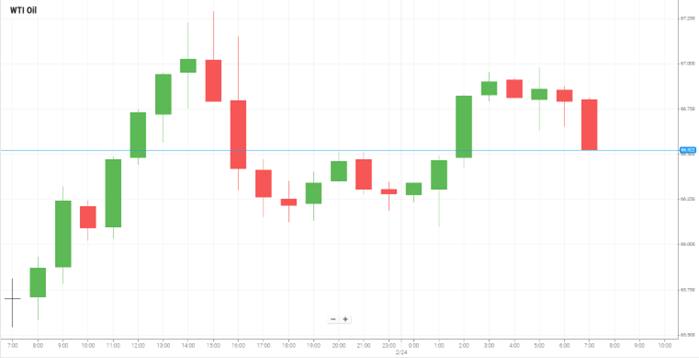
WTI Oil and Brent prices have surged significantly over the past week, rising 5.78% and 6.05% respectively, as the market grapples with heightened supply disruption risks stemming from the persistent U.S.-Iran conflict. WTI Oil is currently holding near six-month highs around $67.00, supported by President Trump’s recent warning of a “very bad day” for Tehran should upcoming nuclear negotiations in Geneva fail to produce a deal. While the EIA forecasts that global production growth will lead to an inventory build of 3.1 million barrels per day in 2026—potentially weighing on long-term prices—the immediate "fear premium" remains the dominant driver.
General Asia news was broadly positive on Tuesday as markets reacted to the US Supreme Court ruling that invalidated several trade tariffs, benefiting export-oriented sectors across the region. The Japan 225 index and South Korea’s KOSPI gained, driven by chipmakers Samsung and SK Hynix ahead of Nvidia’s upcoming earnings. China also saw strong returns for mainland markets following the nine-day Lunar New Year holiday
Individual stocks in the technology sector faced a volatile session. While mainland indices flourished, the Hong Kong 50 was the region's laggard, dropping nearly 2% due to fears that new AI tools from startups like Anthropic could disrupt traditional software business models. This sentiment weighed heavily on industry giants; by the end of today's trading session, Alibaba fell -1.11%, Baidu dropped -1.40%, and Tencent tumbled -2.97%.
Wall Street faced significant volatility on Monday as the main US equity indices closed in the red, pressured by a Supreme Court ruling against the Trump administration's emergency tariffs. This legal setback, coupled with a report detailing the operational risks of rapid AI development, triggered a sell-off in software and logistics sectors. Despite the broader market gloom, Nvidia managed to defy the trend, moving 0.98% up in its last trading session as investors reposition ahead of its fiscal fourth-quarter earnings report on Wednesday. As a critical bellwether for AI-linked demand, the company is expected to post revenue of $65.56 billion, nearly doubling its performance from a year ago.
The EUR/USD was trading around 1.7965 early on Tuesday supported by renewed weakness in the US Dollar amid ongoing uncertainty surrounding US trade policy.
Market sentiment toward the Greenback deteriorated after the Supreme Court of the United States struck down several tariffs previously introduced by Donald Trump. Despite the ruling, President Trump has indicated he will maintain his hardline trade stance, with the administration announcing plans to implement a fresh 15% tariff starting Saturday.
Adding to trade tensions, the European Union signaled a more cautious approach toward transatlantic negotiations. The European Parliament’s trade chief stated that the EU may freeze the ratification process of its trade agreement with the United States until it receives greater clarity from Washington on its future trade strategy.
Meanwhile, European Central Bank President Christine Lagarde emphasized on Monday that policymakers must remain “agile” in calibrating monetary policy, even though the central bank is currently well positioned. Lagarde reiterated that interest rate decisions will continue to be made on a meeting-by-meeting basis, describing the balance of risks as broadly balanced.
Looking ahead, investors will turn their attention to the upcoming US Producer Price Index (PPI) report, which could offer fresh insights into the Federal Reserve’s interest rate trajectory.
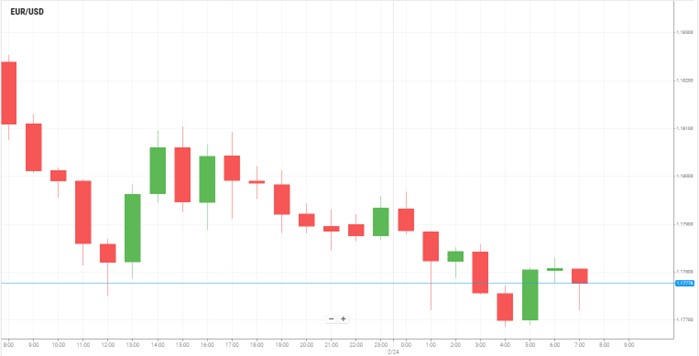
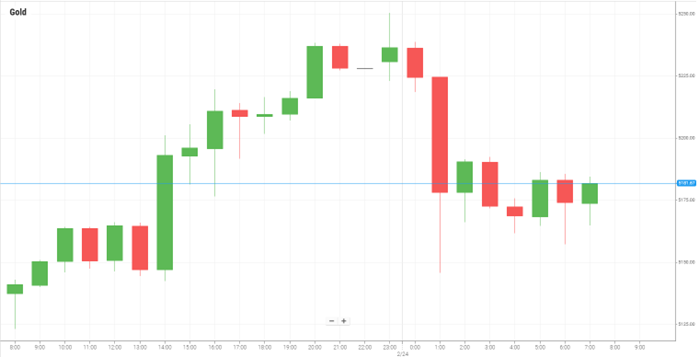
Gold prices advanced for a third consecutive session on Friday, supported by escalating geopolitical tensions, though gains remain limited amid a firm US Dollar and cautious positioning ahead of key US economic data.
The precious metal continues to attract safe-haven demand, but investors appear reluctant to take aggressive positions before the release of the Advance fourth-quarter US Gross Domestic Product (GDP) report and the Personal Consumption Expenditures (PCE) Price Index.
Geopolitical risks intensified after Donald Trump warned Iran that it must reach an agreement over its nuclear program within 10 to 15 days or face serious consequences. In response, Iran informed António Guterres that while it does not seek conflict, it would respond decisively to any military aggression. Tehran also stated that bases and assets of hostile forces in the region would be considered legitimate targets if attacked.
The exchange has heightened concerns about a potential military confrontation and broader instability in the Middle East, providing underlying support to gold as investors seek safe-haven assets.
Despite geopolitical tailwinds, gold’s upside remains capped by expectations that US interest rates could stay elevated for longer.
With geopolitical tensions providing support and monetary policy expectations acting as a counterbalance, gold traders now turn their attention to the upcoming US GDP and PCE data.
Oil prices advanced on Tuesday, hovering near seven-month highs as traders weighed the risk of supply disruptions amid rising geopolitical tensions ahead of a new round of US-Iran nuclear talks.
Iran and the United States are scheduled to hold a third round of nuclear negotiations on Thursday in Geneva, according to Oman’s Foreign Minister Badr Albusaidi. The talks come amid persistent tensions, with Washington demanding that Tehran abandon its nuclear programme — a request Iran has firmly rejected while denying any intention to develop nuclear weapons.
Adding to concerns, the United States Department of State has begun withdrawing non-essential personnel and their families from the US embassy in Beirut, citing growing risks of military conflict involving Iran.
Further escalating rhetoric, Donald Trump warned in a social media post that it would be a “very bad day” for Iran if it fails to reach an agreement.
On the trade front, President Trump added another layer of uncertainty by cautioning countries against retreating from recently negotiated trade agreements with the United States. His remarks followed a decision by the Supreme Court of the United States to strike down emergency tariffs previously introduced under his administration. Trump indicated that higher duties could be imposed under alternative trade laws.
With both geopolitical tensions and trade policy uncertainty in focus, oil markets are likely to remain sensitive to headline-driven volatility in the near term.
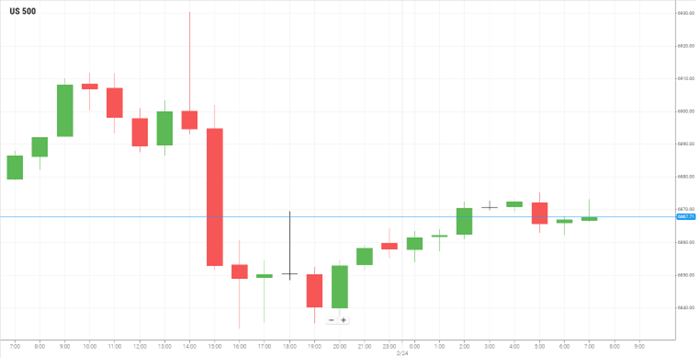
US equities ended Monday deep in negative territory after a ruling by the Supreme Court of the United States against President Donald Trump’s emergency tariffs sparked fresh market turbulence. At the same time, software stocks came under heavy pressure following the release of a report examining long-term risks tied to rapid artificial intelligence development.
The losses followed a stronger performance last week, when investors initially welcomed the Supreme Court’s decision and drew some relief from the absence of immediate US military action against Iran.
Over the weekend, Trump announced plans to raise a temporary universal tariff on imports to 15%, up from 10%, shortly after the Supreme Court ruled that he had exceeded his authority in declaring an economic emergency to impose sweeping trade levies. Several countries that signed trade agreements with Washington in the past year are now reportedly seeking renegotiation or clarification. The European Commission, the executive arm of the European Union, called on the US to uphold the terms of a 2025 accord and provide full transparency on how tariff policies will evolve.
Trump responded on his Truth Social platform, warning that countries attempting to “play games” with the court decision would face significantly higher duties.
Technology shares were further pressured by a report from Citrini Research outlining a hypothetical 2028 scenario in which rapid AI disruption leads to widespread white-collar job displacement. Attention now turns to upcoming results from AI heavyweight Nvidia, widely viewed as a bellwether for AI-driven demand. Nvidia is set to report fiscal fourth-quarter earnings on Wednesday, with analysts expecting earnings per share of $1.52 on revenue of $65.56 billion. That compares with EPS of $0.89 and revenue of $39.33 billion a year earlier.
The materials contained on this document should not in any way be construed, either explicitly or implicitly, directly or indirectly, as investment advice, recommendation or suggestion of an investment strategy with respect to a financial instrument, in any manner whatsoever. Any indication of past performance or simulated past performance included in this document is not a reliable indicator of future results. For the full disclaimer click here.
Join iFOREX to get an education package and start taking advantage of market opportunities.
 A beginner's e-book
 $5,000 practice demo account
 A 12-part video course
 Trusted partner
 Featured partner
 By
By 


