
Listed on 
 Years active
 English (Arabic)
 Chinese Simplified - 中文 (简体)
 Chinese Traditional - 中文 (繁體)
 English
 Japanese - 日本語
 Korean - 한국어 (대한민국)
 Portuguese - Português
 Russian - Русский
 Spanish - Español
 Thai - ไทย
 English (India)
Don't have an account?
Register via AppHave an account?
Login 23/12/2025 - 06:50 UTC
The USDX moved 0.44% lower on Monday, extending its decline for a second consecutive session to trade near the 98.10 level during Tuesday’s Asian hours. This weakness stems from market participants increasing bets that the Federal Reserve will maintain an easing bias in the coming year, despite apparent divisions among policymakers. While the greenback has faced selling pressure, recent commentary from Fed officials highlights an ongoing debate over the pace of monetary normalization.
On Monday, Fed Governor Stephen Miran cautioned in a Bloomberg interview that failing to continue easing policy could unnecessarily heighten recession risks, although he noted that the urgency for aggressive 50-basis-point cuts may fade as interest rates gradually decline. This stands in contrast to the more hawkish stance of Cleveland Fed President Beth Hammack, who suggested on Sunday that the central bank is well-positioned to pause and evaluate the economic impact of the 75 basis points in cuts already delivered this year.
Beyond monetary policy, the USDX is contending with a shift in capital toward safe-haven assets like Gold due to escalating geopolitical tensions. On Monday, President Donald Trump announced that the U.S. would retain and potentially sell oil and vessels recently seized off the coast of Venezuela—a move that further intensifies the "blockade" and pressure campaign against the Maduro administration. Meanwhile, in Eastern Europe, continued strikes by Ukraine on Russian energy infrastructure—including a recent drone attack on a Black Sea oil terminal—have kept global uncertainty elevated.
Regional markets moved slightly higher on Tuesday, following the positive performance of the main US equity indices, which have now closed higher for three consecutive sessions. Sentiment has been lifted by a recovery in the technology sector and cooling inflation signals, though overall trading activity remains subdued due to thin year-end volumes. As the holiday season approaches, market participants are avoiding large positions, resulting in lighter participation across the continent.
The China SSE rose 0.24%, while the China SZSE gained 0.49% as of 05:36 AM GMT Tuesday. Conversely, the Hong Kong 50 declined -0.28%. Mainland markets are benefiting from a modest improvement in risk appetite, even as investors digest the implications of global interest rate paths and wait for further economic data to gauge the effectiveness of recent policy support.
The Japan 225 fell -0.08% as of 05:36 AM GMT Tuesday. Domestic focus shifted toward currency stability after Finance Minister Satsuki Katayama stated that authorities have a "free hand" to address excessive yen volatility. While export-heavy sectors typically benefit from a weaker currency, these warnings of potential intervention have kept traders cautious. Additionally, broader regional sentiment was influenced by the Reserve Bank of Australia’s minutes, which suggested that interest rates might still need to rise in 2026 if inflation remains persistent.
The main US equity indices moved higher on Monday, driven by strong performance in chipmakers and growing expectations that the Federal Reserve will have more room to ease policy next year. While US futures remained steady during Asian hours, the positive momentum from Wall Street continues to provide a tailwind for Asian tech shares, even as the market enters a holiday-shortened trading week.
Investors are also closely monitoring the transition of Federal Reserve leadership, as President Donald Trump interviews finalists to succeed Chair Jerome Powell. This political development, combined with the "soft" inflation readings from last week, has provided a tailwind for equities. However, trading volumes are expected to thin in the coming days as U.S. markets head into a holiday-shortened schedule, with Wall Street closing early on Wednesday and remaining shut on Thursday for the Christmas holiday.
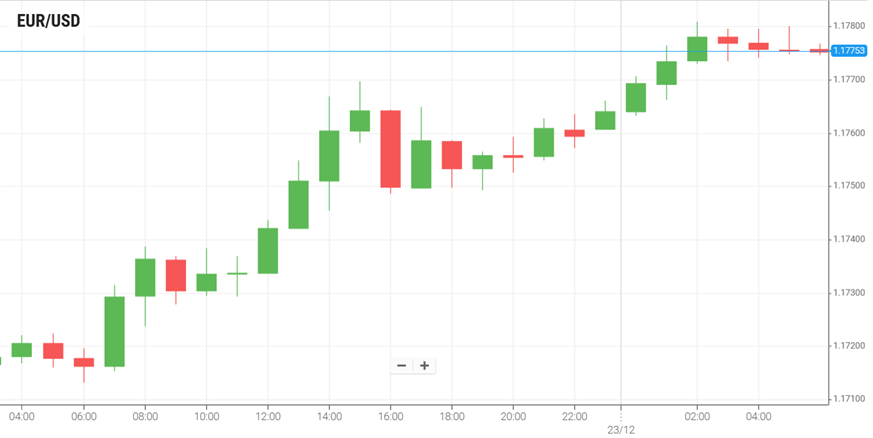
The EUR/USD rose 0.46% on Monday, rebounding to the 1.1757 level as traders favored the Euro amid growing speculation that the Federal Reserve will continue its easing cycle in 2026. Despite a quiet economic calendar on both sides of the Atlantic, the pair found support as investors digested mixed rhetoric from central bank officials. While Cleveland Fed President Beth Hammack maintained a more hawkish "pause and assess" stance, markets are currently pricing in the first 25-basis-point rate cut for mid-June 2026.
In the US, policymakers highlighted that the recent Consumer Price Index (CPI) data for November may have contained irregularities caused by the previous 43-day government shutdown, potentially clouding the immediate inflation outlook. Meanwhile, across the pond, European Central Bank (ECB) officials moved to downplay hawkish expectations, clarifying that recent comments did not necessarily signal a need for further rate hikes.
Looking ahead, the pair’s momentum will be tested by a heavy data slate later this week. Investors are awaiting GDP figures from Germany and Spain, as well as crucial US data including Q3 GDP, Industrial Production, and Consumer Confidence, which will provide clearer direction on the relative health of both economies and the timing of the next central bank moves.
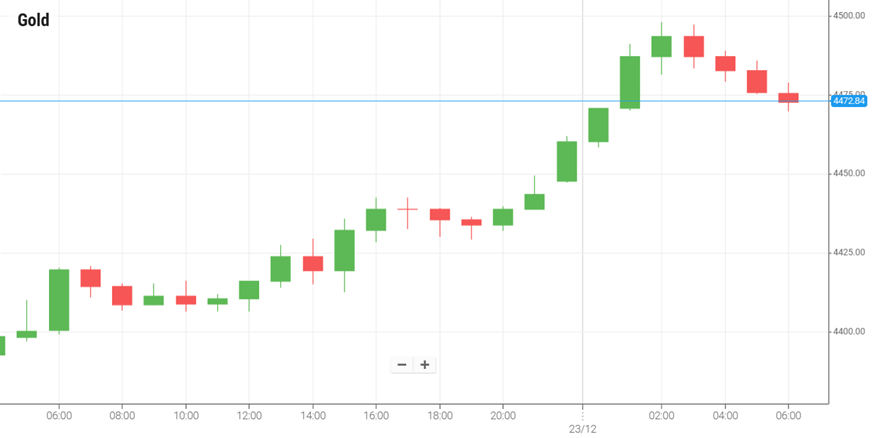
Gold surged 2.41% up on Monday, hitting a new all-time high above $4,400 as safe-haven demand intensified. The metal has gained nearly 70% in 2025, driven by a mix of geopolitical instability and expectations of a more dovish Federal Reserve path in 2026. This momentum continued into Tuesday, with prices peaking near $4,480 as investors sought protection against regional conflicts and currency debasement.
A key driver is the escalating US naval "blockade" against Venezuela and the risk of maritime confrontation, alongside continued drone strikes on energy infrastructure in the Black Sea. Furthermore, President Trump’s public push for significantly lower interest rates has reinforced the metal's status as a premier refuge asset.
Focus now shifts to the preliminary US Q3 GDP report, projected to show a slowdown to 3.2%. While the CME FedWatch tool shows only a 20.0% chance of a January rate cut, the broader trend of cooling inflation and structural central bank demand maintains a bullish tailwind for gold heading into the new year.
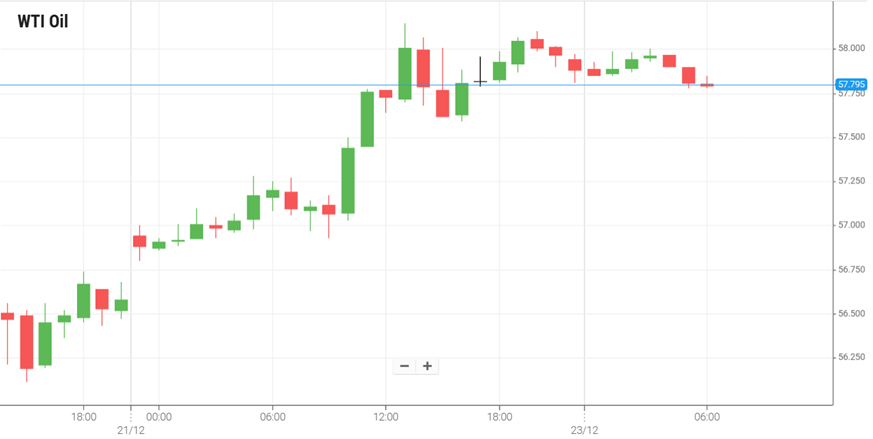
WTI Oil rose 1.76% on Monday to settle near $58.00, driven by escalating geopolitical risks. A primary catalyst was the U.S. naval blockade of Venezuela, with President Trump signaling that seized crude could be sold or added to the Strategic Petroleum Reserve. Additional support came from Ukrainian drone strikes on Russian energy infrastructure and renewed tensions between Israel and Iran.
Despite these supply-side threats, prices edged lower in Tuesday's Asian trade as cautious sentiment and thin holiday volumes returned. While the Venezuelan blockade could disrupt nearly 1% of global supply, investors remain wary of a broader market surplus and slowing demand in 2026. Market focus now shifts to upcoming U.S. inventory data for further direction.
Oil also found support from rising expectations that the Federal Reserve will cut interest rates at next week’s policy meeting. Markets are pricing in roughly a 90% probability of a 25-basis-point reduction, a move that typically weakens the U.S. dollar and supports fuel demand.
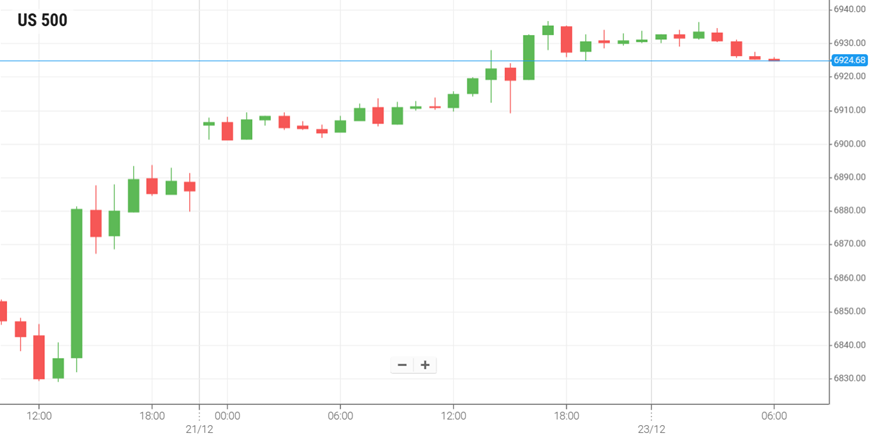
The main US equity indices moved higher on Monday, extending their recent gains as investors aim for a positive end to the year. Despite the thin volumes typical of a holiday-shortened week, the market showed resilience, supported by a continued rally in the financial sector and a recovery in artificial intelligence trades. Market participation is expected to remain subdued in the coming days, with Wall Street closing early on Wednesday and remaining shut on Thursday for Christmas.
In the corporate sector, Citigroup surged 2.79% on Monday, reaching a new 52-week high amid optimism regarding the Trump administration’s plans to reduce financial services regulations and sustained strength in deal-making. The technology sector also regained momentum following its recent volatility; Nvidia rose 1.59%, Oracle jumped 3.28%, and Broadcom edged up 0.38%. This rebound reflects renewed confidence in AI valuations as Treasury yields softened following last week’s cooling inflation data.
Beyond individual stock movements, market participants are closely monitoring the transition of Federal Reserve leadership. With Jerome Powell’s term ending in May, investors are parsing comments from potential candidates for insights into future interest rate strategy.
The materials contained on this document should not in any way be construed, either explicitly or implicitly, directly or indirectly, as investment advice, recommendation or suggestion of an investment strategy with respect to a financial instrument, in any manner whatsoever. Any indication of past performance or simulated past performance included in this document is not a reliable indicator of future results. For the full disclaimer click here.
Join iFOREX to get an education package and start taking advantage of market opportunities.
 A beginner's e-book
 $5,000 practice demo account
 A 12-part video course
 Trusted partner
 Featured partner
 By
By 


