
Listed on 
 Years active
 English (Arabic)
 Chinese Simplified - 中文 (简体)
 Chinese Traditional - 中文 (繁體)
 English
 Japanese - 日本語
 Korean - 한국어 (대한민국)
 Portuguese - Português
 Russian - Русский
 Spanish - Español
 Thai - ไทย
 English (India)
Don't have an account?
Register via AppHave an account?
Login 14/08/2026 - 06:50 UTC
The US Dollar Index (USDX), tracking the Greenback against a basket of six major currencies, continued to lose momentum, trading down -0.02% around the 99.90 level during Friday's Asian session. A softer-than-expected US inflation background—highlighted by July headline PPI remaining flat at 0.0% MoM (4.7% YoY) and core PPI rising just 0.2% MoM (4.2% YoY)—led traders to scale back expectations for Federal Reserve rate hikes. The CME FedWatch Tool lowered the probability of a September rate hike to 34.8%, keeping the currency pinned near recent lows as market attention shifts to the upcoming US Retail Sales release.
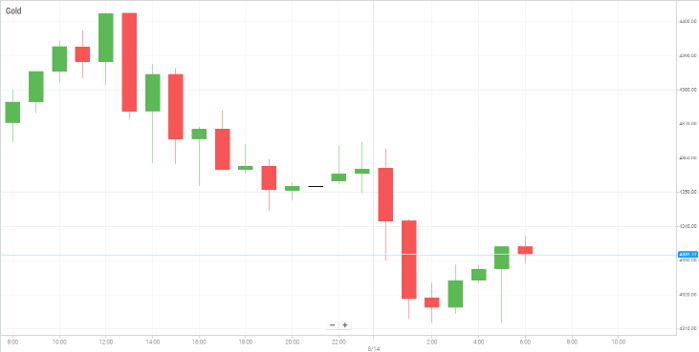
Gold pulled back for a second straight session, declining -1.32% to trade near the $4,300 mark after reaching intraday highs near $4,450 earlier in the week. The precious metal faced follow-through selling as traders trimmed long positions following recent gains, though the downside remains capped as cooling wholesale inflation figures continue to limit aggressive USD buying and bolster expectations for a steady Fed policy path.
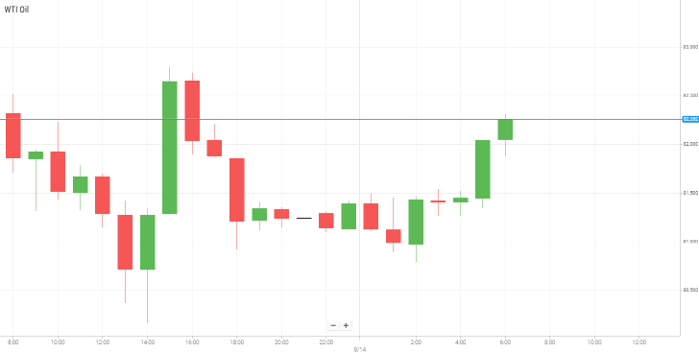
West Texas Intermediate crude oil edged lower by -1.60%, trading around $81.40 after a two-day corrective move. Despite the intraday decline, losses were tempered as fundamental energy supply risks persist in the Middle East. Tensions remain elevated with minimal naval transit through the Strait of Hormuz amid blockades and a breakdown in direct US-Iran talks, though upside momentum was slightly offset by OPEC downwardly revising its 2026 global demand growth forecast to 580,000 bpd.
Asian stock markets mostly pushed higher, heading for their best weekly performance since mid-June, led by gains in semiconductor and technology shares. South Korea's KOSPI continued its sharp bull-market rebound, rising over 1.6% as SK Hynix jumped 3.45% and Samsung Electronics advanced 3.39%. Regionally, tech strength extended across supply chains, with SoftBank Group gaining 3.47% amid sustained optimism around artificial intelligence infrastructure demand across regional markets.
US equities presented a mixed picture as broader index strength collided with earnings-related pressure in individual technology leaders. While benign inflation data provided an overarching tailwind, Cisco Systems fell -8.40% despite reporting record AI-driven equipment demand, as lofty market expectations triggered profit-taking. Similarly, Applied Materials slipped -2.34% as investors parsed broader tech capital expenditure and semiconductor equipment demand.
Bitcoin traded virtually flat, up 0.03% around $63,452, consolidating within its recent $63,000–$65,000 range. The world's largest cryptocurrency showed little reaction to the soft US producer price data, as benign macro figures offered limited fresh momentum for a decisive breakout above major resistance levels.
Today's economic slate delivers a crucial snapshot of the U.S. consumer's overall resilience and inflation outlook. Key focus will be placed on month-over-month Core Retail Sales and headline Retail Sales figures to gauge whether underlying consumer spending momentum is holding steady. Simultaneously, the preliminary University of Michigan Consumer Sentiment survey and its forward-looking Inflation Expectations metrics will offer vital clues regarding household confidence and price expectations. Together, these data points are set to drive short-term volatility across USD pairs and equities as market participants fine-tune their expectations for Federal Reserve monetary policy.
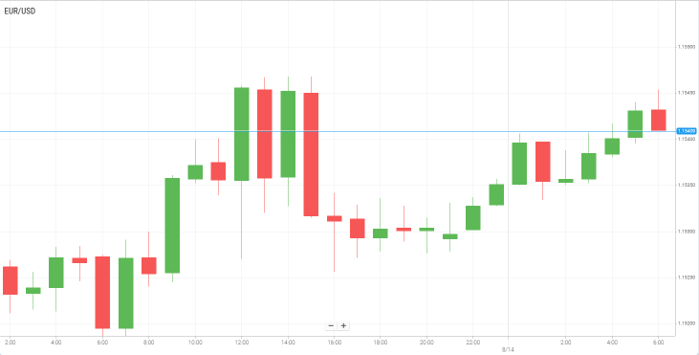
The EUR/USD pair attracts fresh buying during Friday’s Asian session, extending the previous day’s modest rebound. Despite the recovery, the pair remains within a two-week trading range and continues to hover below 1.1550 amid mixed market signals.
The US Producer Price Index (PPI) report released Thursday came in below expectations, reinforcing recent signs of easing inflation following softer Consumer Price Index (CPI) data.
The Euro, meanwhile, is finding support from expectations that the European Central Bank (ECB) could deliver one final 25-basis-point rate hike at its September meeting, as inflation remains above the central bank’s 2% target. However, persistent geopolitical tensions may sustain demand for the safe-haven USD and discourage traders from building aggressive bullish positions in EUR/USD.
Geopolitical developments remain a key factor. NATO fighter jets shot down a drone over Latvian airspace early Friday, while Finland temporarily restricted aviation and maritime traffic in the eastern Gulf of Finland.
Markets are also continuing to factor in a geopolitical risk premium amid the US-Iran standoff over the Strait of Hormuz. Meanwhile, Iran-backed Houthi forces in Yemen have intensified attacks on vessels in the Red Sea and Bab el-Mandeb Strait and claimed responsibility for a drone strike targeting a Saudi Aramco refinery. The developments raise concerns about a wider regional conflict, potentially strengthening safe-haven demand for the USD and limiting further gains in EUR/USD.
Gold comes under renewed selling pressure for a second consecutive session on Friday, extending its pullback from the previous day’s peak near $4,450, its highest level since June 5.
The latest US inflation data continues to weigh on the US Dollar (USD) and provides some support to non-yielding Gold. Fed officials, however, remain divided over the appropriate policy path.
Despite the reduced expectations for near-term Fed tightening, geopolitical risks continue to provide support for the safe-haven USD and weigh on Gold. US Treasury Secretary Scott Bessent warned that Washington could impose unprecedented measures against Iran, while Iranian officials have signaled that any conflict would carry significant costs for the United States.
Tensions surrounding the Strait of Hormuz remain particularly important for financial markets. The US has maintained pressure on Iran, while Tehran has pledged to keep the strategic waterway closed until its demands are met. Meanwhile, Iran-backed Houthi forces in Yemen have intensified attacks on shipping in the Red Sea and Bab el-Mandeb Strait and claimed responsibility for a drone strike targeting a Saudi Aramco refinery.
Attention now turns to upcoming US economic data, including monthly Retail Sales and the preliminary University of Michigan Consumer Sentiment Index, which could provide fresh clues about the US economic outlook and offer further direction to Gold and the US Dollar.
Oil prices edged higher on Friday as renewed US threats of an indefinite naval blockade of Iran revived concerns about potential disruptions to crude supplies. The move followed a sharp decline in the previous session, when weaker demand expectations and a substantial increase in US crude inventories weighed on the market.
The broader geopolitical backdrop continues to provide a floor for oil prices despite increasingly bearish supply and demand signals.
The United States warned on Thursday that it could maintain a naval blockade of Iran indefinitely and increase economic pressure on Tehran as ceasefire negotiations have stalled.
The threats come as Iran restricts traffic through the Strait of Hormuz, a critical energy corridor that previously carried around 20% of global oil supplies. Prolonged disruption to the waterway could tighten global crude markets, push fuel prices higher and increase pressure on the US administration to bring the conflict to an end.
However, concerns about supply disruptions are being offset by a weaker demand outlook. The Organization of the Petroleum Exporting Countries (OPEC) and the International Energy Agency (IEA) have both lowered their forecasts for oil demand growth, while US data showed the largest weekly increase in crude inventories in more than three and a half years.
Fresh concerns over supply emerged on Thursday after two vessels owned by Abu Dhabi National Oil Company were attacked while transiting the Strait of Hormuz. The United Arab Emirates condemned the incident as an Iranian attack, adding another layer of geopolitical risk to an already fragile energy market.
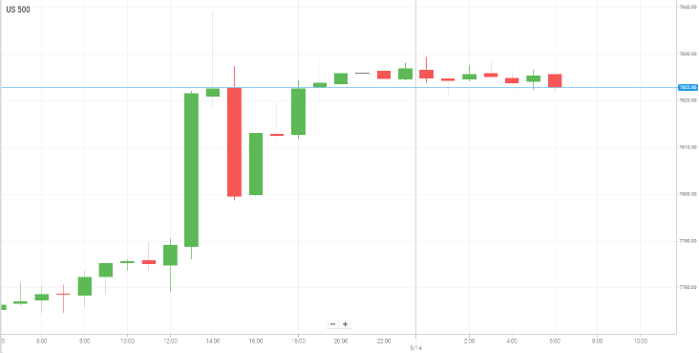
Wall Street closed at record highs on Thursday as softer-than-expected US producer inflation reduced expectations for a Federal Reserve rate hike and boosted demand for rate-sensitive technology stocks. Falling Treasury yields and lower oil prices also supported broader risk sentiment, helping the major US indexes extend their gains.
Together with Wednesday’s Consumer Price Index (CPI) report, the latest data suggest that both headline and core inflation have eased on an annual basis. While the Fed focuses more closely on the core Personal Consumption Expenditures (PCE) price index, components from both CPI and PPI feed into the measure, making the latest reports relevant to the central bank’s policy outlook.
The prospect of a less hawkish Federal Reserve provided a particularly strong boost to technology stocks and other rate-sensitive assets. The US 500 technology sector gained around 1%, while investors also began to look for a broader market rally as lower borrowing costs could benefit mid-cap and small-cap stocks.
Cisco Systems, however, limited the US 30 advance despite reporting strong quarterly results. The networking equipment company benefited from surging demand for infrastructure supporting artificial intelligence applications, with management highlighting exceptionally strong orders from major technology companies.
Attention now shifts to Applied Materials, which was due to report its results after the closing bell. The semiconductor equipment sector remains one of the strongest beneficiaries of the AI investment boom, with the Philadelphia Semiconductor Index having gained sharply this year.
The materials contained on this document should not in any way be construed, either explicitly or implicitly, directly or indirectly, as investment advice, recommendation or suggestion of an investment strategy with respect to a financial instrument, in any manner whatsoever. Any indication of past performance or simulated past performance included in this document is not a reliable indicator of future results. For the full disclaimer click here.
Join iFOREX to get an education package and start taking advantage of market opportunities.
 A beginner's e-book
 $5,000 practice demo account
 A 12-part video course
 Trusted partner
 Featured partner
 By
By 


