
Listed on 
 Years active
 English (Arabic)
 Chinese Simplified - 中文 (简体)
 Chinese Traditional - 中文 (繁體)
 English
 Japanese - 日本語
 Korean - 한국어 (대한민국)
 Portuguese - Português
 Russian - Русский
 Spanish - Español
 Thai - ไทย
 English (India)
Don't have an account?
Register via AppHave an account?
Login 09/03/2026 - 08:11 UTC
The USDX climbed 1.38% last week, reaching its highest level since late 2025 as the Middle East conflict entered its second week. While the Greenback saw minor intraday fluctuations, persistent safe-haven flows and hawkish Federal Reserve expectations—fueled by concerns that energy-led inflation will keep rates higher for longer—provided a powerful tailwind. Despite a weak Nonfarm Payrolls report on Friday, the dollar remains the preferred asset for investors seeking protection as the U.S. and Israel continue their campaign against Iran.
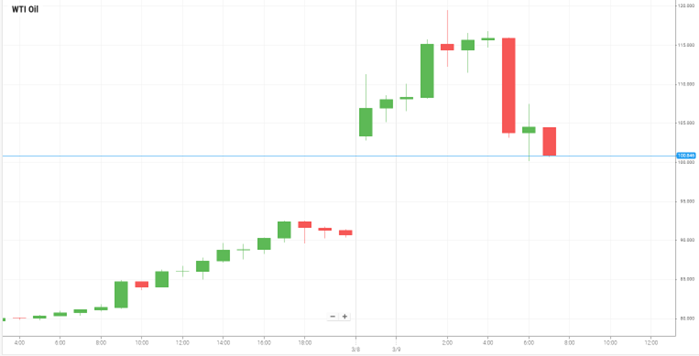
In the energy markets, WTI Oil surged a staggering 34.84% last week, with prices gapping higher on Monday to hit $110.73, the highest level since June 2022. The closure of the Strait of Hormuz and output cuts from major producers like Iraq and Kuwait have triggered severe supply fears, with Qatar’s energy minister warning of a move toward $150. President Trump has characterized these rising costs as a "small price to pay" for defeating Tehran, reinforcing market expectations that supply disruptions will persist as the war widens.
Conversely, Gold fell 2.10% last week, as the resurgent Greenback and a "flight to liquidity" weighed heavily on the precious metal. Although bullion recovered some ground on Monday to trade above $5,100—supported by the appointment of Mojtaba Khamenei as Iran's new Supreme Leader and the resulting risk of escalation—the technical setup remains bearish. The combination of soaring oil prices stoking inflation fears and a dominant USDX continues to cap the recovery of non-yielding assets, keeping Gold on the defensive despite the deteriorating geopolitical climate.
Asian equity markets faced severe downward pressure on Monday as the Middle East conflict entered its second week, driving energy prices to levels not seen in years and stoking fears of a global stagflationary shock. In China, investors weighed fresh inflation data showing the Consumer Price Index (CPI) rose 1.3% in February—hitting its highest level in nearly three years—while producer price deflation eased. Although the data suggested a gradual stabilization of domestic demand, the broader market remained cautious due to the risk of rising imported energy costs. Consequently, as of 07:16 AM GMT, the China SSE fell 0.70% and the China SZSE dropped 0.78%, while the Hong Kong 50 slipped 0.38% in highly volatile trade.
in Seoul, the Korea 200 plummeted 6.31%, leading regional losses after the KOSPI triggered circuit breakers earlier in the session. Major technology and automotive heavyweights were sold off aggressively, with Samsung Electronics and SK Hynix facing intense pressure as investors reassessed the impact of soaring industrial energy costs on South Korea’s export-driven economy.
In a notable divergence from the broader regional rout, the Japan 225 rose 0.77% by 07:16 AM GMT. While the index opened sharply lower and remains under significant weekly pressure, local bank stocks found support from rising global bond yields, helping the benchmark decouple slightly from the deep losses seen in neighboring manufacturing hubs.
In corporate news, Samsung Electronics and SK Hynix have reportedly secured an exclusive deal to supply sixth-generation high-bandwidth memory HBM4 for Nvidia's upcoming flagship AI accelerator, Vera Rubin. According to the Korea Economic Daily, this selection effectively sidelines competitors like Micron from the primary production cycle of Nvidia’s next-generation hardware. As the demand for high-performance processors grows, the integration of HBM4 into the Vera Rubin platform is expected to provide a significant competitive edge, reinforcing South Korea's leadership in the global AI supply chain.
The focus for this week will shift to a high-impact cluster of U.S. economic data, headlined by Wednesday's CPI and Friday’s Core PCE reports, as investors gauge whether the $110+ WTI Oil prices are beginning to drive an energy-led inflation spike. Markets will also closely monitor the unemployment claims, JOLTS job openings, and the preliminary GDP revision for signs of stagflationary pressure, especially as the Federal Reserve faces a leadership transition and persistent geopolitical uncertainty in the Middle East.
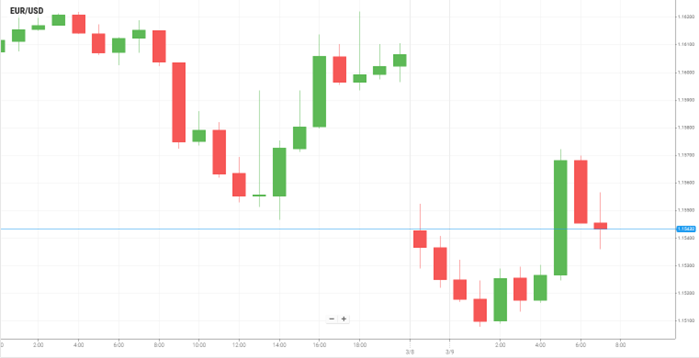
The EUR/USD pair began the week under heavy selling pressure, sliding toward the 1.1500 region and marking its weakest level since November 2025 as the US Dollar strengthened.
Demand for the US Dollar has strengthened as investors turn to safe-haven assets amid escalating geopolitical tensions in the Middle East. Market sentiment remains cautious as the conflict involving the United States, Israel, and Iran continues to unfold, prompting widespread declines across global equity markets and supporting the Dollar’s role as the world’s primary reserve currency.
At the same time, surging energy prices are adding to inflation concerns. Crude oil has climbed above the $100 level amid fears of potential supply disruptions through the Strait of Hormuz. Since the conflict began, oil prices have risen by more than 25%, driving higher fuel costs worldwide and reinforcing expectations that US interest rates may remain elevated for longer. Rising US Treasury yields have further strengthened the Dollar.
The Euro is also facing additional pressure due to Europe’s heavy reliance on imported energy. A sustained rise in oil and natural gas prices could pose a significant economic challenge for the region, adding another headwind for the common currency.
Looking ahead, traders will focus on the upcoming release of US inflation data for further insight into the Federal Reserve’s policy outlook. Nevertheless, geopolitical developments and movements in energy markets are likely to remain key drivers for the EUR/USD pair in the near term.
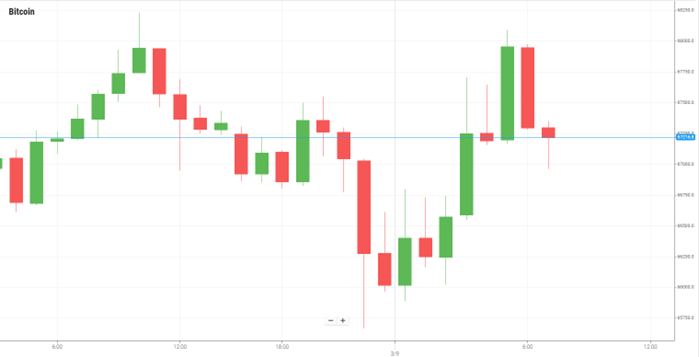
Bitcoin traded largely unchanged during Asian hours on Monday after retreating over the weekend, as escalating tensions involving the United States, Israel and Iran unsettled global financial markets and drove oil prices sharply higher. Despite ending last week with gains—outperforming several traditional risk assets—Bitcoin lost upward momentum during the weekend as geopolitical concerns intensified.
The jump in oil prices has revived concerns about global inflation and added uncertainty to the outlook for major central banks, which had previously been expected to begin easing monetary policy later this year. Bitcoin often behaves like a high-beta risk asset during periods of macroeconomic stress, meaning it can come under pressure when investors move away from riskier investments.
The weekend decline in cryptocurrencies also highlighted the 24/7 nature of digital asset trading, allowing market participants to react immediately to geopolitical developments even when traditional markets are closed. Market participants are now closely watching macroeconomic data and geopolitical headlines for fresh direction. Continued volatility in energy markets and global equities could influence near-term sentiment in the cryptocurrency space.
Oil prices jumped sharply on Monday, climbing more than 25% to their highest levels since mid-2022 as supply cuts from key producers coincided with mounting fears of prolonged shipping disruptions linked to the expanding conflict involving the United States, Israel and Iran.
Energy markets have grown increasingly uneasy as the crisis centers around the Strait of Hormuz, a strategic maritime chokepoint that typically handles about one-fifth of global oil shipments. Heightened security risks and interruptions to tanker traffic have already slowed crude shipments in the region, raising particular concerns for Asian importers that depend heavily on Middle Eastern energy supplies.
Supply pressures have intensified after Iraq and Kuwait began cutting crude output, adding to earlier reductions in liquefied natural gas shipments from Qatar as regional hostilities disrupted energy exports. Oil markets were further rattled by the appointment of Mojtaba Khamenei as Iran’s new supreme leader following the death of his father, Ali Khamenei.
The conflict could leave consumers and businesses facing elevated fuel costs for weeks or even months, even if hostilities end quickly. Damage to energy facilities, logistical disruptions and heightened risks for shipping could prolong the recovery in supply chains.
Iraqi oil production from its major southern fields has already dropped by roughly 70% to about 1.3 million barrels per day, according to industry sources, as the country struggles to export crude through the Strait of Hormuz. Kuwait Petroleum Corporation also began scaling back production over the weekend and declared force majeure on certain shipments, although it has not disclosed the exact volume of output affected.
Tensions remain high on the geopolitical front as Israel’s military warned it could target any successor to the late Iranian leader, while U.S. President Donald Trump indicated the conflict may not end until Iran’s military leadership is defeated.
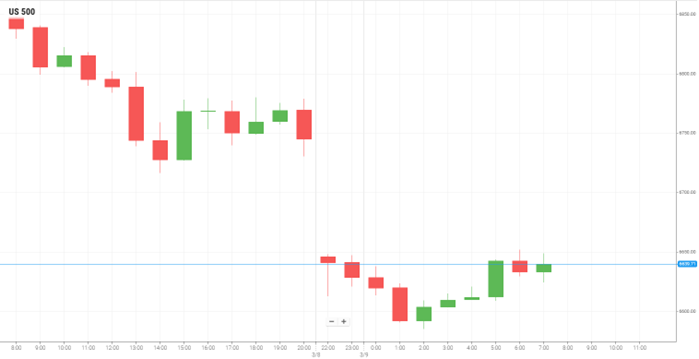
U.S. equities closed lower on Friday, although they recovered somewhat from deeper intraday losses, as disappointing labor market data combined with sharply higher oil prices dampened investor sentiment.
Market participants cited a combination of macroeconomic concerns and geopolitical tensions as the main drivers of the decline.
The major U.S. indexes posted notable weekly losses as geopolitical tensions intensified following the start of the Iran conflict last weekend.
Investor sentiment has been pressured by a sharp rally in crude oil prices as the conflict in the Middle East raised fears about potential disruptions to global energy supplies.
The February nonfarm payrolls report showed the U.S. economy unexpectedly losing 92,000 jobs. Economists had predicted a gain of roughly 58,000 jobs. The unemployment rate also edged higher to 4.4%.
The weak reading followed a relatively strong January report, which showed job growth of 126,000 after revisions. December’s data was also adjusted lower, with employment now estimated to have declined by 17,000 rather than rising.
The disappointing report complicates the outlook for the Federal Reserve, as policymakers continue to navigate a labor market characterized by both subdued hiring and relatively low layoffs.
Traders have already adjusted expectations for monetary policy following the report. Data from the CME FedWatch tool indicates markets are now pricing in higher odds of rate reductions by the Federal Reserve.
The materials contained on this document should not in any way be construed, either explicitly or implicitly, directly or indirectly, as investment advice, recommendation or suggestion of an investment strategy with respect to a financial instrument, in any manner whatsoever. Any indication of past performance or simulated past performance included in this document is not a reliable indicator of future results. For the full disclaimer click here.
Join iFOREX to get an education package and start taking advantage of market opportunities.
 A beginner's e-book
 $5,000 practice demo account
 A 12-part video course
 Trusted partner
 Featured partner
 By
By 


