
Listed on 
 Years active
 English (Arabic)
 Chinese Simplified - 中文 (简体)
 Chinese Traditional - 中文 (繁體)
 English
 Japanese - 日本語
 Korean - 한국어 (대한민국)
 Portuguese - Português
 Russian - Русский
 Spanish - Español
 Thai - ไทย
 English (India)
Don't have an account?
Register via AppHave an account?
Login 13/08/2026 - 07:40 UTC
The US Dollar Index, tracking the Greenback against a basket of currencies, struggled to build momentum beyond the 100.00 level, remaining confined within a two-week range after logging a modest gain of 0.17% on Wednesday. Moderating US inflation data—with July headline CPI easing to 3.4% and core CPI rising 2.5% YoY—alongside recent labor market softness, prompted traders to scale back expectations for an immediate Federal Reserve interest rate hike. However, persistent safe-haven demand and sticky inflation fears rooted in ongoing Middle East geopolitical tensions continue to limit significant downside for the currency.
Gold pulled back from intraday highs near $4,450 to trade below the $4,400 mark heading into the European session. Despite the intraday easing, the precious metal finished Wednesday up 0.98%, near its highest levels since June 5. The initial relief from softer US inflation figures proved short-lived as market participants digested energy-driven inflation risks. With traders still pricing in a significant chance of further Fed policy tightening in 2026, higher yield expectations and a firm US Dollar continue to cap bullion’s upside.
West Texas Intermediate crude oil edged lower around $82.45 following a minor loss of -0.04% on Wednesday. Downward pressure followed a massive, larger-than-expected US crude inventory build of 17.4 million barrels reported by the Energy Information Administration. Nevertheless, oil price losses remain capped as talks between Washington and Tehran over the Strait of Hormuz remain at a standstill, while continued Houthi attacks on Red Sea shipping lanes reinforce fears of broader regional supply disruptions.
Asian stock markets mostly pushed higher, led by a sharp surge in semiconductor giants as South Korea's KOSPI entered technical bull-market territory. The tech-led rebound saw SK Hynix jump 5.70% and Samsung Electronics gain 3.91% in their latest trading sessions, supported by stabilizing retail leverage rules and expectations for enhanced shareholder returns alongside solid broad-based demand for AI infrastructure across Japanese and regional supply chains.
US equities also found support as technology shares regained momentum following a moderate session on Wall Street. Nvidia rose 3.06%—bolstered by major institutional AI infrastructure financing initiatives—while Alphabet dipped slightly by -0.16%. The broader tech complex gathered additional strength from impressive post-earnings outlooks, with CoreWeave surging 19.48% and Super Micro Computer jumping 18.60% as enterprise demand for computing power remains robust.
Looking ahead to Thursday's session, market focus shifts toward the US economic calendar, featuring the release of the core Producer Price Index (PPI) and weekly jobless claims alongside scheduled comments from Federal Reserve officials. On the corporate front, investors will closely monitor upcoming quarterly earnings results from Applied Materials to gauge the ongoing strength of semiconductor equipment demand and tech capital spending.
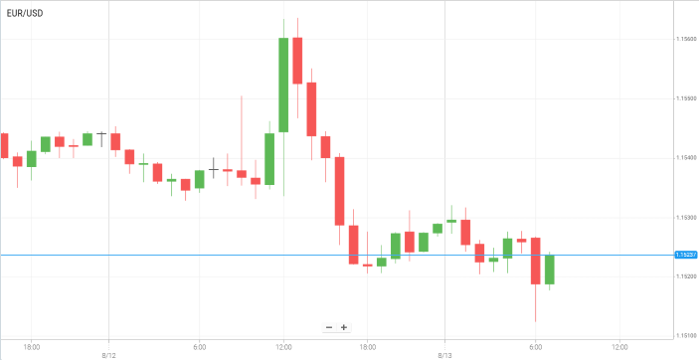
EUR/USD trades with a cautious undertone, hovering near the 1.1520–1.1530 region during Thursday’s early European session after posting a -0.13% decline on Wednesday. The shared currency finds brief support as the US Dollar faces upside headwinds following the release of July's US Consumer Price Index report. Headline inflation moderated to 3.4% YoY while core inflation eased to 2.5% YoY—both matching market expectations and reducing bets for a September Federal Reserve rate hike to roughly 40%.
Despite the softer US inflation print, the Greenback continues to derive underlying support from persistent Middle East geopolitical friction and stalled US-Iran talks over the resolution of the Gulf conflict. With no signs of progress toward reviving the interim agreement or securing critical maritime choke points, elevated geopolitical uncertainty and volatile energy prices sustain fears of lingering inflation risks.
Meanwhile, solid Eurozone macroeconomic fundamentals—including Q2 GDP growth of 0.4% and regional inflation at 2.9%—keep the prospect of a 25-basis-point ECB rate hike on the table, helping keep spot prices anchored. Investors are now turning their primary focus today toward the release of the July US Producer Price Index (PPI) report for fresh macroeconomic direction.
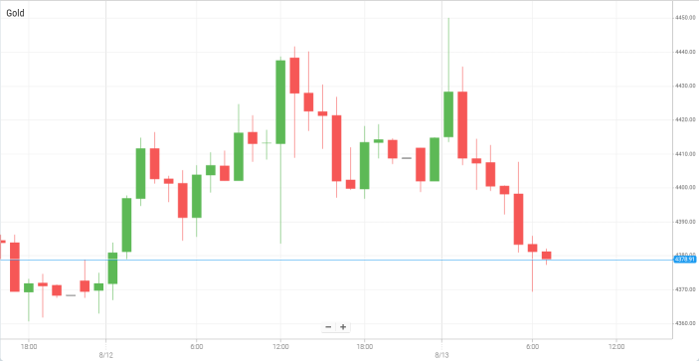
Gold extends its intraday retracement slide from the highest level since June 5, touched earlier around the $4,450 area, sliding further below the $4,400 mark heading into Thursday's European session despite posting a solid gain of 0.98% on Wednesday. The initial market optimism following signs of moderating US inflation faded quickly as investors remain concerned that elevated energy prices could reignite broader inflationary pressures.
Data released by the US Bureau of Labor Statistics showed July headline CPI easing in line with estimates to 3.4% YoY, while core CPI matched expectations at 2.5% YoY. Coupled with last week's softer Nonfarm Payrolls report, the figures reinforced arguments for the Federal Reserve to hold rates steady in September. However, persistent worries over energy-driven inflation—amplified by the ongoing US-Iran deadlock over the Strait of Hormuz and escalated Houthi attacks on Red Sea shipping—continue to fuel expectations for at least one Fed rate hike before the end of the year, providing underlying support to the US Dollar and capping gains for the non-yielding metal.
Market participants now turn their attention to Thursday’s US economic calendar, featuring the Producer Price Index (PPI) and Weekly Initial Jobless Claims, alongside scheduled commentary from Federal Reserve officials.
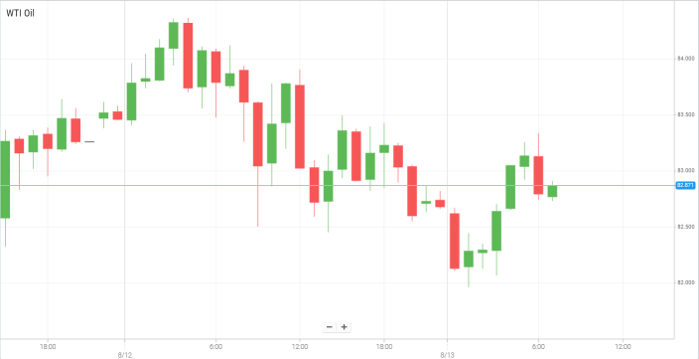
West Texas Intermediate (WTI) Crude Oil edged lower to trade near the $82.45 region during Thursday's early Asian session, retreating after logging a loss of -0.94% on Wednesday. The US benchmark black liquid faced renewed downward pressure as market participants digested a massive, larger-than-expected build in US crude inventories.
The downside momentum was driven by data from the US Energy Information Administration (EIA), which revealed that US crude oil stockpiles surged by 17.422 million barrels for the week ending August 7, sharply defying market consensus expectations for a 1.4 million-barrel draw. Meanwhile, geopolitical uncertainty remains high as talks between Washington and Tehran over a permanent resolution to the Middle East conflict remain deadlocked.
Despite assertions from US President Donald Trump claiming total control over the Strait of Hormuz, Iranian officials pushed back, insisting the vital maritime corridor remains blocked until Tehran's demands are fully met. This ongoing impasse across key Middle Eastern maritime routes continues to preserve a firm war-risk premium in energy markets while fueling lingering supply disruption fears.
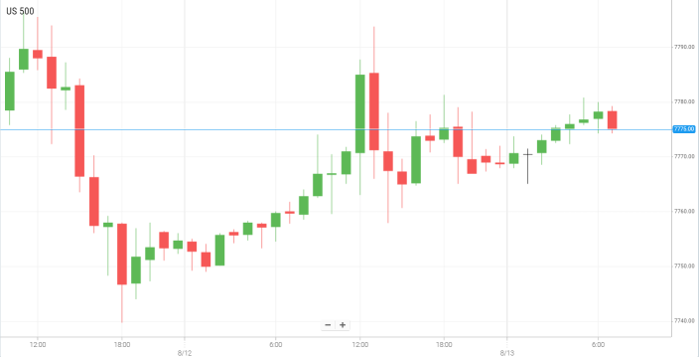
US equities rebounded on Wednesday as technology shares regained momentum, lifting broader sentiment after in-line inflation figures. Main averages found solid footing following the July Consumer Price Index report, which showed headline CPI easing to 3.4% YoY and core CPI moderating to 2.5% YoY. Matching consensus estimates, the data prompted traders to pare back Federal Reserve rate-hike expectations. The US 500 gained 0.18% on the session, while the Nasdaq Composite advanced and the Dow Jones finished roughly flat.
Market participants balanced the moderating inflation numbers against lingering Middle East geopolitical friction and seesawing oil prices, driven by conflicting claims over control of the Strait of Hormuz between US President Donald Trump and Iranian officials. Despite fears that elevated energy costs could make future inflation sticky, the softer CPI print—following last Friday's weak July jobs report—strengthened the case for the Fed to keep borrowing costs steady at its upcoming meeting.
The broader tech complex gathered notable strength from robust individual corporate catalysts and enterprise demand for AI infrastructure. Nvidia gained 3.06%—bolstered by major institutional AI infrastructure financing initiatives. Gains were further driven by impressive post-earnings outlooks across the sector, with CoreWeave surging 19.48% after posting record revenues and a $104 billion sales backlog, while Super Micro Computer jumped 18.60% after issuing full-year revenue guidance that comfortably beat expectations.
Looking ahead, market focus shifts to Thursday's economic calendar for the release of the July Producer Price Index (PPI) and weekly jobless claims to gain further clarity on the trajectory of price pressures. On the corporate front, investors will closely monitor upcoming quarterly earnings results from Applied Materials to gauge the ongoing health of semiconductor equipment demand and broader capital spending.
The materials contained on this document should not in any way be construed, either explicitly or implicitly, directly or indirectly, as investment advice, recommendation or suggestion of an investment strategy with respect to a financial instrument, in any manner whatsoever. Any indication of past performance or simulated past performance included in this document is not a reliable indicator of future results. For the full disclaimer click here.
Join iFOREX to get an education package and start taking advantage of market opportunities.
 A beginner's e-book
 $5,000 practice demo account
 A 12-part video course
 Trusted partner
 Featured partner
 By
By 


