
Listed on 
 Years active
 English (Arabic)
 Chinese Simplified - 中文 (简体)
 Chinese Traditional - 中文 (繁體)
 English
 Japanese - 日本語
 Korean - 한국어 (대한민국)
 Portuguese - Português
 Russian - Русский
 Spanish - Español
 Thai - ไทย
 English (India)
Don't have an account?
Register via AppHave an account?
Login 15/01/2026 - 08:27 UTC
The USDX traded on a defensive note during Wednesday’s session, closing -0.11% lower as investors balanced stronger-than-expected economic data against intensifying political friction. Despite the daily dip, the greenback regained some footing in early Thursday trading, moving back toward the 99.15 level. The retreat on Wednesday came even as the U.S. Census Bureau reported a robust 0.6% increase in Retail Sales for November, surpassing the forecast of 0.4%. This rebound from October’s contraction was joined by a "hotter" Producer Price Index (PPI), which climbed 3.0% year-over-year, beating estimates of 2.7%. While these figures typically bolster the case for the Federal Reserve to maintain a "higher-for-longer" rate stance, the USDX faced pressure as markets reacted to unprecedented legal tension between the White House and the central bank. on Wednesday, President Trump noted that the situation is currently in a "holding pattern," stating he has no immediate plan to dismiss Powell but that it is "too early" to determine a final course of action. As the USDX navigates the balance between strong domestic demand and this administrative friction, focus shifts to Thursday's Unemployment Claims and a slate of speeches from Fed officials.
The U.K. economy returned to growth in November, with GDP expanding by 0.3% following a contraction the previous month. This recovery was bolstered by a significant 2.1% jump in manufacturing, though analysts remain cautious, citing an "anaemic" pace of growth and ongoing fiscal uncertainty. While inflation cooled to 3.2% in November, it remains above the Bank of England’s 2% target, though officials suggest interest rates will stay on a downward path through 2026 as energy prices stabilize. Reflecting this cautious optimism, the UK 100 rose 0.72% on Wednesday. Meanwhile, GBP/USD saw a modest gain of 0.11% as traders balanced the improved growth data against the prospect of further rate cuts from the Bank of England later this year.
On the geopolitical front, U.S. President Donald Trump indicated a more restrained stance regarding Iran, noting a lack of immediate plans for large-scale military intervention following domestic protests. This shift, combined with "positive" discussions between Trump and Venezuela’s leadership regarding oil and trade, significantly reduced the risk premium that had previously driven markets higher. Consequently, energy prices retreated from recent multi-month peaks. On Wednesday, the two main crude benchmarks moved lower, with WTI Petróleo declining -0.69% and Brent dropping -0.31%. Beyond the easing of geopolitical tensions, downward pressure was further amplified by an unexpected jump in U.S. crude stockpiles, which rose by 3.4 million barrels last week against expectations of a draw, underscoring a well-supplied domestic market.
In corporate news, TSMC reported a record-breaking fourth-quarter net profit of $16 billion, significantly exceeding market expectations due to the sustained "AI megatrend." Despite this strong performance and a robust revenue forecast for the first quarter of 2026, the company's US-traded stock fell -1.23%. The market reaction was weighed down by the chipmaker's aggressive capital expenditure forecast, which is set to rise to a range of $52 billion to $56 billion in 2026. CFO Wendell Huang warned that margins could weaken in the mid-to-long term as the firm expands production capacity, particularly with its massive $165 billion investment in Arizona. While TSMC continues to benefit from outsized demand from key clients like Nvidia and Apple, the high costs associated with domestic US manufacturing and overseas expansion are creating a "significantly higher" expenditure profile for the coming years.
For Thursday, the spotlight is on the U.S. Unemployment Claims report. Analysts are anticipating a figure of 215K, a slight uptick from the previous 208K.
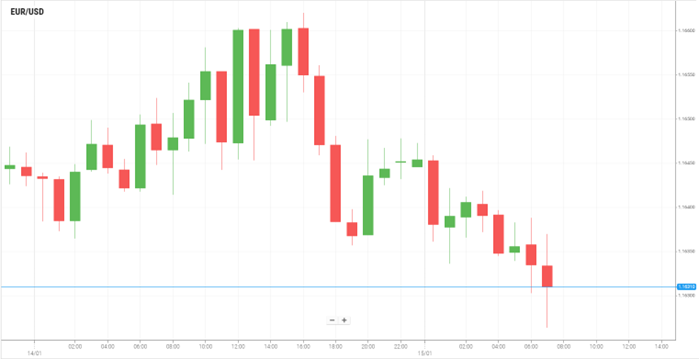
The EUR/USD pair slipped and trading near 1.1640 during Thursday’s Asian session. The pair remains under pressure as the US Dollar strengthens, supported by a series of upbeat US economic indicators that reinforce expectations the Federal Reserve will keep interest rates unchanged in the coming months.
Recent US data surprised to the upside, bolstering the dollar’s appeal. Retail Sales rose by 0.6% in November to $735.9 billion, according to the US Census Bureau, comfortably exceeding market expectations of a 0.4% increase. The rebound followed a revised 0.1% decline in October, signaling resilient consumer demand. In addition, November’s Producer Price Index (PPI) came in stronger than anticipated, with both headline and core inflation rising 3% year-over-year. Combined with last week’s decline in the Unemployment Rate, the data have strengthened the case for a prolonged Fed pause.
Comments from Federal Reserve officials have echoed the data-driven optimism. Minneapolis Fed President Neel Kashkari noted that the US economy continues to show resilience, adding that tariff-related inflationary effects have been more limited than expected. While acknowledging that inflation remains above target, Kashkari emphasized that progress is being made in the right direction.
Meanwhile, the Euro remains subdued despite cautious remarks from European Central Bank officials. ECB Vice President Luis de Guindos warned that current market pricing may underestimate global uncertainty, highlighting geopolitical risks as a significant downside threat to economic growth. Similarly, ECB Governing Council member and Latvian central bank governor Mārtiņš Kazāks said that risks to the outlook remain broadly balanced but stressed that uncertainty remains elevated, including the possibility of non-linear shocks.
Bitcoin extended its recent recovery on Thursday, rising as investors assessed developments surrounding a proposed US bill aimed at establishing a clearer regulatory framework for cryptocurrencies. The world’s largest digital asset has rebounded from a sluggish start to the year, supported in part by renewed institutional interest, though broader risk sentiment in the crypto market remains fragile.
Attention remained focused on Washington after the US Senate Banking Committee announced it had postponed discussions on a proposed cryptocurrency bill.
Senator Tim Scott confirmed via social media that the scheduled discussion had been deferred.
The crypto industry has long advocated for comprehensive regulation to provide clarity on whether digital assets should be classified as securities or commodities, an issue that continues to shape policy debates.
While Bitcoin advanced, broader cryptocurrency markets lagged, reflecting subdued risk appetite amid elevated geopolitical tensions. Investor caution persisted as markets remained alert to potential US actions involving Venezuela and Iran.

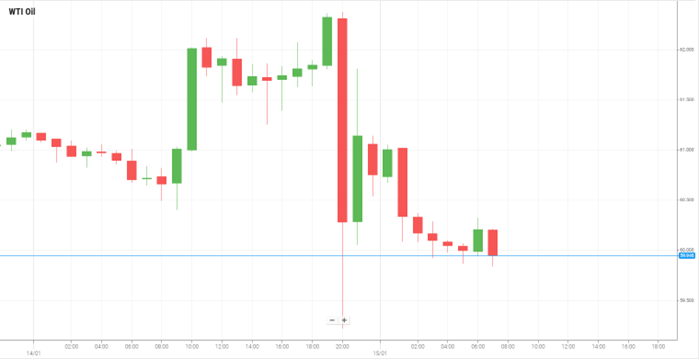
Oil prices fell sharply during Asian trading on Thursday, snapping a five-day rally as comments from US President Donald Trump signaled a more measured approach toward Iran, easing concerns over near-term supply disruptions.
The recent rally had been driven largely by fears that escalating unrest in Iran could prompt US military intervention, potentially disrupting oil production or shipping routes involving one of OPEC’s largest producers.
Market sentiment shifted after President Trump suggested that tensions with Iran may not escalate imminently. Speaking on Wednesday, Trump said he had received assurances that Iranian authorities would halt the killing of protesters and that there were no plans for widespread executions, easing fears of an immediate US response to the unrest.
His remarks helped deflate the geopolitical risk premium that had been built into oil prices amid concerns of supply disruptions linked to Iran.
Oil prices also came under additional pressure after Trump hinted at improving relations with Venezuela, another major oil producer currently under US sanctions. The president said he held a “very positive” conversation with Venezuela’s interim leader, Delcy Rodríguez, noting that discussions covered oil, minerals, trade, and national security.
Beyond geopolitics, bearish inventory data from the United States also weighed on prices. The US Energy Information Administration reported that crude oil stockpiles rose by 3.4 million barrels last week, defying expectations for a 1.7 million-barrel draw.
US equity markets closed lower on Wednesday, marking a second consecutive day of losses, as weakness in technology stocks and underwhelming reactions to major bank earnings weighed on sentiment.
Shares of major US banks struggled despite earnings results that exceeded Wall Street expectations. Bank of America and Citigroup both ended the session more than 3% lower, suggesting investors were unimpressed with forward-looking guidance. Wells Fargo dropped over 4% after reporting quarterly revenue that missed consensus estimates.
JPMorgan Chase, the largest US bank by assets, reported a decline in fourth-quarter profit, partly due to provisions tied to its acquisition of a credit card partnership from Goldman Sachs. The bank also cautioned that President Donald Trump’s proposed cap on credit card interest rates could weigh on profitability across the industry and potentially affect consumer credit availability.
Investor attention also remained fixed on broader political developments surrounding the Federal Reserve. Concerns about the central bank’s independence have intensified following the Trump administration’s decision to launch a criminal investigation into Fed Chair Jerome Powell. Powell has stated that the move was aimed at influencing monetary policy decisions.
Looking ahead, earnings from Goldman Sachs, Morgan Stanley, and asset manager BlackRock are due on Thursday.
The technology sector led market declines after reports that China imposed import restrictions on Nvidia’s H200 chips. Shares of Nvidia and Broadcom fell sharply, dragging the broader chip sector and Nasdaq lower.

The materials contained on this document should not in any way be construed, either explicitly or implicitly, directly or indirectly, as investment advice, recommendation or suggestion of an investment strategy with respect to a financial instrument, in any manner whatsoever. Any indication of past performance or simulated past performance included in this document is not a reliable indicator of future results. For the full disclaimer click here.
Join iFOREX to get an education package and start taking advantage of market opportunities.
 A beginner's e-book
 $5,000 practice demo account
 A 12-part video course
 Trusted partner
 Featured partner
 By
By 


