
Listed on 
 Years active
 English (Arabic)
 Chinese Simplified - 中文 (简体)
 Chinese Traditional - 中文 (繁體)
 English
 Japanese - 日本語
 Korean - 한국어 (대한민국)
 Portuguese - Português
 Russian - Русский
 Spanish - Español
 Thai - ไทย
 English (India)
Don't have an account?
Register via AppHave an account?
Login 23/01/2026 - 08:02 UTC
The US Dollar Index (USDX) is maintaining a stable position around 98.30 during Friday’s Asian session, attempting to find its footing after a 0.51% drop the previous day. Investors are currently recalibrating their expectations as they await the release of the preliminary US S&P Global PMI data later today. While recent economic indicators portray a picture of significant resilience, highlighted by a third-quarter GDP growth rate of 4.4% and a tightening labor market with jobless claims falling to 200,000, inflationary pressures persist. The core Personal Consumption Expenditures (PCE) Price Index reached 2.8% in November, meeting forecasts and keeping the Federal Reserve’s primary inflation metric at the forefront of policy discussions.
Despite these strong economic fundamentals, the Greenback is navigating a complex landscape of geopolitical friction and shifting monetary sentiment. Trade tensions between the US and Europe have caused recent volatility; though immediate tariff threats linked to disagreements over Greenland have eased following a preliminary NATO framework, the lack of specific details keeps markets on edge. Furthermore, reports of a Danish pension fund divesting from US Treasuries have raised concerns about broader European sentiment toward US assets.
On Friday, January 23, 2026, Asian equity markets experienced a broad recovery, supported by a resurgence in the technology sector and a notable easing of geopolitical tensions. Investors reacted positively to news from Davos, where U.S. President Donald Trump moved to de-escalate a week-long crisis over Greenland by scrapping proposed tariffs on European allies and ruling out the use of military force. This "framework" for a new Arctic security deal helped stabilize global sentiment, allowing regional indices like the China SSE (+0.28%) and the China SZSE (+0.64%) to post gains, even as the Hong Kong 50 and Japan 225 saw minor pullbacks of 0.71% and 0.20% respectively following early-week volatility.
Central bank policy also played a pivotal role in the day's session as the Bank of Japan (BOJ) opted to maintain its short-term interest rate at 0.75%. Despite the hold, the BOJ adopted a hawkish tone by upwardly revising its growth and inflation forecasts for fiscal years 2025 and 2026, citing expectations for increased government spending and private consumption. Market participants are now closely monitoring Governor Kazuo Ueda’s guidance for potential rate hikes in the spring, once the results of annual wage negotiations provide a clearer picture of Japan's economic trajectory and the yen's stability.
Wall Street saw a second consecutive day of significant gains on Thursday, driven by a surge in the technology sector and a decrease in geopolitical concerns. Corporate earnings and positive economic data continue to signal a resilient U.S. economy, with GDP growth exceeding expectations and jobless claims remaining lower than forecast. The rally was highlighted by strong moves from several major players with Meta leading the tech sector's climb with a 5.65% surge on Thursday. Analysts reiterated the company as a top pick, pointing toward its strength in AI and a favorable risk-reward profile. Tesla gained 4.15% as investors look forward to the upcoming earnings report next week. Microsoft advanced 1.55% amid the broader tech-driven momentum on Wall Street. Procter & Gamble recovered from earlier losses to close up 0.94%. While its quarterly net sales of $22.21 billion slightly missed consensus estimates, the stock remained resilient by the closing bell.
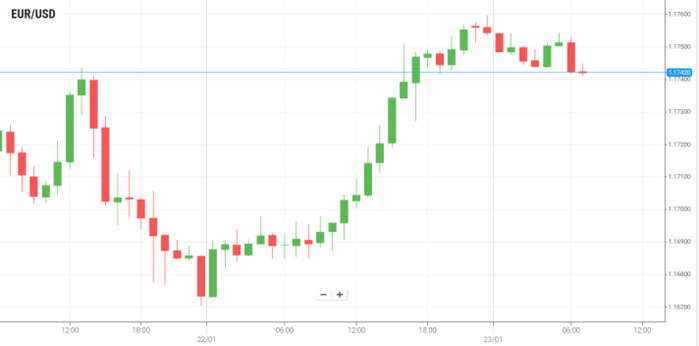
The EUR/USD pair extended its advance for a second consecutive session, climbing more than 0.6% on Thursday as the US Dollar retreated despite the release of solid US economic data. Improved risk sentiment, sparked by US President Donald Trump stepping back from tariff threats against Europe, supported demand for the shared currency.
The Euro’s rally comes even as US macroeconomic indicators remained firm. Wall Street was on track to close the session higher, underpinned by robust third-quarter 2025 GDP growth and resilient labor market data. The stronger data, alongside a steady inflation reading, effectively ruled out the possibility of a Federal Reserve rate cut at its January meeting.
In the Eurozone, the latest European Central Bank (ECB) meeting minutes reinforced confidence that inflation is on track to return to the central bank’s 2% medium-term target. Policymakers broadly agreed that underlying inflation indicators remain consistent with this objective, while acknowledging that economic growth, although resilient, is still vulnerable to geopolitical risks.
Adding to the positive tone for the Euro, reports indicated that European Union officials are planning to revive a previously stalled trade agreement with the United States, with a vote on ratification expected, according to sources cited by Bloomberg.
Looking ahead, traders will monitor HCOB Flash PMI data from France, Germany, and the wider Eurozone, along with remarks from ECB President Christine Lagarde. In the United States, attention will shift to S&P Global Flash PMIs and the final reading of the University of Michigan Consumer Sentiment survey.
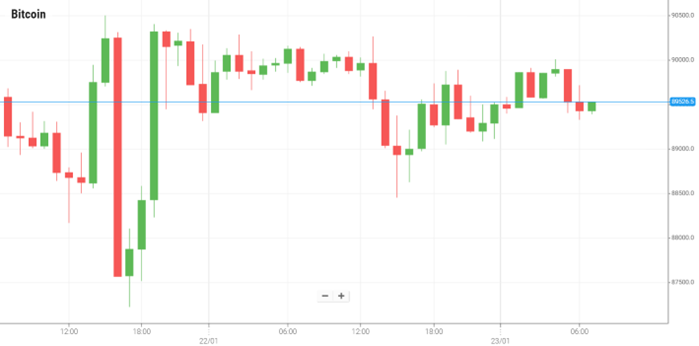
Bitcoin is trading around $89.500 level on Friday, rounding off a weak week as easing geopolitical tensions and a large corporate purchase failed to revive demand for cryptocurrencies. Lingering caution across global markets, combined with renewed geopolitical risks, continued to weigh on sentiment.
During the Asian session, risk appetite remained subdued ahead of a Bank of Japan policy meeting, while comments from US President Donald Trump warning of possible military action against Iran further dampened investor confidence.
Safe-haven assets, including gold and other precious metals, surged to fresh record highs amid rising demand for physical assets, leaving Bitcoin trailing traditional stores of value.
Bitcoin was on track to post a weekly decline of roughly 5%, having reversed earlier gains sparked by a softening in Trump’s rhetoric toward Greenland earlier in the week. Prices drifted back toward one-month lows, highlighting the market’s fragile tone.
The cryptocurrency drew limited support from Strategy Inc, which disclosed a $2.1 billion Bitcoin purchase. While the firm remains the largest corporate holder of Bitcoin, its aggressive accumulation strategy has increasingly become a source of concern for markets, particularly as Bitcoin’s price continues to underperform.
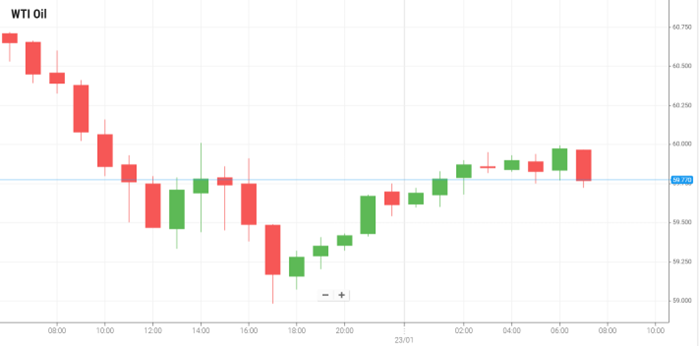
Oil prices edged higher during Asian trading on Friday after US President Donald Trump signaled the possibility of military action against Iran, heightening concerns over potential supply disruptions in the Middle East.
Despite some pullbacks earlier in the week, crude benchmarks were on track for a fifth consecutive weekly gain, supported by expectations of improving global demand and an increased geopolitical risk premium amid elevated global tensions.
Speaking to reporters aboard Air Force One on Thursday, Trump said the United States had naval forces moving toward Iran, warning Tehran against killing protestors or reviving its nuclear program.
Media reports indicated that an aircraft carrier and several destroyers were expected to arrive in the Middle East in the coming days, raising market concerns about renewed military confrontation in the region.
Iran is one of the largest oil producers within the Organization of the Petroleum Exporting Countries (OPEC) and a key supplier to China, the world’s largest oil importer. Any escalation involving US military action could significantly disrupt Iranian oil exports and tighten global supply.
For the week, oil prices were up between 0.6% and 0.8% following volatile trading, as markets also assessed shifting US policy signals related to Greenland. Additional support came from mildly upbeat economic data out of China and the International Energy Agency’s decision to raise its 2026 oil demand forecast. Prices also benefited from bargain hunting after crude’s sharp underperformance in 2025.
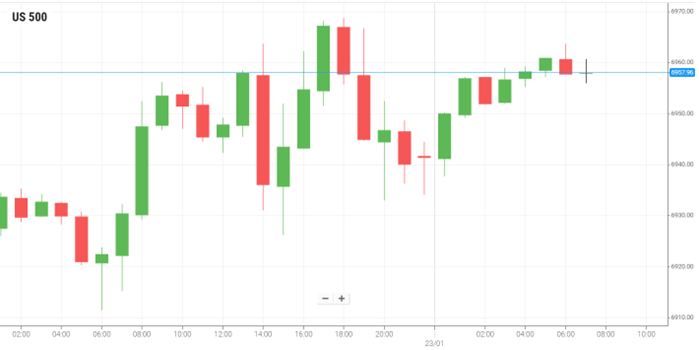
US stocks closed higher on Thursday, marking a second consecutive session of strong gains, as a rally in technology shares—led by Meta Platforms—and easing geopolitical tensions lifted investor sentiment. The major indexes had already rebounded sharply on Wednesday after suffering their steepest decline since October in the prior session, as concerns over geopolitical risks began to fade.
Technology stocks outperformed, with Meta Platforms Inc jumping more than 5% after Jefferies reiterated the stock as a top pick, citing an attractive risk-reward profile and the company’s strength in artificial intelligence. Alibaba shares also moved higher following a Bloomberg report that the Chinese tech giant is planning to list its AI chip unit, T-Head. Elsewhere, Procter & Gamble pared earlier losses to finish higher after posting second-quarter net sales of $22.21 billion, slightly below consensus estimates, while organic revenue growth came in flat.
Overall, earnings released over the past week have pointed to continued corporate resilience amid a still-solid US economic backdrop. The reporting calendar remains heavy next week, with results due from major technology names including Microsoft, Meta Platforms, and Tesla.
The Federal Reserve is scheduled to meet next week, with markets widely expecting policymakers to leave interest rates unchanged, despite renewed pressure from the White House to cut rates.
Recent US economic data has reinforced the view that the economy remains in good shape. Weekly initial jobless claims rose by just 1,000 to 200,000 in the week ended January 17, below forecasts for 210,000, signaling ongoing strength in the labor market. Meanwhile, third-quarter US gross domestic product expanded at an annualized pace of 4.4%, beating expectations and accelerating from the previous quarter’s 3.8% growth rate.
Investors are now turning their attention to November core personal consumption expenditures (PCE) inflation—the Federal Reserve’s preferred inflation gauge—for further clues on the outlook for US interest rates.
The materials contained on this document should not in any way be construed, either explicitly or implicitly, directly or indirectly, as investment advice, recommendation or suggestion of an investment strategy with respect to a financial instrument, in any manner whatsoever. Any indication of past performance or simulated past performance included in this document is not a reliable indicator of future results. For the full disclaimer click here.
Join iFOREX to get an education package and start taking advantage of market opportunities.
 A beginner's e-book
 $5,000 practice demo account
 A 12-part video course
 Trusted partner
 Featured partner
 By
By 


