
Listed on 
 Years active
 English (Arabic)
 Chinese Simplified - 中文 (简体)
 Chinese Traditional - 中文 (繁體)
 English
 Japanese - 日本語
 Korean - 한국어 (대한민국)
 Portuguese - Português
 Russian - Русский
 Spanish - Español
 Thai - ไทย
 English (India)
Don't have an account?
Register via AppHave an account?
Login 10/03/2026 - 08:26 UTC
The USDX fell 0.82% on Monday, retreating from a 15-week high near 99.70 as markets positioned for a heavy cluster of economic data. While the Greenback had gapped higher at the open, driven by its status as an energy-independent safe haven, it ultimately slipped back toward 99.00 by the close. Investors are now bracing for Wednesday’s February CPI report—with headline expectations at 0.3% month-over-month—followed by Friday's Core PCE and preliminary Q4 GDP. These releases will be pivotal in determining whether the Federal Reserve maintains its restrictive 3.50% to 3.75% rate range or shifts toward a more hawkish path should energy-led inflation persist.
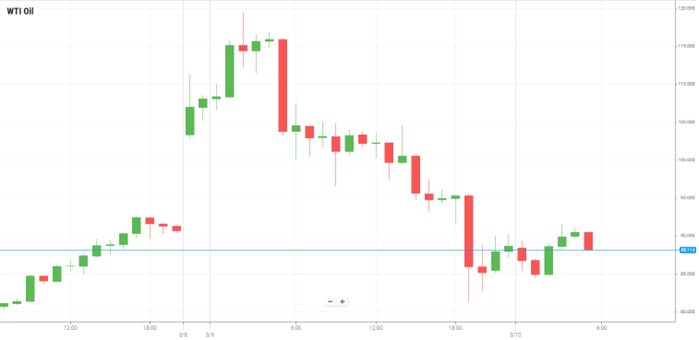
In the energy markets, WTI Oil fell 17.94% on Monday, following a dramatic intraday reversal. After gapping higher to touch $119.48, its highest level since June 2022, prices plummeted toward $88.00 as de-escalation hopes emerged. Despite the sharp retracement, the technical setup remains tilted in favor of the bulls as the closure of the Strait of Hormuz continues to fuel long-term supply concerns. Market participants are closely watching for any coordinated emergency reserve releases from the IEA, though the prevailing "path of least resistance" appears to be higher as geopolitical uncertainty rages on.
Conversely, Gold rose 1.26% on Monday, attracting safe-haven flows after a bounce from the $5,000 psychological level. Although persistent inflation fears and a firming U.S. dollar continue to act as headwinds for the non-yielding metal, Iranian officials' dismissal of quick de-escalation remarks has kept a floor under prices. Spot gold remains in a delicate range below the $5,200 mark, with traders awaiting Wednesday’s CPI figures for fresh impetus. Until there is a clearer signal on the Federal Reserve's next move or a definitive turn in the Middle East conflict, caution remains the watchword for directional bets.
Wall Street witnessed a dramatic "V-shaped" recovery on Monday, as initial deep losses were erased following optimistic geopolitical commentary from the White House. While markets spent the morning under pressure from soaring energy costs and recession fears, sentiment pivoted sharply after President Donald Trump described the operations in the Middle East as "very complete" and ahead of schedule. This shift triggered a massive wave of dip-buying, particularly within the technology sector, as investors reacted to a sudden cooling in crude prices.
The US Tech 100 surged 2.76% on Monday, leading the broader market recovery after rebounding from an early-session deficit of 1.5%. This rally was bolstered by a rotation back into mega-cap growth names, even as companies like Amazon faced scrutiny over reports of AI-linked system outages. Despite the IMF warning that prolonged energy shocks could keep global inflation elevated, the tech-heavy benchmark's performance suggests that traders are once again prioritizing long-term growth as they await Wednesday's crucial CPI data.
The focus for this week will shift to a high-impact cluster of U.S. economic data, headlined by Wednesday's CPI and Friday’s Core PCE reports, as investors gauge whether oil prices are beginning to drive an energy-led inflation spike. Markets will also closely monitor the unemployment claims, JOLTS job openings, and the preliminary GDP revision for signs of stagflationary pressure, especially as the Federal Reserve faces a leadership transition and persistent geopolitical uncertainty in the Middle East.
The EUR/USD pair moved lower during Tuesday’s early Asian trading hours, slipping toward the 1.1620 area as the US Dollar gained support from rising geopolitical tensions in the Middle East.
The Greenback attracted safe-haven demand amid concerns that the conflict in the region could escalate and potentially disrupt global energy supplies, which in turn may pose risks to global economic growth.
Iran’s Islamic Revolutionary Guard Corps (IRGC) stated that Tehran—not the United States—will determine when the conflict ends, warning that continued US and Israeli attacks could lead Iran to block regional oil exports. Meanwhile, US President Donald Trump said late Monday that he intends to waive certain oil-related sanctions and may deploy the US Navy to escort tankers through the Strait of Hormuz. Trump also suggested that the conflict with Iran could be resolved “very soon.”
Ongoing uncertainty and the absence of clear progress toward a diplomatic solution have supported demand for the US Dollar, weighing on the EUR/USD pair.
Higher crude oil prices are also becoming a concern for the Eurozone economy. As Europe relies heavily on imported energy, rising oil costs could fuel inflation while simultaneously slowing economic activity, increasing the risk of stagflation.
Market expectations for European Central Bank policy have also shifted. According to Reuters, traders are now pricing in the possibility that the ECB could implement as many as two 25-basis-point rate hikes this year, whereas earlier forecasts suggested interest rates would remain unchanged through 2026.

Bitcoin moved higher on Monday after a volatile weekend, as broader financial markets reacted to shifting developments in the Middle East and comments from US President Donald Trump suggesting the conflict with Iran could be approaching a resolution.
Bitcoin had closed the previous week in positive territory while many traditional risk assets declined, partly because the digital asset market has less direct exposure to oil price fluctuations. However, the cryptocurrency lost some momentum over the weekend before staging a rebound.
The conflict has now entered its second week with little indication of de-escalation. Iran recently named Mojtaba Khamenei as the successor to Supreme Leader Ali Khamenei, a development that investors interpret as signaling the continuation of the country’s hardline political stance and potentially extended geopolitical tensions.
Bitcoin frequently behaves like a high-beta risk asset during periods of macroeconomic uncertainty, meaning it often declines when investors move away from riskier assets and rises when market sentiment improves. US equities closed sharply higher on Monday following Trump’s comments, supporting the recovery in crypto prices.
Moreover, bitcoin treasury firm Strategy disclosed on Monday that it acquired an additional 17,994 BTC between March 2 and March 8 for approximately $1.28 billion, according to a filing with the US Securities and Exchange Commission.
Following the latest purchase, Strategy’s total Bitcoin holdings increased to 738,731 BTC, currently worth roughly $50 billion.

Oil prices declined early on Tuesday after reaching their highest levels in more than three years during the previous session, as comments from US President Donald Trump suggesting the Middle East conflict could end soon eased concerns about prolonged disruptions to global energy supplies.
Crude prices had surged above the $100 mark on Monday, reaching their highest levels since mid-2022. The rally was driven by fears that escalating military tensions involving the United States, Israel, and Iran could threaten oil shipments, especially as Saudi Arabia and other producers maintained supply curbs.
Market sentiment shifted later in the session after Russian President Vladimir Putin reportedly held a phone conversation with Trump and presented proposals aimed at reaching a swift resolution to the conflict in Iran. The development helped ease fears of a prolonged disruption to global oil flows.
Trump also said in a CBS News interview that the military operation against Iran was “very complete” and progressing much faster than the initial four- to five-week timeline previously suggested by his administration.
Meanwhile, Iran’s Islamic Revolutionary Guard Corps (IRGC) responded to Trump’s remarks by stating that Tehran would ultimately decide when the conflict ends. The group warned that if US and Israeli attacks persist, Iran could prevent any oil exports from the region, according to state media.
Despite these warnings, oil prices remain under pressure amid reports that the Trump administration is considering several measures to ease price spikes. These options reportedly include relaxing sanctions on Russian oil exports and potentially releasing emergency crude supplies from strategic reserves.
The Group of Seven (G7) nations said on Monday they are ready to take “necessary measures” to address rising global oil prices, though they stopped short of announcing any immediate release of emergency reserves.
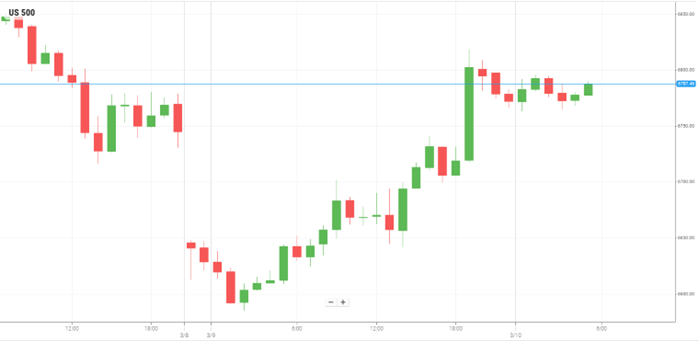
US stocks recovered from earlier losses to close higher on Monday, staging a sharp late-session rebound after President Donald Trump suggested the conflict involving the United States, Israel, and Iran could end sooner than expected.
All three major indexes reversed course in the final hour of trading after Trump said the military campaign was progressing “very far ahead” of the administration’s original four- to five-week timeline.
Earlier in the session, markets were pressured as oil prices surged to their highest levels since mid-2022. The spike was driven by supply concerns linked to shipping disruptions as the conflict with Iran entered its tenth day. Rising energy costs have fueled fears that inflation could accelerate again at a time when many US households are already facing affordability pressures.
At the same time, concerns about economic conditions are growing. Friday’s weaker-than-expected US jobs report, combined with higher energy prices, has raised the risk of stagflation—an environment where slow economic growth coincides with persistent inflation. Such a scenario could complicate the US Federal Reserve’s policy decisions as it tries to balance its goals of stable prices and maximum employment.
Investors are now looking ahead to several important economic reports scheduled later this week. These include the Labor Department’s Consumer Price Index, the Commerce Department’s updated estimate of fourth-quarter GDP, and its Personal Consumption Expenditures report—one of the Federal Reserve’s preferred measures of inflation.
The materials contained on this document should not in any way be construed, either explicitly or implicitly, directly or indirectly, as investment advice, recommendation or suggestion of an investment strategy with respect to a financial instrument, in any manner whatsoever. Any indication of past performance or simulated past performance included in this document is not a reliable indicator of future results. For the full disclaimer click here.
Join iFOREX to get an education package and start taking advantage of market opportunities.
 A beginner's e-book
 $5,000 practice demo account
 A 12-part video course
 Trusted partner
 Featured partner
 By
By 


