
Listed on 
 Years active
 English (Arabic)
 Chinese Simplified - 中文 (简体)
 Chinese Traditional - 中文 (繁體)
 English
 Japanese - 日本語
 Korean - 한국어 (대한민국)
 Portuguese - Português
 Russian - Русский
 Spanish - Español
 Thai - ไทย
 English (India)
Don't have an account?
Register via AppHave an account?
Login 24/07/2026 - 06:48 UTC
The US Dollar Index (USDX) rebounded firmly in its latest trading session, advancing 0.31% to trade above the 101.40 level as resilient economic data and escalating hostilities in the Middle East bolstered demand for the Greenback. A surprisingly tight labor market—highlighted by US Initial Jobless Claims plummeting to 187K, its lowest level since 1969—reinforced expectations that the Federal Reserve could maintain restrictive monetary policy for longer. Soaring energy prices and rising Treasury yields further backed the Dollar’s broad-based strength, alongside safe-haven flows triggered by heightened geopolitical uncertainty.
Gold faced significant downside pressure, slumping 2.09% to settle near the $4,050 mark as a crude oil-led inflation scare bolstered expectations of a more hawkish Federal Reserve stance. Despite persistent safe-haven demand stemming from escalating US-Iran conflict and Red Sea naval blockades, the precious metal retreated from recent highs as money markets began pricing in a 35.8% chance of a Fed rate hike as soon as July. Rising benchmark yields and a firmer US Dollar created a tough backdrop for the non-yielding asset, constraining further bullish momentum.
WTI crude oil extended its dramatic rally, surging 5.07% in its latest session to hold firmly above $90.00 per barrel ($90.20) and locking in a weekly gain exceeding 10%. Intense fears of widespread energy supply disruptions drove the advance as the US initiated its 13th consecutive night of military strikes on Iran and President Trump warned of a "massive attack" in response to Houthi strikes on Saudi oil tankers in the Red Sea. With global shipping rerouting around Africa and the Caspian Pipeline Consortium halting loadings at its Black Sea terminal, severe threats to key maritime chokepoints including the Strait of Hormuz and Bab el-Mandeb kept crude prices sharply bid.
Asian equity markets tumbled into negative territory on Friday, led lower by a steep sell-off across semiconductor and technology heavyweights. South Korea’s tech giants took a heavy beating, with Samsung Electronics plunging over 7% and SK Hynix dropping by more than 6% as regional sentiment was battered by overnight losses on Wall Street and mounting fears over elevated corporate capital expenditures. Japan’s Nikkei 225 also slid over 2.6%, burdened by sharp losses in chip-equipment providers and SoftBank. Region-wide gains were further capped by soaring energy costs and reignited global inflation risks, which prompted traders to brace for prolonged higher interest rates.
Wall Street indexes closed sharply lower on Thursday, dragged down by heavy losses in mega-cap technology stocks following disappointing profit margins and cash flow guidance. Tesla plunged 14.57% and Alphabet sank 6.97% as both companies flagged mounting capital expenditures tied to their aggressive artificial intelligence buildouts, sparking widespread concerns over outsized infrastructure spending. The tech-led sell-off spilled into broader market heavyweights, sending Microsoft down 2.26% and Meta Platforms lower by 3.39%, while the Nasdaq Composite fell more than 2%.
Attention now turns to next week’s key monetary policy decisions and a crucial stretch of corporate earnings reports, with tech giants Microsoft, Meta, Apple, and Amazon set to offer fresh insight into AI monetization, enterprise spending, and global consumer demand. Investors also remain focused on fresh trade headwinds after the Trump administration outlined tariffs ranging from 10% to 12.5% on 60 trading partners, as well as the Federal Reserve’s upcoming policy meeting, where persistent energy-driven inflation risks will weigh heavily on interest rate expectations.
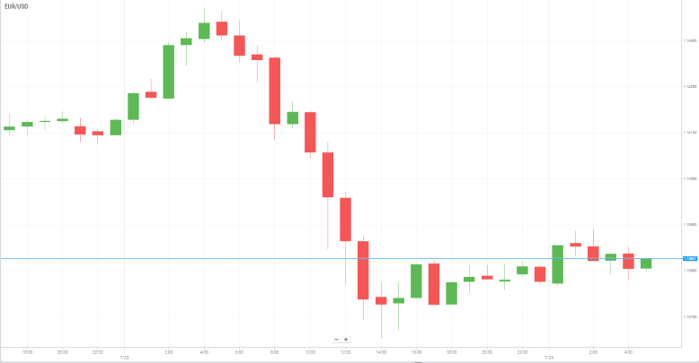
EUR/USD traded slightly higher early on Friday, hovering near the 1.1380 area during the Asian session, as the US Dollar remained under pressure. However, gains in the common currency could remain limited as escalating tensions in the Middle East continue to support oil prices, reinforcing inflation concerns and raising expectations that the Federal Reserve may need to tighten monetary policy further.
Market pricing reflects a growing possibility of additional Fed action, with the CME FedWatch Tool indicating a 35.8% probability of a rate increase at the upcoming meeting and an 82.1% chance of at least one 25-basis-point hike by September.
Geopolitical risks remain elevated after Yemen's Iran-backed Houthi rebels reportedly attacked two Saudi oil tankers in the Red Sea, accusing them of violating a naval blockade. The United States responded with a 13th consecutive night of strikes on Iranian targets, while President Donald Trump warned of severe military retaliation against both Iran and the Houthis if attacks persist, saying he is considering an unprecedented military operation.
Meanwhile, investors digested the European Central Bank's latest policy decision. As widely expected, the ECB left its benchmark interest rates unchanged after raising them by 25 basis points in June. Policymakers reiterated their commitment to returning inflation to the 2% medium-term target but warned that uncertainty remains elevated and that the full inflationary impact of higher energy prices has yet to be reflected in the economy. The deposit facility rate was maintained at 2.25%, while the main refinancing and marginal lending rates remained at 2.40% and 2.65%, respectively.
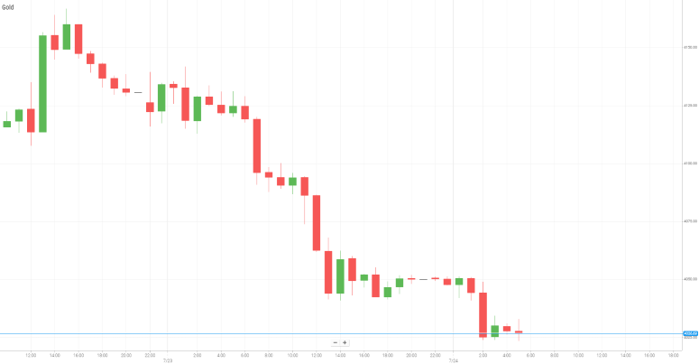
Gold prices extended their decline for a second consecutive session on Friday, slipping below the $4,050 level during Asian trading as rising inflation concerns and a firmer US Dollar continued to dampen demand for the precious metal. Persistent geopolitical tensions in the Middle East have driven crude oil prices higher, reinforcing expectations that the Federal Reserve may keep interest rates elevated or tighten policy further, reducing the appeal of non-yielding assets such as gold.
Geopolitical risks intensified after the US military carried out a 13th consecutive night of strikes on Iranian targets. The conflict has widened across the region, with Iran and its allies reportedly launching retaliatory attacks against US-linked military facilities in Kuwait, Bahrain, and Jordan. Meanwhile, Yemen's Iran-backed Houthi rebels attacked two Saudi oil tankers in the Red Sea, describing the operation as part of a naval blockade. The renewed disruption to key shipping routes has heightened concerns over global energy supplies, pushing crude oil prices to their highest levels since mid-June.
US Initial Jobless Claims fell to their lowest level since September 1969, highlighting the resilience of the labour market and giving policymakers greater room to prioritise inflation over economic growth.
Trade developments also remained in focus after President Donald Trump announced new tariffs ranging from 10% to 12.5% on imports from 60 major US trading partners, covering nearly all US imports. The move has revived concerns over a broader global trade conflict, boosting demand for the US Dollar as a safe-haven asset.
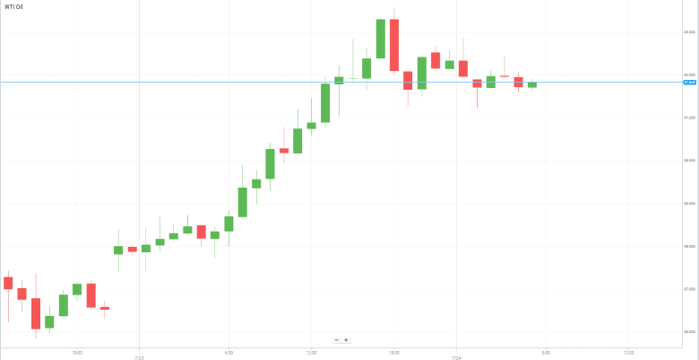
Oil prices edged lower during Friday's Asian session but remained on course to post a third consecutive week of strong gains, as escalating tensions in the Middle East and ongoing supply disruption concerns continued to support the energy market.
Market sentiment continued to be dominated by geopolitical developments after Yemen's Iran-backed Houthi rebels attacked Saudi oil tankers in the Red Sea, intensifying concerns over global energy supplies. The strikes targeted vessels passing through the Bab el-Mandeb Strait, adding another key shipping route to the growing list of regional flashpoints.
The latest incident comes as military exchanges between the United States and Iran continue for a second consecutive week, while uncertainty surrounding traffic through the Strait of Hormuz has further heightened fears of supply disruptions. President Donald Trump warned of severe military retaliation against both Iran and the Houthis following the attacks, while reports indicated that Iran had rejected a US-backed ceasefire proposal, reducing hopes for a diplomatic breakthrough.
The Houthis' attacks have increased pressure on Saudi Arabia's export routes after the kingdom had relied on the Bab el-Mandeb corridor to mitigate risks associated with the Strait of Hormuz. As a result, concerns over disruptions to Middle Eastern oil shipments have intensified, contributing to expectations of tighter global crude supplies during July.
The sustained rise in oil prices has also reinforced fears of renewed inflationary pressures, increasing the likelihood that major central banks could maintain restrictive monetary policies for longer. Investors continue to monitor geopolitical developments closely, as further escalation in the region could keep energy markets well supported despite Friday's modest pullback.
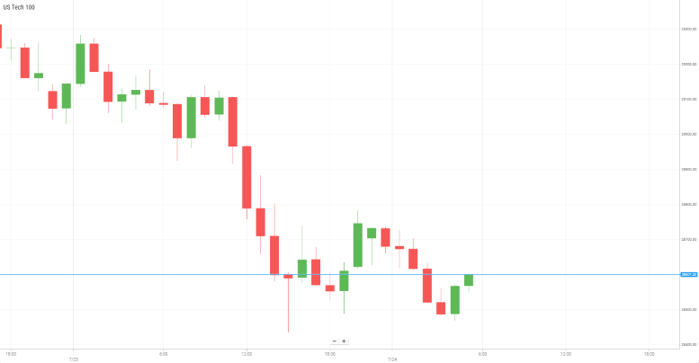
US equities closed sharply lower on Thursday as disappointing investor reactions to earnings from Alphabet and Tesla, combined with rising oil prices and renewed geopolitical tensions, triggered broad selling across major indices.
Investor sentiment remained fragile as Brent crude climbed above $100 per barrel for the first time since May, driven by escalating conflict in the Middle East. Higher energy prices renewed inflation concerns and reinforced expectations that the Federal Reserve could keep interest rates elevated for longer.
Despite the broader market weakness, economic data highlighted the resilience of the US economy. Initial Jobless Claims fell to their lowest level since 1969, suggesting that labour market conditions remain strong and giving policymakers greater flexibility to focus on inflation risks.
Technology shares led the decline after quarterly results from Alphabet and Tesla failed to reassure investors over the massive spending required to support future AI growth. Alphabet shares fell more than 7%, while Tesla plunged 14.57%, making them among the worst-performing stocks on Nasdaq. Investors remained concerned that soaring AI-related spending, rising operating costs, and pressure on cash flows may delay meaningful returns on these investments.
Outside the technology sector, earnings provided some support. Defense contractors RTX and Lockheed Martin advanced after both raised their full-year guidance, benefiting from increased defense spending linked to the Middle East conflict. Honeywell also gained after reporting strong order growth and an expanding backlog. In contrast, T-Mobile US declined sharply after weaker-than-expected quarterly revenue and softer subscriber growth.
Attention now turns to Intel's quarterly earnings, with investors looking for signs that the chipmaker is making progress in narrowing the gap with competitors benefiting from the rapid expansion of artificial intelligence infrastructure.
The materials contained on this document should not in any way be construed, either explicitly or implicitly, directly or indirectly, as investment advice, recommendation or suggestion of an investment strategy with respect to a financial instrument, in any manner whatsoever. Any indication of past performance or simulated past performance included in this document is not a reliable indicator of future results. For the full disclaimer click here.
Join iFOREX to get an education package and start taking advantage of market opportunities.
 A beginner's e-book
 $5,000 practice demo account
 A 12-part video course
 Trusted partner
 Featured partner
 By
By 


