
Listed on 
 Years active
 English (Arabic)
 Chinese Simplified - 中文 (简体)
 Chinese Traditional - 中文 (繁體)
 English
 Japanese - 日本語
 Korean - 한국어 (대한민국)
 Portuguese - Português
 Russian - Русский
 Spanish - Español
 Thai - ไทย
 English (India)
Don't have an account?
Register via AppHave an account?
Login 21/05/2026 - 07:32 UTC
The USDX eased -0.17% on Thursday, experiencing a mild corrective slide as global financial markets reacted to mixed signals regarding international diplomacy. The index hovered around 99.10 during trading hours as market participants weighed optimistic remarks from U.S. President Donald Trump, who characterized negotiations with Iran as being in their "final stages," against a firm pledge to resume military actions within days if terms are rejected. The Greenback's downside remained heavily insulated by a hawkish tone in the newly released FOMC meeting minutes. A majority of Federal Reserve officials warned that policy firming and an interest rate hike later this year would likely become appropriate if inflation continues to run persistently above the 2% target, especially given the upside price risks driven by prolonged regional disruptions.
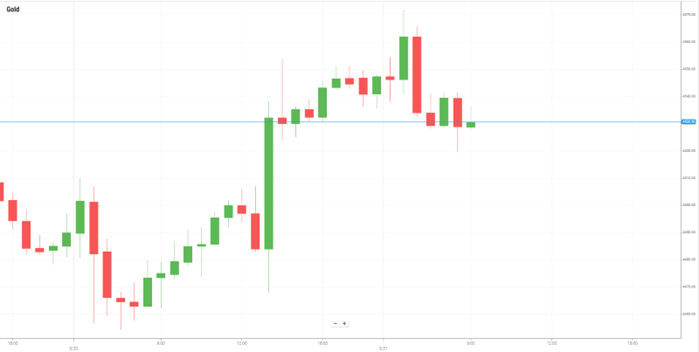
Gold climbed 1.28% on Thursday, staging an recovery to trade near the $4,571 area. The non-yielding bullion capitalized on the slight pullback in the U.S. Dollar, drawing additional support from persistent underlying skepticism over whether a comprehensive diplomatic agreement can actually be reached. Despite optimistic comments from U.S. officials, Iranian President Masoud Pezeshkian emphasized on social media that attempting to force a surrender through coercion is an illusion, while Tehran concurrently launched a new "Persian Gulf Strait Authority" to control traffic through the strategic waterway. This lingering geopolitical friction cushioned the downside for the precious metal, helping it withstand the broader structural headwind of rising Fed rate-hike bets, which now stand at an estimated probability of over 50% for the year.
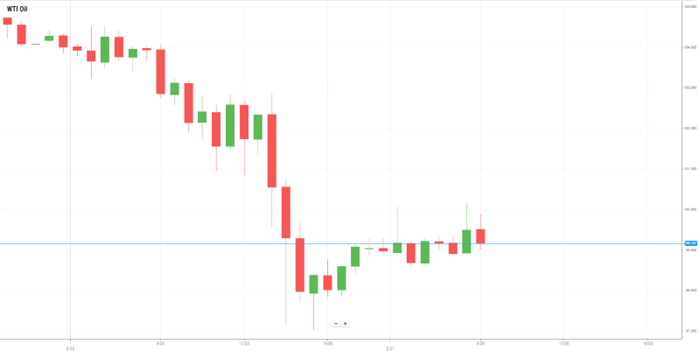
WTI Oil plunged -4.83% on Thursday, drifting sharply lower to trade near $98.20 per barrel as supply-side anxieties were significantly alleviated by the sudden optimism surrounding the U.S.-Iran peace talks. Energy traders aggressively unwound risk premiums on hopes that a diplomatic breakthrough would soon allow blocked crude supplies to flow freely out of the critical Strait of Hormuz. This massive sell-off completely overshadowed a highly bullish physical demand indicator from the Energy Information Administration (EIA). The official report revealed that U.S. commercial crude oil inventories fell sharply by 7.864 million barrels for the week ending May 15—vastly exceeding the market consensus of a 2.9 million-barrel draw—confirming that domestic demand remains highly elevated even as geopolitical risk premiums compress.
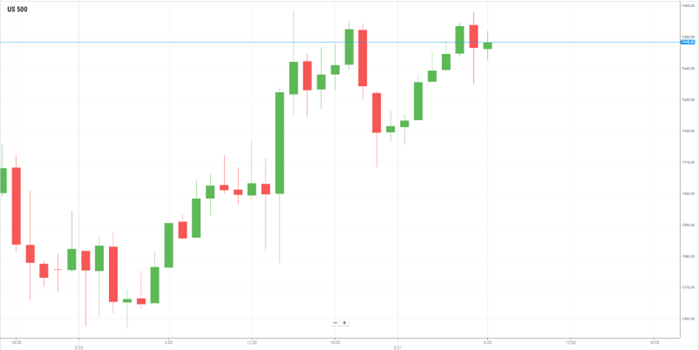
Most equity indices rallied sharply on Thursday as upbeat quarterly results and optimistic revenue guidance from AI bellwether Nvidia reignited robust demand for technology shares. Prior to the highly anticipated announcement, Nvidia shares had dipped -0.7% as market participants cautiously locked in profits; however, the actual results reinforced firm investor confidence in the sustainability of global artificial intelligence and data center infrastructure spending.
In regional market developments, mainland Chinese indices notably lagged behind their regional peers as investors maintained a cautious posture regarding the property sector and the pace of near-term policy support from Beijing. Consequently, the China SSE traded flat, while the China SZSE declined. Bucking the broader regional tech surge, the Hong Kong 50 also finished on the back foot. Conversely, Japanese equities posted powerful gains, with both the Nikkei 225 and the broader TOPIX index rising. This rally unfolded even as a raft of fresh economic indicators painted a mixed picture of the domestic recovery; while April exports rose strongly, flash PMI data showed manufacturing growth slowing slightly amid softer external demand, and the services sector slipped back into contraction.
On the corporate front, the main US equity indices provided a positive lead-in after ending higher on Wednesday, though US stock index futures moved flatly during Asian hours. The absolute standout of the session was South Korea, where market sentiment soared after a last-minute tentative wage agreement successfully averted an impending 18-day strike involving 48,000 workers, entirely removing fears of immediate semiconductor supply chain bottlenecks. Driven by this domestic breakthrough and riding the coattails of the global AI chip rebound, Samsung Electronics skyrocketed +8.52% in its latest trading session, while rival memory chipmaker SK Hynix surged an astonishing +10.53%.
The euro traded in a narrow range above the 1.1600 mark during Thursday’s early Asian session, with EUR/USD hovering near 1.1625 as investors weighed renewed geopolitical tensions and a more hawkish outlook from the US Federal Reserve.
Market sentiment remained cautious after US President Donald Trump said negotiations with Iran were entering their final phase, while warning that military action could follow if an agreement is not reached. In response, Iranian President Masoud Pezeshkian rejected suggestions that Tehran was prepared to concede, warning that any strikes would trigger retaliation extending beyond the Middle East.
Rising uncertainty surrounding US-Iran relations supported demand for safe-haven assets, underpinning the US Dollar and limiting upside momentum for the euro.
The greenback also drew support from the Federal Reserve’s latest policy signals. Minutes from the Fed’s April meeting, released Wednesday, showed that several policymakers believe further interest rate increases may be required if inflation remains stubbornly above the central bank’s 2% target.
Investors are now awaiting the release of preliminary May Purchasing Managers’ Index (PMI) data from the Eurozone, Germany, and the United States later on Thursday for further direction on global economic activity.
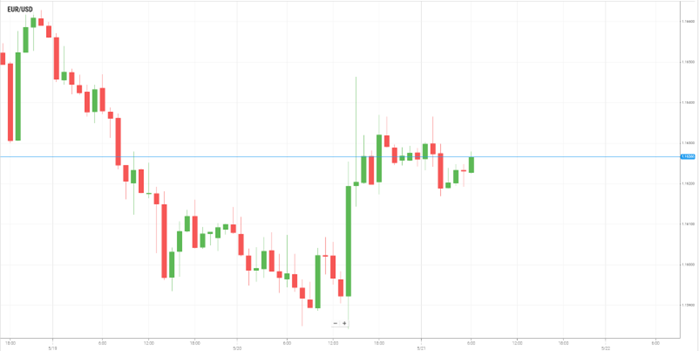
Gold prices edged lower early on Thursday as the US Dollar remained supported by persistent geopolitical tensions and expectations that the Federal Reserve could keep interest rates higher for longer.
The decline came as investors reacted to the Federal Reserve’s latest meeting minutes, which reinforced expectations for tighter monetary policy.
Minutes from the Fed’s April 28–29 meeting showed that most policymakers believe additional policy tightening may be necessary if inflation continues to remain above the central bank’s 2% target. Officials also highlighted upside risks to inflation and warned that ongoing conflict in the Middle East could complicate the future policy outlook.
The hawkish tone helped keep the US Dollar near a six-week high, reducing demand for non-yielding assets such as gold.
However, losses in bullion were limited as traders remained cautious amid uncertainty surrounding negotiations between the United States and Iran. US President Donald Trump said discussions with Tehran had entered the “final stages,” while Vice President JD Vance also expressed optimism that Iran was willing to reach an agreement. The comments initially improved market sentiment and weighed on the dollar, offering temporary support to gold prices.
Ongoing tensions in the Middle East continue to support safe-haven demand, helping to prevent a sharper decline in gold prices even as the stronger dollar caps broader upside momentum.
Oil prices moved higher during Thursday’s Asian trading session as geopolitical tensions in the Middle East continued to support concerns over global supply disruptions.
The gains followed comments from US President Donald Trump, who said Washington was prepared to launch strikes against Iran if negotiations over a peace agreement fail.
At the same time, Trump indicated that the US was willing to delay further military action for several days, citing ongoing diplomatic discussions with Tehran. Iranian state media also reported that officials were reviewing Washington’s latest response to Iran’s peace proposal, adding to mixed signals surrounding the conflict.
Oil markets recovered after suffering two consecutive sessions of losses, with prices having dropped sharply on Wednesday after earlier indications of progress in US-Iran negotiations raised hopes for de-escalation. However, Trump later warned that the situation remained “right on the borderline,” reviving fears of renewed conflict and potential supply disruptions.
The Strait of Hormuz remains a major focal point for energy markets, as roughly 20% of global oil supplies pass through the channel. Although reports indicated that two Chinese oil tankers successfully crossed the strait on Wednesday, overall shipping activity remains well below normal levels, sustaining concerns over restricted supply flows.
Additional support for oil prices came from the latest US inventory data, which showed a much larger-than-expected drawdown in crude stockpiles. According to figures released Wednesday, US crude inventories fell by 7.9 million barrels in the week ending May 15, significantly exceeding market expectations for a 2.9 million-barrel decline.
US stocks rallied on Wednesday as investors looked ahead to highly anticipated quarterly results from AI chip giant Nvidia, while easing Treasury yields and renewed optimism surrounding US-Iran negotiations also boosted market sentiment.
Investor focus remained firmly on Nvidia’s earnings release after the closing bell, with markets viewing the results as a key test for the broader artificial intelligence trade that has powered Wall Street’s rally over the past several years.
Since the rapid expansion of AI technologies in late 2022, Nvidia has become the dominant supplier of advanced graphics processing units (GPUs) used in artificial intelligence systems. The company’s market value has surged to more than $5 trillion, making its earnings reports among the most closely watched events on Wall Street.
Federal Reserve meeting minutes released Wednesday reinforced the view that policymakers remain concerned about inflation. Minutes from the Fed’s April meeting showed that a majority of officials believe further interest rate increases could become necessary if inflation remains persistently above the central bank’s 2% target.
Recent economic data has highlighted the inflationary impact of higher oil prices, with both consumer and producer price growth accelerating in recent months. Markets currently expect the Fed to keep rates unchanged through most of this year, although expectations for possible tightening later in the year have increased.
Attention also remained on developments in the Middle East after President Donald Trump said the US was in the “final stages” of negotiations with Iran. Reports suggesting potential diplomatic progress helped improve investor sentiment and pushed oil prices lower during the session. Trump also stated earlier this week that he had delayed additional military action against Iran following requests from Gulf nations.
Among individual stocks, Target fell 3.9% despite reporting better-than-expected quarterly earnings and raising its full-year sales outlook, as investors focused on warnings about rising costs and tougher comparisons ahead.
The materials contained on this document should not in any way be construed, either explicitly or implicitly, directly or indirectly, as investment advice, recommendation or suggestion of an investment strategy with respect to a financial instrument, in any manner whatsoever. Any indication of past performance or simulated past performance included in this document is not a reliable indicator of future results. For the full disclaimer click here.
Join iFOREX to get an education package and start taking advantage of market opportunities.
 A beginner's e-book
 $5,000 practice demo account
 A 12-part video course
 Trusted partner
 Featured partner
 By
By 


