
Listed on 
 Years active
 English (Arabic)
 Chinese Simplified - 中文 (简体)
 Chinese Traditional - 中文 (繁體)
 English
 Japanese - 日本語
 Korean - 한국어 (대한민국)
 Portuguese - Português
 Russian - Русский
 Spanish - Español
 Thai - ไทย
 English (India)
Don't have an account?
Register via AppHave an account?
Login 17/06/2026 - 12:33 UTC
Optimism surrounding a breakthrough US-Iran peace deal has sent shockwaves through the financial markets, driving a massive collapse in crude prices while leaving currency and precious metals traders on edge. On Tuesday, crude oil plunged sharply, with WTI settling down 6.03% as investors reacted to US President Donald Trump’s announcement regarding the reopening of the strategically vital Strait of Hormuz. Although a 60-day ceasefire framework and plans for a formal signing in Switzerland on Friday have significantly unwound the geopolitical risk premiums that previously drove energy prices higher, analysts warn that extensive damage to Middle East energy infrastructure could prevent a prolonged downfall.
The dramatic de-escalation in the Middle East simultaneously sapped safe-haven demand for the greenback, causing the US Dollar Index (DXY) to slip 0.09% on Tuesday to trade near the 99.50 mark. Despite the downward pressure from the peace deal, aggressive selling of the USD was held in check due to conflicting reports over the specific terms of the agreement, including a disputed $300 billion private investment fund. This underlying skepticism, combined with caution ahead of a major central bank event, prevented a deeper selloff as currency markets braced for the impending interest rate decision.
Amid this shifting macroeconomic backdrop, gold managed to tick up by 0.35% on Tuesday, holding comfortably above the $4,300 threshold. While the weakening US dollar provided a modest tailwind for the bullion, the precious metal remained largely range-bound and below its recent weekly highs as investors chose not to place aggressive directional bets. Market participants are tightly focused on the Federal Reserve's policy announcement, where the central bank is widely anticipated to hold interest rates steady between 3.50% and 3.75%, leaving gold traders eagerly awaiting the updated dot plot projections and incoming Fed Chair Kevin Warsh's press conference for clues on the future inflation path.
U.S. stock index futures posted early gains on Wednesday as Wall Street braced for the conclusion of the highly anticipated Federal Reserve policy meeting. Market sentiment was simultaneously supported by an impending geopolitical milestone, as the United States and Iran prepare to officially sign a peace framework in Switzerland. While the broader market displayed signs of a rotation out of the high-flying technology sector and into economically sensitive value plays, all eyes remain fixed on the central bank's policy announcement. The Federal Open Market Committee is universally expected to leave its benchmark interest rate unchanged, maintaining a steady target range as it monitors the long-term economic ripple effects of recent energy price shocks. A highly resilient domestic labor market has provided the Fed with ample breathing room to sustain its current restrictive stance without triggering immediate panic over an economic slowdown.
The primary significance of today's meeting lies heavily in its presentation, marking the first monetary policy decision presided over by newly appointed Fed Chair Kevin Warsh. Investors are eagerly looking past the stagnant rate decision to scrutinize the central bank's updated Summary of Economic Projections and the closely watched "dot plot." Analysts will parse these forecasts to see if sticky inflation has prompted officials to completely strip away their previous rate-cutting bias in favor of a neutral or hawkish policy path for the remainder of the year. Furthermore, Warsh’s debut press conference will be heavily dissected for clues regarding his personal communication style, his stance on central bank independence, and how the new leadership intends to balance persistent domestic price pressures against a shifting global landscape.
In corporate news, SpaceX continued its historic post-IPO surge, rising roughly 50% from its initial offering price in just four trading sessions to close at $201.80 on Tuesday. This explosive rally gave the aerospace company an implied market capitalization of approximately $2.65 trillion, allowing it to surpass Amazon's valuation and briefly leapfrog Microsoft to become one of the world's most valuable companies. The unprecedented market debut has significantly reshuffled global wealth rankings, propelling CEO Elon Musk back to the top spot as the world's richest person by an expanding margin.
Following the recent policy decisions out of Australia and Japan, global investor attention is shifting toward a fresh slate of macroeconomic data. The primary focus centers on upcoming UK data, which highlights a 25.8K increase in the Claimant Count Change alongside the Bank of England's latest monetary policy decisions. The Monetary Policy Committee (MPC) voted 1-0-8 to maintain the Official Bank Rate at 3.75%, indicating a heavy majority in favor of keeping borrowing costs unchanged, with only one member dissenting.
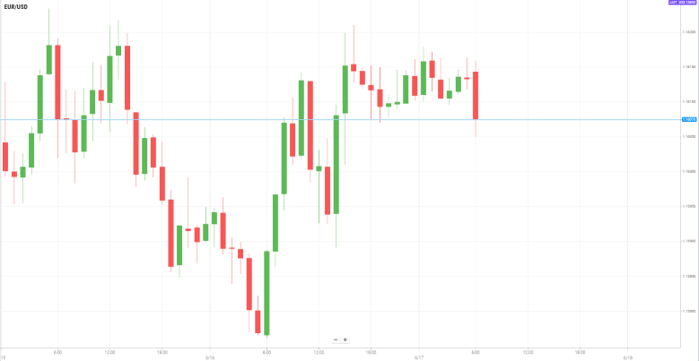
The EUR/USD pair continues to trade with a constructive bias for the third consecutive session, holding firmly above the 1.1600 level during Wednesday’s Asian trading hours. However, bullish momentum remains cautious as traders await the outcome of the Federal Reserve’s two-day FOMC policy meeting.
The US Dollar remains under pressure amid growing optimism surrounding a potential interim peace agreement between the United States and Iran, reducing demand for safe-haven assets and providing support for EUR/USD. At the same time, the Euro continues to benefit from the European Central Bank’s relatively hawkish stance after delivering its first interest-rate hike in three years. The ECB has also raised its 2026 inflation forecast to 3% amid persistent energy-related pressures and broader price increases across the euro area.
Market participants are still pricing in around 40 basis points of additional ECB rate increases in 2026, even as geopolitical tensions in the Middle East show signs of easing. The US and Iran have reportedly agreed on a preliminary framework aimed at ending the conflict that began earlier in 2026.
Despite the softer tone surrounding the Dollar, expectations that the Federal Reserve could deliver another 25-basis-point rate hike in December are preventing aggressive USD selling and limiting further gains in EUR/USD. As a result, traders are closely watching the Fed’s interest-rate decision, updated economic forecasts, and the latest dot plot for clues about future monetary policy.
Attention will also turn to comments from incoming Fed Chair Kevin Warsh during the post-meeting press conference, as markets seek guidance on the central bank’s outlook for interest rates and the broader direction of US monetary policy.
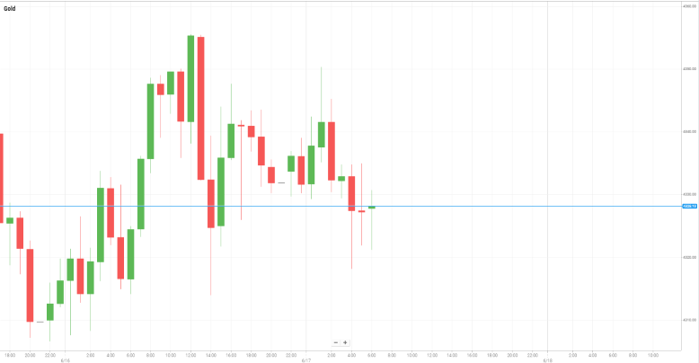
Gold continues to trade with a subdued tone heading into Wednesday’s European session, although the precious metal remains supported above the $4,300 level as selling pressure lacks momentum.
Recent optimism surrounding a potential interim peace agreement between the United States and Iran has weighed on demand for the safe-haven US Dollar, providing some support for Gold. However, uncertainty remains as conflicting reports have emerged over the agreement’s details.
The Fed is widely expected to keep interest rates unchanged at its upcoming meeting, while markets are watching for signs that policymakers may reduce their previous easing bias as inflation remains more persistent than expected. The updated economic projections, particularly the central bank’s dot plot, will be closely examined for clues about the future rate path.
Investors will also focus on comments from new Fed Chair Kevin Warsh during the post-meeting press conference for further guidance on monetary policy. Meanwhile, markets have started unwinding some of the extreme inflation concerns and hawkish Fed expectations that emerged during the US-Iran conflict.
Despite this shift, traders continue to price in roughly a 60% probability of a 25-basis-point Fed rate hike in December. A more dovish signal from the central bank may be required before traders increase bearish bets on the US Dollar and position for a stronger recovery in Gold from last week’s year-to-date low.
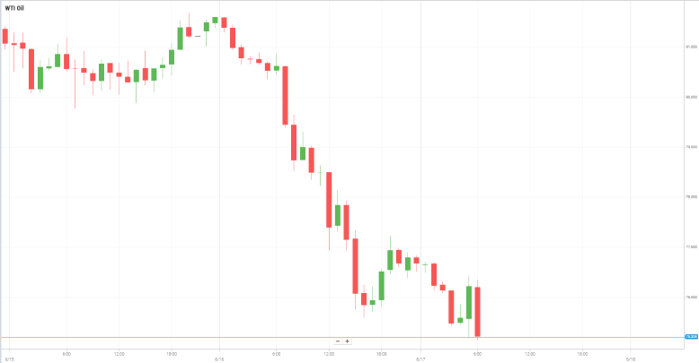
Oil prices extended their decline on Wednesday as investors continued to evaluate the implications of the emerging US-Iran peace agreement. However, uncertainty surrounding the full restoration of shipping activity through the Strait of Hormuz limited further losses and kept traders cautious.
Both benchmarks dropped nearly 5% for a second consecutive session on Tuesday, reaching three-month lows as hopes grew that a diplomatic breakthrough could help restore oil flows through the strategically important waterway.
Under the proposed agreement, the United States would ease restrictions on Iranian ports, while Tehran would allow oil tanker movement through the Strait, which had been effectively disrupted following US and Israeli strikes on February 28. The development has encouraged selling pressure in crude markets, although traders remain reluctant to extend positions until more details of the deal become available. The Strait of Hormuz remains a key focus for energy markets, as approximately one-fifth of global crude oil and liquefied natural gas supplies previously passed through the route before disruptions occurred.
Despite the diplomatic progress, industry participants warn that a complete recovery in Iranian oil production and refining capacity could take weeks, months, or even longer. Additional uncertainty remains due to Israel’s cautious stance toward both the previous ceasefire and the latest US-Iran agreement.
On the supply side, the latest American Petroleum Institute (API) report indicated that US crude inventories declined by 8.3 million barrels in the week ending June 12, exceeding expectations for a 4.6 million-barrel draw. Traders now await official inventory data from the Energy Information Administration (EIA) for further direction.
With geopolitical uncertainty easing but supply risks unresolved, crude prices are likely to remain volatile as markets balance expectations of increased Iranian exports against the pace of any recovery in global oil flows.
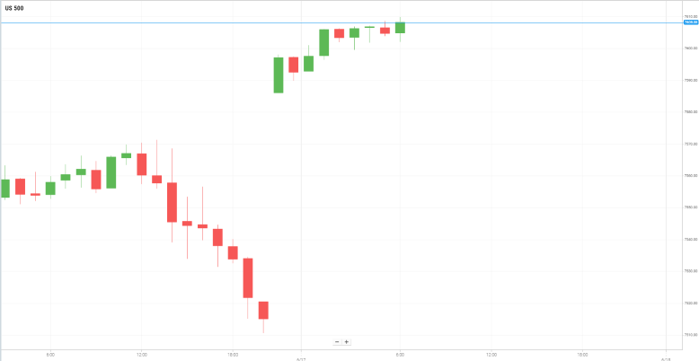
US equities closed mixed on Tuesday as the initial optimism surrounding the US-Iran interim peace agreement faded, with investors adopting a more cautious approach while awaiting further details on the deal.
The Federal Reserve’s meeting marks the first policy gathering under new Chair Kevin Warsh. The central bank is widely expected to keep interest rates unchanged while releasing updated economic projections that could provide fresh insight into the future direction of monetary policy.
Technology and energy stocks were among the weakest-performing sectors within the US 500 as investors rotated away from high-growth technology shares and declining oil prices weighed on energy companies. Meanwhile, financials, industrials, and real estate stocks showed strength, reflecting confidence in economic resilience and easing inflation pressures.
Attention now turns to the Federal Reserve’s policy announcement, with markets expecting interest rates to remain unchanged. Investors will focus on updated economic forecasts and comments from Chair Kevin Warsh for clues about the central bank’s future approach.
Among individual stocks, attention remained focused on SpaceX following its strong market debut. After gaining nearly 19% on its first trading day, the company’s shares rose almost 20% on Monday and added another 4.8% on Tuesday.
The rally pushed SpaceX’s market value close to $3 trillion, briefly allowing it to surpass major technology companies such as Amazon and Microsoft in market capitalization rankings.
The company also drew attention after reports that it agreed to acquire an AI coding startup for $60 billion and allocated additional funds toward debt repayment, using a significant portion of the capital raised from its recent listing.
The materials contained on this document should not in any way be construed, either explicitly or implicitly, directly or indirectly, as investment advice, recommendation or suggestion of an investment strategy with respect to a financial instrument, in any manner whatsoever. Any indication of past performance or simulated past performance included in this document is not a reliable indicator of future results. For the full disclaimer click here.
Join iFOREX to get an education package and start taking advantage of market opportunities.
 A beginner's e-book
 $5,000 practice demo account
 A 12-part video course
 Trusted partner
 Featured partner
 By
By 


