
Listed on 
 Years active
 English (Arabic)
 Chinese Simplified - 中文 (简体)
 Chinese Traditional - 中文 (繁體)
 English
 Japanese - 日本語
 Korean - 한국어 (대한민국)
 Portuguese - Português
 Russian - Русский
 Spanish - Español
 Thai - ไทย
 English (India)
Don't have an account?
Register via AppHave an account?
Login 15/06/2026 - 13:55 UTC

The week ahead – 15th June 2026
With earnings season more or less over the market’s attention has now shifted to the SpaceX IPO, as well as what it might mean for IPOs from the likes of Anthropic and OpenAI, against the continued backdrop of events in the Middle East.
The recent sharp selloff in the Nasdaq and S&P500 earlier this month, shows that investors are a little trigger happy when it comes to current valuations, and are alive to the fact that the market is vulnerable to a sharp correction.

That said the buy the dip mentality is still just about there, however, it is becoming vulnerable to the idea that central banks may be forced to hike rates if inflation expectations start to become embedded into the wider economic picture. This is particularly important given that, under the stewardship of new Fed chair Kevin Warsh, the US central bank could adopt a different tack with respect to monetary policy as he looks to make his mark when it comes to monetary policy in his first meeting as head.

Ordinarily a by-election wouldn’t be of much interest to financial markets, however this particular by-election is different, as it could signal an attempt by the Labour party to spend even more. This is because the Labour candidate, and ex-Manchester mayor Andy Burnham, if he wins, looks set to challenge Keir Starmer for leadership of the Labour Party, and ergo for the position of Prime Minister. Given his recent comments about being in hock to the bond markets, his winning of the seat could prompt a sell-off in the gilt market as investors fret about the prospect of what might happen when it comes to future government spending commitments. Bond markets have already shown that they are nervous about the low calibre of many Labour MPs, when it comes to economic literacy, and any indication that a new Chancellor of the Exchequer might look to relax further the so-called “fiscal rules” is unlikely to be well received by the markets, and could worsen the outlook for the UK’s fiscal position further.
There was some modest relief in the recent April inflation numbers when headline price pressures slowed from 3.3% to 2.8%, largely due to a reduction in the energy price cap, which offered some relief to consumers at a time when price pressures are increasing elsewhere. It’s also somewhat cold comfort given that people tend to cut down on energy usage during the spring and summer months anyway due to warmer temperatures.

This slowdown is also set to reverse when the cap is raised again in July. We also saw food inflation slip back from 3.7% to 3% as increased competition from supermarkets helped to cushion the blow on hard pressed consumers. Unfortunately, all of these trends look set to be relatively short lived if you look at the recent PPI numbers for the same month, and which tend to act as leading indicators for the broader inflation outlook. Here we saw input prices surge by 7.7%, the highest in over 3 years, while output prices also jumped sharply, while recent PMI data has shown similar trends which suggest that headline inflation could jump above last year’s peak of 3.8% as we head into the summer months.
With the ECB raising its own headline rate by 0.25% at this month’s meeting markets are now starting to price the likelihood of the Federal Reserve being forced to follow suit by the end of the year after headline inflation in the US rose to 4.2% to the highest level in 3 years. Given that this is new Fed chair Kevin Warsh’s first meeting in charge of the US central bank and that his appointment was predicated on the expectation he would be looking to persuade his new colleagues to look at cutting rates the timing couldn’t be worse. The recent US jobs data would appear to suggest that the recent slowdown in hiring has come to an end with the last 3 months seeing jobs added at their fastest rate since the end of 2024. Vacancy rates have also shown signs of picking up meaning that as far as the Fed’s employment mandate is concerned there is less reason to worry about than there was at the end of last year. This shift means that price pressures will have a much greater focus and it is here that the US economy appears to be starting to hum, with ISM prices paid numbers showing significant signs of elevated price pressures. While no change in policy is expected, Warsh could make changes to the Fed’s communication policy, perhaps by shelving the dot plots, which he’s on the record as saying he’s not a fan of. He could also introduce more introspection as to how Fed policymakers deliver forward guidance.

At the last meeting there were also splits over the removal of the easing bias in the recent statement. Will those dissenters get their wish and see that easing bias removed, and if it is, could we see an upward shift in yields? While Warsh will be keen to make his mark as Chair, he also needs to be mindful that there is a risk in making wholesale changes to the FOMC’s comms strategy given the current uncertain geopolitical backdrop. Sometimes change needs to be done slowly given how markets have become used to the current guidance regime which for all its faults does help anchor long term interest rate expectations.
Having slipped from 5.2% to 4.9% earlier this year a number of Labour MPs were taking a victory lap, ignoring the inconvenient fact that the reason unemployment slowed was down to a matching 0.3% increase in the economic inactivity rate which rose from 20.7% to 21%, (rising to at least 8m people) while the number of workers on payrolls dropped by 11k in March, with job vacancies dropping to their lowest levels in 5 years for the period encompassing Q1. This slowdown in the headline rate didn’t last long, edging back to 5% in March, while vacancies fell to 705k, the lowest level in 12 years. Wage growth also slowed with the gap between private and public sector at 1.8% with private sector pay rising at 3%, and now negative in real terms. The bigger question going forward is how much worse could this get when it comes to headline unemployment with many employers continuing to cite higher costs, due to the workers’ rights act, along with higher minimum wages as further reasons to cut back on hiring expectations. It is these trends along with concerns about second and third round effects on inflation that is likely to concentrate minds on the MPC with some members already arguing that a rate hike might start to become necessary if inflation starts to become embedded in consumer inflation expectations.
We’re already starting to hear briefings from some MPC members that a rate hike might become necessary in the event consumer inflation expectations start to become embedded. We already know that the Bank of England chief economist Huw Pill leans towards the hawkish camp, and while he has been a lone voice more recently, external MPC member Megan Greene has started to break cover by arguing that a rate hike may become necessary if second round effects start to become evident, given that the current crisis is ongoing and as such at some point the effects of events will eventually trickle down into input prices, and by definition into wages, which could then force companies to raise prices. Greene also argues that because inflation has been above target for most of the last 6 years there is a greater chance that it becomes more difficult to squeeze out. Her view is that the longer the current crisis continues the more likely the central bank will have to hike. While this is currently a minority view there’s every chance that could change in the coming months especially if the government continues down its current path of economic illiteracy.
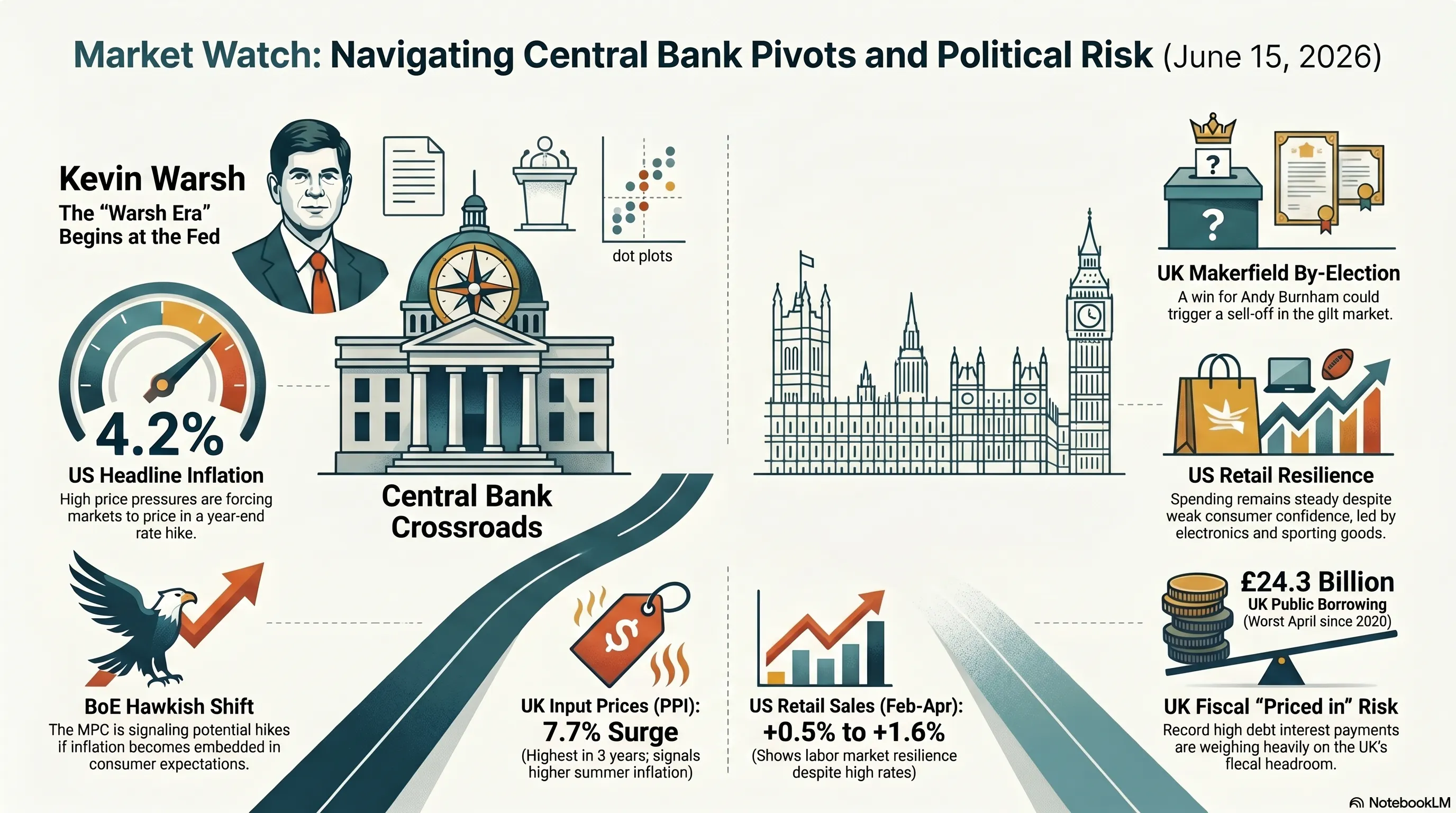
US retail sales have held up reasonably well in the last few months, despite consumer confidence levels that have been by and large quite weak. The resilience of the labour market over the last few months may well have had a part to play in that resilience with retail sales since February seeing gains of 0.9%, 1.6% and 0.5% respectively. With the football World Cup starting in June, there is a possibility that we might see May retail sales slow further, ahead of a rebound as the games get underway. One of the more notable takeaways in recent retail sales numbers, aside from the choppiness in gasoline sales, has been the resilience in sporting goods and hobby stores, along with electronic retailers. On the downside furniture sales were weak, along with clothing sales. Are these trends that can be sustained or could we see spending patterns flip as the warmer weather prompts an increase in outdoor spending habits as the summer gets underway. .

The April set of public sector borrowing numbers were both ugly in the extreme, highlighting the parlous state of the UK public finances, as well as the UK consumer. In April public sector borrowing rose by 25% to £24.3bn, and was the worst monthly number since September 2020. The number was driven higher by a £2.7bn increase in social benefits, while debt interest payments hit a record high of £10.3bn, with rising political risks cited as one reason for the big surge in this area. This risk premium is unlikely to diminish in the weeks and months ahead, and is expected to continue to weigh on the borrowing numbers for the foreseeable future, with the risk that the Chancellors fiscal headroom could disappear again as we look towards the next budget in October or November. Consumer spending also saw a sharp slowdown in April, sliding at the fastest rate since May last year, by -1.3%, caused mainly by a slump in fuel sales as motorists used their cars less, although some of this was a mechanical counter reaction which saw April fuel sales surge as motorists rushed to fill up to beat price increases. Even without the fuel factor however demand was still weak with retail sales still seeing a -0.4% decline, with sales at non-food stores hit especially hard, with clothing sales sliding -2.4%. As we look to the upcoming May numbers, we could well see a modest recovery from the gloom in April, due to the two Bank Holidays during the month, as well as the warm weather, as well as half term break, that prompted consumers to go out and spend.
After years of markets being driven primarily by earnings, technology stocks, and AI enthusiasm, macroeconomic factors are back in focus. Investors are increasingly concerned that persistent inflation could force central banks to maintain higher interest rates for longer—or even raise them further.
The week ahead features several critical events that could shape market expectations, including UK inflation data, the Federal Reserve's rate decision under new Chair Kevin Warsh, the Bank of England's policy meeting, and key UK fiscal and consumer spending figures.
Rising producer prices, resilient labour markets, and growing concerns about inflation becoming embedded in consumer expectations are prompting markets to reassess the likelihood of future rate cuts. As a result, bond yields, currencies, and equity markets could all experience increased volatility.
For investors, understanding inflation trends and central bank responses may once again become the most important factor driving asset prices.
What does "The Return of Macro" mean?
It refers to a market environment where inflation, interest rates, economic growth, and central bank policies become the primary drivers of asset prices rather than company-specific factors.
Why is inflation important for investors?
Inflation affects consumer spending, business costs, bond yields, interest rates, and corporate profits, making it one of the most influential economic indicators.
Why is the UK CPI release important?
The Consumer Price Index measures inflation. Higher-than-expected inflation could increase expectations that the Bank of England may maintain or raise interest rates.
What should investors watch from the Federal Reserve meeting?
Investors will focus on interest rate guidance, inflation forecasts, and any communication changes introduced by new Fed Chair Kevin Warsh.
Could the Bank of England raise rates again?
While no immediate rate hike is expected, policymakers have increasingly suggested that persistent inflation could require tighter monetary policy.
This material (whether or not it states any opinions) is for general information purposes only and does not take into account your personal circumstances or objectives. Nothing in this material is (or should be considered to be) financial, investment or other advice on which reliance should be placed. The material has not been prepared in accordance with legal requirements designed to promote the independence of investment research.
![Bank of America [1:1]](/fihservices/ZyEOC68jQArTz_WH_money-business-close-up-cash-bank-silver-604844-pxhere.jpg?auto=format,compress "Bank of America [1:1]")
The materials contained on this document should not in any way be construed, either explicitly or implicitly, directly or indirectly, as investment advice, recommendation or suggestion of an investment strategy with respect to a financial instrument, in any manner whatsoever. Any indication of past performance or simulated past performance included in this document is not a reliable indicator of future results. For the full disclaimer click here.
Join iFOREX to get an education package and start taking advantage of market opportunities.
 A beginner's e-book
 $5,000 practice demo account
 A 12-part video course
 Trusted partner
 Featured partner
 By
By 


