
Listed on 
 Years active
 English (Arabic)
 Chinese Simplified - 中文 (简体)
 Chinese Traditional - 中文 (繁體)
 English
 Japanese - 日本語
 Korean - 한국어 (대한민국)
 Portuguese - Português
 Russian - Русский
 Spanish - Español
 Thai - ไทย
 English (India)
Don't have an account?
Register via AppHave an account?
Login 14/07/2026 - 07:00 UTC
The US Dollar Index (USDX) extended its gains to hover around 101.25, building on a 0.24% increase for the Greenback. This upward momentum was reinforced by hawkish comments from Federal Reserve Governor Christopher Waller, which paired with intense safe-haven demand as geopolitical conflicts in the Middle East escalated. Fierce military confrontations—highlighted by US Central Command striking over 300 targets and retaliatory Iranian missile strikes on Gulf bases—have crippled regional diplomacy and severely disrupted transit through the vital Strait of Hormuz chokepoint, forcing shipping companies to rapidly reassess their security protocols.
This sudden threat to global energy supplies sent shockwaves through the commodities pit, driving West Texas Intermediate Crude Oil prices surging 7.04% on the day. The spike has forcefully revived energy-fueled inflation concerns, complicating the policy path for central banks and prompting traders to price in a nearly 90% chance of an additional Federal Reserve interest rate hike before the year ends. Conversely, the compounding pressure of a stronger Greenback and elevated Treasury yields hammered non-yielding assets, causing Gold to slide -2.04% to trade just above the $4,030 level as capital rotated out of precious metals and into yield-bearing US dollar reserves.
Asian equities retreated sharply, led by a steep selloff in South Korean shares, as the escalating Middle East crisis sent energy costs higher and dampened investor appetite for risk, particularly across the high-valuation technology sector. In South Korea, where the broader index has struggled to find a footing, semiconductor heavyweights bore the brunt of the selling, with Samsung Electronics dropping 3.50% and SK Hynix falling 3.75% as investors rushed to trim exposure to foreign-listed tech assets.
A similar risk-off sentiment swept through Western trading sessions, where high-profile technology and aerospace giants faced notable liquidation pressure. NVIDIA slid -3.46% and SpaceX dropped -4.26% in their latest trading sessions, reflecting broader anxieties that higher-for-longer borrowing costs will curb capital expenditure on next-generation computing and aerospace hardware. Bucking the downward trend, Apple managed a slight gain of 0.71%, offering a rare pocket of resilience for defensive tech investors.
Looking ahead, global financial markets face a major dual catalyst of top-tier economic data and high-profile monetary policy testimony. The US inflation landscape will be heavily micro-analyzed with Tuesday's release of the Consumer Price Index (CPI)—where headline CPI is projected at 4.2% year-over-year and core CPI is expected at 0.2% month-over-month—followed immediately by the Producer Price Index (PPI) metrics on Wednesday and critical UK GDP data.
Market volatility is bound to spike mid-week as central bankers take center stage; newly appointed Federal Reserve Chairman Kevin Warsh will deliver his highly anticipated first official congressional testimony, while Bank of England Governor Andrew Bailey is scheduled to speak, with both leaders expected to clarify the global interest rate outlook amid stubborn inflationary pressures. Simultaneously, the upcoming week unofficially kicks off the corporate earnings season, shifting Wall Street's focus toward the financial health of the banking sector. Institutional heavyweights including JPMorgan, Bank of America, Goldman Sachs, Wells Fargo, and Citigroup are all scheduled to report their quarterly results, with investors intensely analyzing executive commentary regarding loan-loss provisions, consumer credit health, and net interest margins.
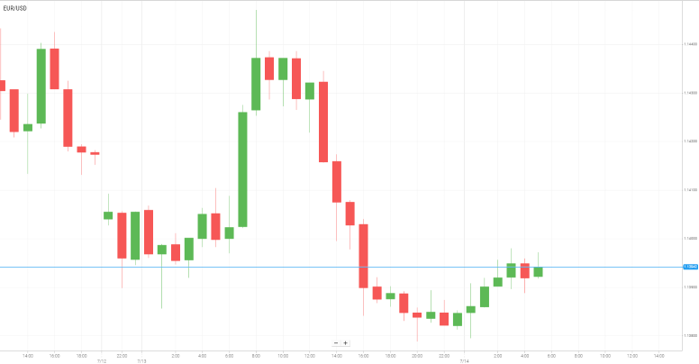
The euro traded modestly higher against the US dollar during Tuesday's Asian session, with EUR/USD hovering around 1.1385 as investors awaited the release of the US June Consumer Price Index (CPI) report later in the day.
Despite the pair's gains, upside momentum remained constrained by rising geopolitical risks. US President Donald Trump announced on Monday that Washington would reinstate its blockade of Iranian maritime traffic and impose a 20% toll on cargo vessels transiting the Strait of Hormuz.
The US military also resumed strikes on Iranian targets, including Bandar Abbas and the islands of Qeshm and Kish. Iran retaliated by attacking two UAE tankers, Mombasa and Al Bahiyah. The renewed conflict has increased demand for safe-haven assets, lending support to the US dollar and limiting EUR/USD's advance.
Market participants are now focused on the US CPI report, which could provide fresh clues about the Federal Reserve's policy outlook. A weaker-than-expected inflation reading would likely reinforce expectations for a more accommodative Fed, weighing on the US dollar and offering additional support to the euro.
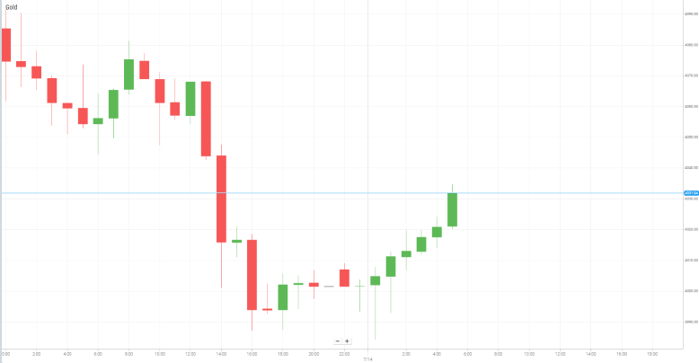
Gold prices slipped below the $4,000 mark in early Asian trading on Tuesday as investors reacted to renewed geopolitical tensions in the Middle East while awaiting key US inflation data.
The precious metal remained under pressure after US President Donald Trump announced the reinstatement of a blockade targeting Iranian vessels transiting the Strait of Hormuz.
The move has raised concerns that Tehran could retaliate by escalating attacks on commercial shipping in the region, potentially disrupting global energy supplies. Such risks could fuel inflationary pressures, reinforcing expectations that the Federal Reserve will keep interest rates elevated for longer. While gold typically benefits from geopolitical uncertainty as a safe-haven asset, higher interest rates reduce its appeal because it does not generate yield.
Market attention now turns to the release of the US June Consumer Price Index (CPI) later on Tuesday, alongside testimony from Federal Reserve Chair Kevin Warsh. Economists expect headline CPI to decline by 0.1% month-on-month in June, while core CPI is forecast to rise by 0.3%.
A weaker-than-expected inflation reading could weigh on the US dollar and provide near-term support for gold prices by strengthening demand for the dollar-denominated precious metal. Conversely, firmer inflation data may reinforce expectations of a prolonged higher-rate environment, adding further pressure to gold.
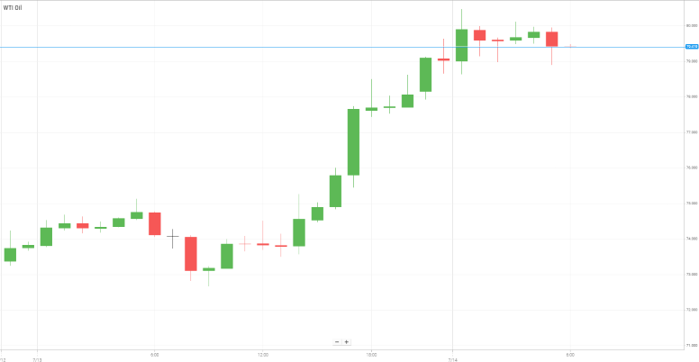
Oil prices rechead their highest levels in four weeks as renewed military tensions between the United States and Iran heightened concerns over potential disruptions to global energy supplies through the Strait of Hormuz.
The rally followed the United States' decision to reinstate its naval blockade of Iranian shipping after carrying out a third consecutive night of strikes against Iran. US President Donald Trump also proposed imposing a 20% fee on vessels using the Strait of Hormuz, a key global oil transit route.
Adding to market concerns, two United Arab Emirates oil tankers were struck by Iranian cruise missiles in Omani territorial waters, leaving one crew member dead and eight others injured, according to the UAE Ministry of Defence. Shipping data also showed tanker traffic through the Strait of Hormuz fell to its lowest level in two months.
Market participants are closely monitoring crude shipments through the strategic waterway. Analysts warn that any sustained disruption to tanker movements or export flows could drive oil prices significantly higher. However, if shipments continue despite the military escalation, some of the current geopolitical premium may gradually ease.
Regional tensions intensified further after Yemen's Houthi movement launched missiles toward Saudi Arabia, accusing the kingdom of carrying out airstrikes on an airport under Houthi control.
Meanwhile, investors are also awaiting the latest US inventory data. Preliminary market estimates suggest US crude oil stockpiles declined last week, while gasoline and distillate inventories are expected to have increased, offering additional clues on demand and supply conditions in the world's largest oil consumer.
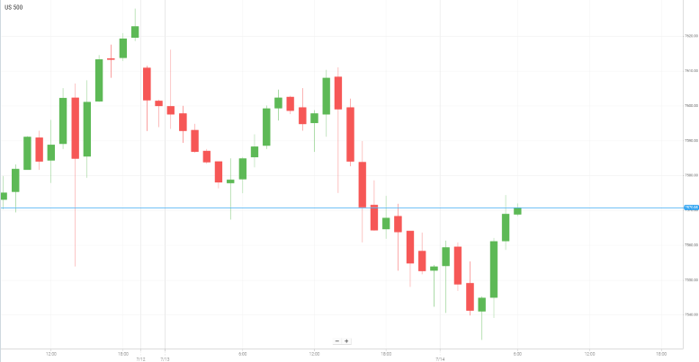
US stock index futures traded lower on Monday as escalating tensions between Washington and Tehran over the Strait of Hormuz weighed on investor sentiment, while markets also turned their attention to a busy week of corporate earnings and key inflation data.
US 500, US Tech 100 and US 30 edged lower following a weak session on Wall Street, where technology shares—particularly semiconductor stocks—led the declines amid growing concerns over stretched valuations driven by the artificial intelligence rally.
Investor caution intensified after the US military launched another round of strikes against Iranian targets, marking a third consecutive day of attacks. The escalation came after President Donald Trump reinstated a naval blockade on Iranian shipping and announced that vessels using the Strait of Hormuz would be required to pay a 20% fee for US protection.
Markets are now awaiting the official start of the second-quarter earnings season, with several major US banks—including JPMorgan Chase, Bank of America, Goldman Sachs, Wells Fargo and Citigroup—scheduled to report on Tuesday. Investors will be watching closely for signs of how corporate profits have held up amid heightened economic and geopolitical uncertainty.
Attention will also be on the release of the June US Consumer Price Index (CPI), a key inflation gauge expected to influence expectations for Federal Reserve policy.
The materials contained on this document should not in any way be construed, either explicitly or implicitly, directly or indirectly, as investment advice, recommendation or suggestion of an investment strategy with respect to a financial instrument, in any manner whatsoever. Any indication of past performance or simulated past performance included in this document is not a reliable indicator of future results. For the full disclaimer click here.
Join iFOREX to get an education package and start taking advantage of market opportunities.
 A beginner's e-book
 $5,000 practice demo account
 A 12-part video course
 Trusted partner
 Featured partner
 By
By 


