
Listed on 
 Years active
 English (Arabic)
 Chinese Simplified - 中文 (简体)
 Chinese Traditional - 中文 (繁體)
 English
 Japanese - 日本語
 Korean - 한국어 (대한민국)
 Portuguese - Português
 Russian - Русский
 Spanish - Español
 Thai - ไทย
 English (India)
Don't have an account?
Register via AppHave an account?
Login 25/06/2026 - 07:58 UTC
Global financial markets faced notable pressure on Wednesday as commodities fell sharply alongside a marginal uptick of 0.19% in the US Dollar Index (USDX). Gold dropped 2.12%, pushing the precious metal below the $4,000 psychological milestone and forcing it down to its lowest level since November 2025. This marked the third consecutive day of losses for gold, heavily driven by receding inflation fears and a broader global tech stock sell-off that shifted investors toward cash. Meanwhile, West Texas Intermediate (WTI) crude oil plummeted 3.68% on Wednesday, extending a multi-day slide as traders aggressively unloaded their futures positions ahead of an impending flood of Middle Eastern supply.
The primary catalyst for this massive commodity sell-off is a major geopolitical breakthrough between the United States and Iran, which has vastly improved the global energy outlook. The formal reopening of the critical Strait of Hormuz has already restored normal shipping traffic, with roughly 20 million barrels of oil clearing the strait in a single 24-hour window, including three previously stranded tankers that finally departed on Wednesday. Furthermore, a temporary 60-day US sanctions waiver authorizing the production and sale of Iranian petroleum has pushed oil prices down toward pre-war levels. This sudden influx of actual and anticipated crude supply has effectively alleviated upstream inflationary pressures.
Despite the recent dip in energy costs, market participants remain highly focused on the upcoming US Personal Consumption Expenditures (PCE) price index data. While the drop in oil prices has lowered US Treasury bond yields and capped major gains for the US Dollar, it has provided little relief to gold. Investors are staying cautious because core inflation is still projected to rise, and headline annual inflation is expected to hit a three-year high of 4%. Because of these underlying pressures and a resilient labor market, the market is still pricing in a strong probability that the Federal Reserve will raise interest rates later this year, keeping the broader negative outlook intact for non-yielding assets like gold.
European equities opened positively for the first time this week on Thursday, as a sharp retreat in crude oil prices to levels seen before the recent Middle East conflict soothed inflation anxieties. This drop prompted investors to pare back bets on aggressive interest rate hikes by the European Central Bank (ECB) following its 25-basis-point increase earlier this month. The swift decline in Brent crude, effectively erased the geopolitical risk premium and led money markets to rapidly re-evaluate the central bank’s tightening trajectory.
While the drop in energy costs injected broader optimism into the region, the slide simultaneously acted as a major drag on commodity heavyweights. London’s FTSE bucked the positive opening trend, pressured heavily by energy giants BP, which fell 0.65%, and Shell, which slid 0.36%. Because the broader European market features a heavy concentration of energy giants whose share prices trade in lockstep with crude, continued oil weakness threatens to create downward pressure that could cap upside potential for the Euro Stoxx 50, even as it attempts to maintain its current momentum at 6,214.70.
The semiconductor sector was particularly energized overnight by stellar earnings from U.S. chipmaker Micron Technology, which effectively soothed valuation anxieties. This sparked a strong regional rally led by ASML, which gained 3.66%, and Infineon, which jumped 6.52%, as investors eagerly shifted capital back into growth sectors.
In other news, Micron Technology (MU) delivered an exceptionally strong earnings report for the quarter ended May 2026, significantly beating Wall Street expectations despite finishing 0.43% lower on Wednesday. Revenue skyrocketed 345.7% year-over-year to $41.46 billion, outperforming the Zacks Consensus Estimate by 12.91%, while earnings per share surged to $25.11, posting a 17.39% positive surprise. This dramatic growth was driven by triple-digit, cross-segment demand that comfortably cleared analyst estimates. DRAM revenue led the pack at $31.33 billion (up 343.1%), comfortably beating the $27.23 billion forecast. Meanwhile, NAND revenue jumped 361.4% to $9.94 billion against the $7.81 billion projection, and other technologies, primarily NOR, surged 146.7% to $185 million, well ahead of the anticipated $89 million.
Moving forward, investors are preparing for the final Q1 Gross Domestic Product (GDP) reading and the Core Personal Consumption Expenditures (PCE) Price Index. This key inflation metric will be heavily scrutinized to gauge the future trajectory of monetary policy under Federal Reserve Chair Kevin Warsh.
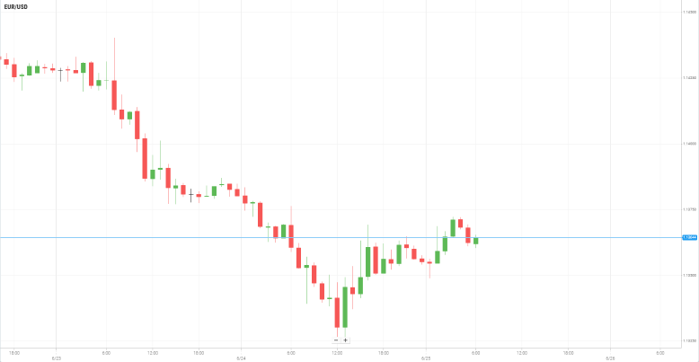
Τhe EUR/USD pair fell to around 1.1355 during early Asian trading on Thursday, with the euro weakening to its lowest level since June 2025 against the US dollar. The decline came as traders increased expectations for potential Federal Reserve rate hikes later this year, while markets awaited the release of the US Personal Consumption Expenditures (PCE) inflation report for May.
Market participants have raised their expectations for further Fed tightening after new Fed Chair Kevin Warsh indicated that controlling inflation remains a priority, with the US economy showing signs of resilience. According to the CME FedWatch tool, traders are now pricing in a 34.2% chance of a 25-basis-point rate hike at the July meeting, up sharply from 8.5% a week earlier.
Investors will closely watch Thursday’s US PCE Price Index data for further clues on the Fed’s policy outlook. The headline PCE inflation rate is forecast to rise 4.1% year-over-year in May, compared with 3.8% in April. Core PCE inflation, which excludes food and energy costs, is expected to increase to 3.4% year-over-year from 3.3% in the previous month.
Meanwhile, easing tensions between the US and Iran have contributed to lower oil prices, raising expectations that the European Central Bank (ECB) could adopt a more cautious stance on monetary policy. This shift could weigh on the euro in the near term.
Earlier this month, the ECB raised its key interest rates by 25 basis points despite signs of slowing economic growth, as policymakers sought to counter inflation pressures linked to the surge in oil prices caused by the Iran conflict.
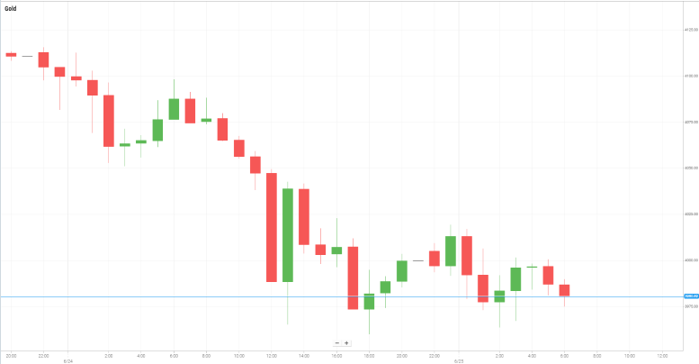
Gold prices extended their decline during early Asian trading on Thursday, falling to around $3,970 and breaking below the key $4,000 psychological level for the first time since November 2025. The precious metal came under pressure as expectations of higher US interest rates strengthened, boosting the US dollar and reducing demand for non-yielding assets like gold.
Traders have increased their bets on Federal Reserve rate hikes this year following the Fed’s more hawkish signals at its June policy meeting. Concerns over persistent inflation risks linked to the Iran conflict have also supported expectations for tighter monetary policy. Although gold is often viewed as a hedge against inflation, higher interest rates tend to weigh on the metal because it does not generate interest income.
Investors are now turning their attention to Thursday’s release of the US May Personal Consumption Expenditures (PCE) Price Index, the Federal Reserve’s preferred inflation gauge.
A softer-than-expected inflation reading could weaken the US dollar and offer some relief to dollar-denominated commodities, potentially providing support for gold prices. However, stronger inflation data could further strengthen expectations for Fed tightening and keep pressure on the precious metal.
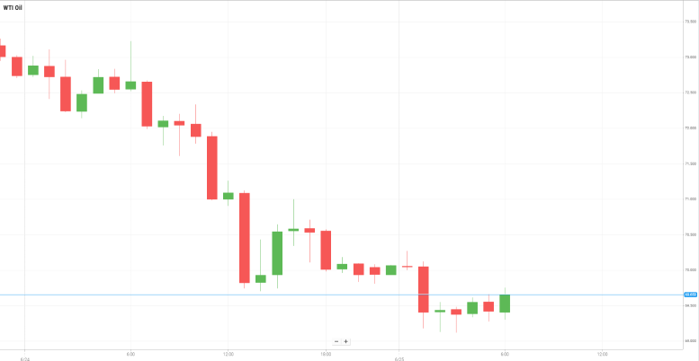
Oil prices continued to fall on Thursday, approaching levels seen before the start of the Iran conflict, as expectations of increased Middle Eastern supply outweighed concerns over global demand.
Oil prices had already fallen more than $3 on Wednesday as supply concerns eased, with WTI also closing nearly $3 lower. Markets have increasingly focused on the reopening of key supply routes and the return of regional crude flows.
US Energy Secretary Chris Wright said Wednesday that oil shipments through the Strait of Hormuz had nearly returned to pre-war levels, with at least 20 million barrels passing through the strategic waterway over the previous 24 hours. He added that a full return to normal operations could take several weeks due to ongoing demining efforts in the strait. Additional Middle Eastern supply, along with expectations that Iran could increase exports following a temporary easing of US sanctions, has pressured physical crude markets worldwide.
An initial agreement last week to end the US-Israeli conflict with Iran, which began on February 28, has allowed tanker traffic through the Strait of Hormuz to resume. The agreement established a 60-day negotiation period focused on broader issues, including Iran’s nuclear programme.
Authorities have continued efforts to restore normal shipping activity. Oman opened temporary routes to facilitate tanker departures from the Strait of Hormuz, while discussions involving Oman, Iran, Iraq, and Gulf states focused on future management of the strategic passage.
Despite US crude inventories falling to their lowest level since 1984 last week, according to the Energy Information Administration (EIA), markets largely overlooked the data as traders remained focused on developments surrounding the Strait of Hormuz and the outlook for Middle Eastern supply.
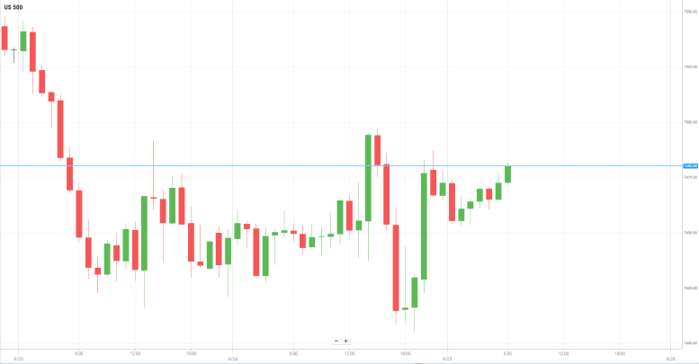
Wall Street attempted to recover on Wednesday following the sharp sell-off in memory and semiconductor stocks during the previous session, but the rebound lost momentum as investors remained cautious ahead of key earnings from Micron Technology. The technology sector continued to weigh on broader markets as traders reassessed valuations in artificial intelligence-related stocks.
Asian semiconductor stocks showed signs of recovery on Wednesday. Shares of Samsung Electronics surged nearly 10% following reports that the company was considering a large-scale share buyback program.
Investors had recently increased expectations for Fed rate hikes following a more hawkish shift from the central bank. However, the rapid decline in crude prices has led markets to scale back those expectations, putting downward pressure on Treasury yields.
Among individual movers, Verizon Communications shares fell 2.17% after it was announced that the company would be removed from the Dow Jones Industrial Average and replaced by Alphabet Inc.. The change is scheduled to take effect on June 29.
Meanwhile, Cerebras Systems shares dropped more than 19.5% after the artificial intelligence chipmaker issued weaker-than-expected margin guidance in its first quarterly report since going public.
The materials contained on this document should not in any way be construed, either explicitly or implicitly, directly or indirectly, as investment advice, recommendation or suggestion of an investment strategy with respect to a financial instrument, in any manner whatsoever. Any indication of past performance or simulated past performance included in this document is not a reliable indicator of future results. For the full disclaimer click here.
Join iFOREX to get an education package and start taking advantage of market opportunities.
 A beginner's e-book
 $5,000 practice demo account
 A 12-part video course
 Trusted partner
 Featured partner
 By
By 


