
Listed on 
 Years active
 English (Arabic)
 Chinese Simplified - 中文 (简体)
 Chinese Traditional - 中文 (繁體)
 English
 Japanese - 日本語
 Korean - 한국어 (대한민국)
 Portuguese - Português
 Russian - Русский
 Spanish - Español
 Thai - ไทย
 English (India)
Don't have an account?
Register via AppHave an account?
Login 20/05/2026 - 07:07 UTC
The USDX advanced 0.35% on Wednesday, extending its gains for a second consecutive session and hovering near a six-week high of 99.43. The Greenback drew strong safe-haven support from renewed risk aversion after U.S. President Donald Trump threatened to resume military attacks on Iran within days to force a diplomatic resolution. These war-driven energy pressures continued to fuel broader inflation anxieties, prompting expectations that the Federal Reserve will maintain a tighter-for-longer monetary policy stance. Philadelphia Fed President Anna Paulson reinforced this outlook, noting that a rate increase remains possible if new inflation threats arise. In response, fixed-income markets saw intense action; the 30-year U.S. Treasury yield touched a near 19-year high of 5.200% before minorly easing to 5.189%, while the 10-year and 2-year yields held firm near multi-month highs.
Gold fell -2.02% on Wednesday, sliding toward the $4,470 region and hanging just above its lowest levels since late March. The non-yielding bullion faced heavy liquidation pressures as a bullish U.S. Dollar preserved its strong upward momentum. Market participants remained highly skeptical about a potential U.S.-Iran peace deal due to deep disagreements over Tehran's nuclear program and control of the critical Strait of Hormuz. This geopolitical gridlock, combined with rising interest rate expectations, has severely diminished the appeal of precious metals. According to the CME Group's FedWatch Tool, traders are now pricing in over a 55% chance of a Fed rate hike, keeping the broader fundamental path for gold heavily tilted to the downside ahead of the upcoming FOMC Minutes.
WTI Oil surged 1.58% on Wednesday, reversing its minor intraday drift to trade higher near $103.20 per barrel. Energy traders aggressively priced in a premium following Trump’s warnings that Iran has only a "limited period of time" to agree to a deal before facing another significant military strike. Tensions escalated further as Iranian officials vowed to meet any U.S. aggression "resolutely," compounding fears of protracted supply disruptions across major Middle East shipping routes. While the market remains highly sensitive to these conflicting geopolitical headlines, oil participants are also re-centering their attention on physical demand indicators, closely bracing for the release of the official Energy Information Administration (EIA) crude oil inventory report later in the day.
Most regional indices fell in broad-based selling on Wednesday, with technology shares tracking a weak lead-in from Wall Street as investors turned cautious ahead of high-impact corporate catalysts. This downside momentum followed Tuesday's session, which saw the main US equity indices end lower for a third straight day due to a sharp pullback in semiconductor shares. During Asian hours, US stock futures remained largely unchanged.
In regional developments, the People’s Bank of China left its one-year loan prime rate (LPR) at 3.00% and the five-year LPR at 3.50%, keeping benchmark lending rates steady for a 12th consecutive month. This decision offered little support to equity markets as investors remained focused on sluggish credit demand and a prolonged property downturn; consequently, both the China SSE and the China SZSE edged lower. Concurrently, Japanese growth and technology stocks faced heavy selling pressure, pulling the Nikkei 225 down.
On the corporate front, tech shares remained under global pressure as rising bond yields weighed on the sector. This burden was particularly evident in South Korea, where market sentiment soured rapidly after critical labor negotiations fell apart. Samsung Electronics dropped -0.72% in its latest session, reversing early gains after management confirmed that talks with its labor union had broken down, sparking plans for a strike to begin on Thursday, May 21. Conversely, rival memory chipmaker SK Hynix managed to buck the broader sector downturn, edging higher by 0.33%.
Meanwhile, market participants are keeping a close eye on the broader technology sector ahead of chip giant Nvidia's first-quarter earnings report later on Wednesday. These quarterly results are being widely scrutinized for fresh clues regarding the sustainability of global artificial intelligence spending momentum, especially amid growing concerns that near-term market expectations may have become overextended following a massive year-to-date rally.
The Euro traded in a narrow range against the US Dollar early on Wednesday after posting modest losses in the previous session, with EUR/USD hovering near the 1.1600 mark during Asian trading hours. The pair remained under pressure as rising geopolitical tensions in the Middle East boosted demand for the safe-haven US Dollar.
Market sentiment weakened after US President Donald Trump warned that military strikes on Iran could resume within days if negotiations to end the conflict fail. According to reports, Tehran recently proposed a framework aimed at easing tensions in the US-Israeli dispute, prompting a temporary pause in hostilities. However, Iranian officials responded firmly to Washington’s threats, stating that the country is prepared to counter any military action.
Investors also continued to monitor signals from the Federal Reserve. Philadelphia Fed President Anna Paulson said current monetary policy remains mildly restrictive and is helping contain inflation while supporting labor market stability. She added that interest rates are currently appropriate, although additional tightening could still be considered if inflationary pressures intensify or economic growth accelerates beyond expectations.
Despite broader Dollar strength, the Euro found some support from increasingly hawkish remarks by European Central Bank policymakers. ECB Governing Council member Martin Kocher warned that a prolonged closure of the Strait of Hormuz could significantly increase inflationary pressures in the eurozone, potentially making a June rate hike necessary.
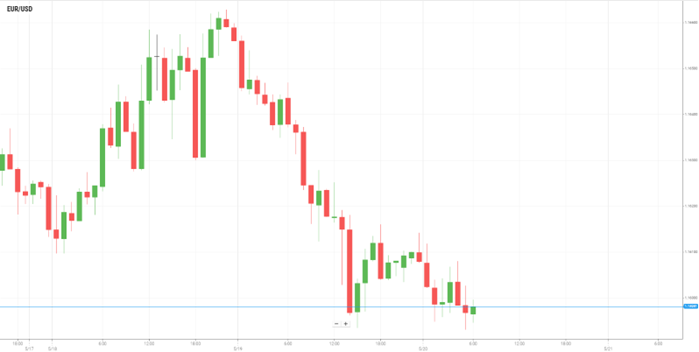
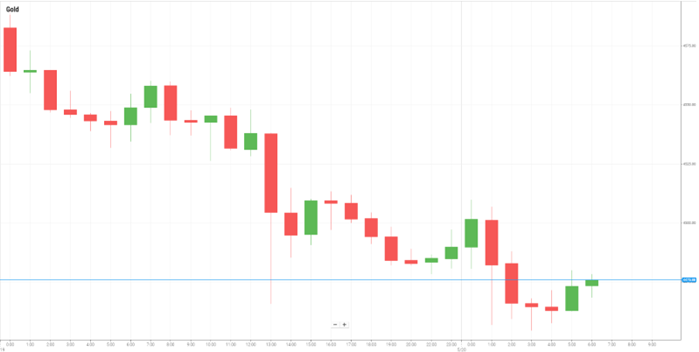
Gold prices remained under pressure during Wednesday’s Asian trading session, with XAU/USD hovering near its weakest level since late March as a stronger US Dollar and growing expectations of tighter Federal Reserve policy weighed on the precious metal.
The metal traded around the $4,470 area after extending recent losses, while the US Dollar stayed close to a six-week high amid persistent geopolitical uncertainty and rising inflation concerns. Investors continue to question the prospects of a lasting diplomatic agreement between the United States and Iran, supporting demand for the Dollar as a safe-haven asset.
US President Donald Trump said on Tuesday that military action against Iran could resume if negotiations fail to produce a deal, revealing that he had been close to authorizing a strike before delaying the decision following appeals from Gulf leaders. Vice President JD Vance, however, noted that discussions between Washington and Tehran have shown progress and emphasized that neither side appears eager to restart military operations.
At the same time, higher Crude Oil prices linked to Middle East instability have intensified inflation worries, reinforcing expectations that the Federal Reserve may maintain a hawkish stance. According to CME FedWatch data, traders are increasingly pricing in the possibility of at least one 25 basis point US interest rate hike in 2026.
Market participants are now turning their attention to the release of the Federal Open Market Committee (FOMC) Minutes later in the day for further insight into the Fed’s policy direction. Investors will also continue monitoring developments in the Middle East, which could influence short-term price action across commodity and currency markets.
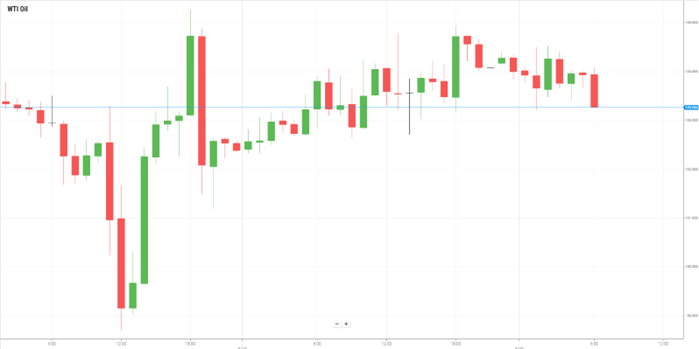
Oil prices edged lower on Wednesday as markets weighed renewed diplomatic efforts between the United States and Iran against ongoing concerns over disruptions to Middle East energy supplies.
Both benchmarks had already retreated by nearly $1 in the previous session after comments from US Vice President JD Vance suggested progress in negotiations between Washington and Tehran.
Investors remain cautious as uncertainty surrounding the conflict continues to dominate sentiment. Analysts noted that the US position on Iran has shifted frequently in recent days, making it difficult for markets to determine whether a lasting peace agreement is achievable.
The conflicting signals from Washington have kept oil traders on edge, particularly as the conflict has severely disrupted shipping flows through the Strait of Hormuz, a vital energy corridor that normally handles around one-fifth of global oil supplies. According to the International Energy Agency, the situation represents one of the most significant oil supply disruptions in recent years.
Despite the recent pullback in prices, analysts expect crude markets to remain elevated due to fears that supply conditions may not normalize quickly even if a ceasefire or political agreement is reached. Concerns over potential renewed US military action against Iran continue to support the market.
Investors are now awaiting official inventory figures from the US Energy Information Administration later on Wednesday. Analysts surveyed by Reuters expect US crude stockpiles to have fallen by approximately 3.4 million barrels in the latest reporting week.
The combination of geopolitical uncertainty, tightening inventories, and supply disruptions continues to keep energy markets volatile, with traders closely monitoring both diplomatic developments and supply data for further direction.
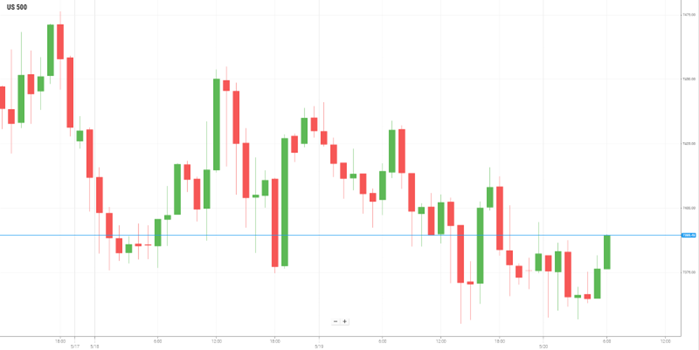
Wall Street closed lower on Tuesday as investors reacted to renewed geopolitical uncertainty surrounding Iran and rising global bond yields, while technology shares weakened ahead of Nvidia’s closely watched quarterly earnings report.
Market sentiment remained under pressure amid concerns that inflation risks and higher bond yields could weigh on equity valuations, particularly within the technology sector. Investors also continued to monitor developments in the Middle East after US President Donald Trump signaled that military action against Iran remains possible if negotiations fail.
Despite signs of ongoing diplomacy, investors remained cautious as previous proposals from Tehran had already been dismissed by Washington. Oil prices remained volatile amid fears that any escalation in the conflict could further disrupt global energy supplies.
Away from geopolitics, investor attention increasingly shifted toward Nvidia’s upcoming earnings report, viewed as a critical test for the artificial intelligence-driven rally that has powered US equity markets to record highs in recent months.
Shares of Nvidia closed 0.7% lower ahead of the results, contributing to broader weakness in technology stocks. However, some semiconductor names, including Marvell Technology and Arm Holdings, posted gains during the session.
Among individual stocks, Home Depot gained nearly 1% after reporting quarterly results that exceeded analyst expectations. Company executives said consumer demand remained relatively resilient despite rising fuel prices and broader economic uncertainty.
The materials contained on this document should not in any way be construed, either explicitly or implicitly, directly or indirectly, as investment advice, recommendation or suggestion of an investment strategy with respect to a financial instrument, in any manner whatsoever. Any indication of past performance or simulated past performance included in this document is not a reliable indicator of future results. For the full disclaimer click here.
Join iFOREX to get an education package and start taking advantage of market opportunities.
 A beginner's e-book
 $5,000 practice demo account
 A 12-part video course
 Trusted partner
 Featured partner
 By
By 


