
Listed on 
 Years active
 English (Arabic)
 Chinese Simplified - 中文 (简体)
 Chinese Traditional - 中文 (繁體)
 English
 Japanese - 日本語
 Korean - 한국어 (대한민국)
 Portuguese - Português
 Russian - Русский
 Spanish - Español
 Thai - ไทย
 English (India)
Don't have an account?
Register via AppHave an account?
Login 17/03/2026 - 08:29 UTC
The USDX showed signs of cooling, retreating -0.5% on Monday as it settled around the 100.00 psychological mark. While the index recently hit its highest levels since mid-2025, the Greenback faced some selling pressure during the early European session on Tuesday. Investors are currently weighing the impact of the ongoing conflict in the Middle East against shifting expectations for the Federal Reserve. Although the disruption of shipping through the Strait of Hormuz continues to fuel long-term inflation worries, many bulls are moving to the sidelines to await the formal policy update from the Fed on Wednesday before committing to new positions.
WTI Oil prices experienced a notable pullback, falling -3.9% on Monday to trade just above the $95.00 level. This retracement follows a failed attempt to break through the $100.00 barrier in previous sessions. Despite the daily decline, the effective closure of the Strait of Hormuz—a transit point for approximately 20% of global oil and liquefied natural gas—remains a primary concern for the market. While supply shortage fears persist due to the regional instability, the commodity is currently navigating a period of intraday volatility as traders balance technical resistance with the broader bullish outlook driven by geopolitical risks.
Gold prices managed a modest recovery, ticking up 0.31% on Monday to hold its ground above the $5,000 threshold. The precious metal is drawing support from its status as a safe-haven asset as the conflict in the Middle East shows signs of further escalation, particularly with expanded military operations in southern Lebanon. However, these gains remain capped by the reality of sustained energy-driven inflation. With the market anticipating that the Federal Reserve may keep interest rates higher for a longer period to combat rising consumer prices, the demand for non-yielding bullion faces a persistent headwind heading into this week’s heavy schedule of central bank decisions.
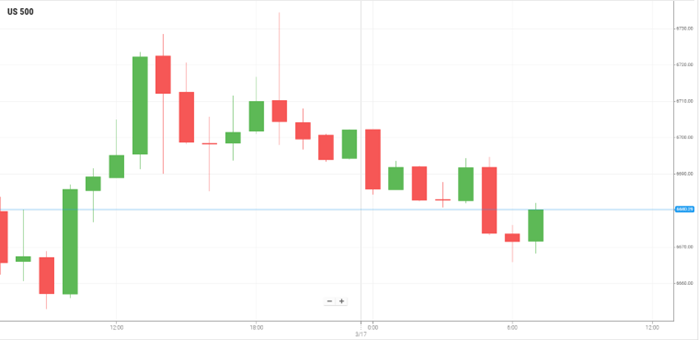
The main US equity indices moved upward on Monday, staging a recovery following a difficult period last week. Investor sentiment was bolstered by a retreat in energy prices, providing a much-needed stabilizer for the markets. Market analysts noted that while the gap up in major indices is encouraging, the persistent risk premium in longer-dated crude suggests that traders remain wary of a sustained regional conflict rather than a quick resolution.
The technology sector’s recent recovery has been largely anchored by a surge in optimism surrounding Nvidia. CEO Jensen Huang’s projection of up to $1 trillion in purchase orders for the company’s Blackwell and Rubin AI chip technologies—double previous estimates—has provided a significant boost to investor confidence. As of early Tuesday, Nvidia’s stock has maintained this positive trajectory, rising approximately 1.7% so far this week. This momentum comes as the company continues to defend its market leadership against both traditional competitors and tech giants developing in-house processors. Beyond chip sales, the market remains focused on Nvidia’s strategic moves, particularly its integration of Groq’s inference technology and a $2 billion investment in laser-based data transmission to enhance chip-to-chip connectivity.
This corporate strength is unfolding during a pivotal week for global monetary policy. Central banks are currently navigating a complex "two-sided risk" environment, attempting to balance the inflationary pressures of high energy costs with the potential for slower economic growth. Expectations for the Federal Reserve suggest that while growth remains resilient, inflation forecasts could be lifted toward 3%, with markets anticipating just one rate cut for the remainder of 2026.
Markets are focused on a heavy slate of central bank decisions and U.S. data this week. On Wednesday, the Federal Reserve is expected to hold rates at 3.50% to 3.75% while providing new projections for 2026, followed by steady rate holds from the Bank of Japan and Bank of England on Thursday. Key U.S. releases include Wednesday’s Core PPI and Thursday’s unemployment claims, both of which will be used to assess inflation risks and labor market strength.
The EUR/USD pair edged lower to around 1.1490 during Tuesday’s early European trading session, as the US Dollar gained strength against the Euro. Rising oil prices, driven by escalating tensions involving the US and Israel in Iran have heightened inflation concerns, prompting markets to reassess the outlook for interest rates.
Meanwhile, Donald Trump reiterated his call for countries to support efforts to reopen shipping routes through the Strait of Hormuz. The remarks contributed to a modest improvement in global risk sentiment, reflected in firmer equity markets, and could limit further gains in the safe-haven US Dollar.Attention now turns to upcoming policy decisions from the Federal Reserve and the European Central Bank later this week.
The Federal Reserve is widely expected to leave its benchmark interest rate unchanged within the 3.50%–3.75% range at the conclusion of its two-day meeting on Wednesday. Elevated oil prices since the onset of the Iran conflict have led analysts to revise expectations for rate cuts.
In the Eurozone, the European Central Bank is also expected to keep its deposit rate steady at 2.0% during Thursday’s meeting. However, ECB Governing Council member Peter Kazimir has indicated that policymakers may consider tightening monetary policy sooner than previously expected.
Market pricing currently reflects expectations of a rate hike by the end of July, with roughly a 55% probability of a second increase by December.
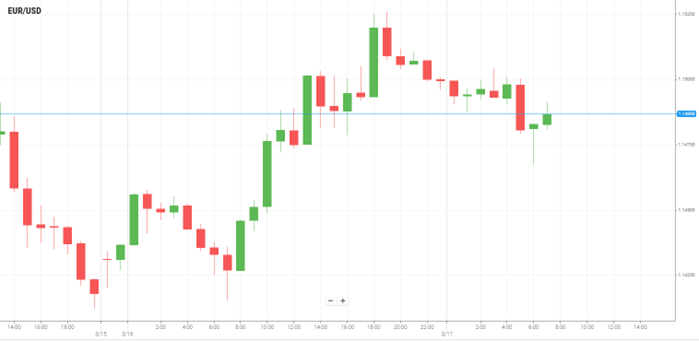
Bitcoin traded in a narrow range around $74,000 early on Tuesday, giving back part of its earlier advance after briefly approaching the $76,000 mark. Market participants remained cautious, tracking oil price fluctuations linked to Middle East tensions while awaiting key central bank decisions.
Bitcoin found some support from short covering, as traders unwound bearish bets established during the early February sell-off. Still, upside momentum proved limited, leaving prices largely range-bound.
Ongoing institutional interest and consistent inflows into spot Bitcoin exchange-traded funds also helped underpin the market.
Investor sentiment remained sensitive as the conflict involving the U.S., Israel, and Iran entered its third week, keeping global markets on edge.
Meanwhile, Donald Trump reiterated calls for international cooperation to reopen shipping routes in the region. His remarks contributed to a modest improvement in overall risk sentiment, reflected in firmer equity markets, which may cap further gains in safe-haven assets. Persistently high energy costs have reinforced inflation concerns, shaping investor positioning across asset classes, including cryptocurrencies.
Attention is now firmly on the upcoming policy decision by the Federal Reserve on Wednesday. Additional central bank meetings are also scheduled globally this week.
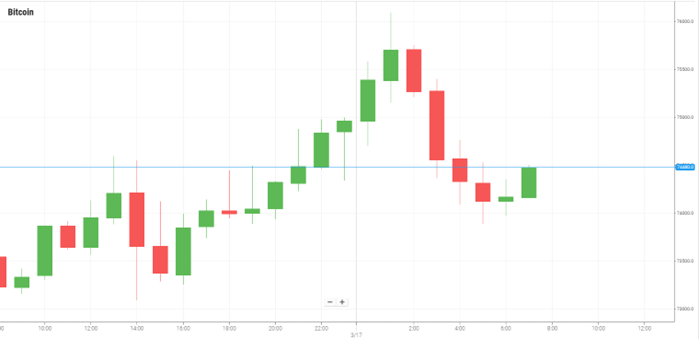
Oil prices climbed more than 2% in early Tuesday trading, recovering part of the previous session’s losses as renewed concerns over supply disruptions in the Strait of Hormuz supported the market.
The Strait of Hormuz—through which roughly 20% of global oil and liquefied natural gas flows—has been heavily disrupted by the ongoing conflict involving the U.S., Israel, and Iran, now in its third week. The situation has heightened fears of supply shortages, rising energy costs, and persistent inflationary pressures.
Tensions also escalated after several U.S. allies rejected calls from Donald Trump to deploy naval forces to safeguard tanker traffic through the region. The U.S. president criticized the response, accusing Western partners of failing to reciprocate longstanding American support.
Meanwhile, Iran has reportedly asked India to release three tankers seized earlier this year as part of ongoing negotiations aimed at ensuring safe passage for Indian-linked vessels through the Gulf, according to Reuters.
The disruption has already had tangible supply impacts. The Organization of the Petroleum Exporting Countries’s third-largest producer, the United Arab Emirates, has been forced to cut output by more than half due to constrained export routes.
In response to rising energy prices, the International Energy Agency indicated that member countries could release additional crude supplies beyond the 400 million barrels already committed from strategic reserves.
On the geopolitical front, Israel signaled preparations for at least three more weeks of military operations, with overnight strikes reported across Iran, underscoring the risk of a prolonged conflict and continued volatility in energy markets.
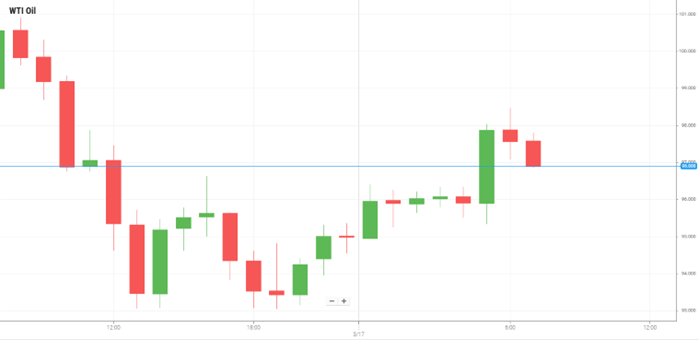
U.S. equities rallied on Monday, recovering from last week’s sharp losses as declining oil prices helped improve investor sentiment. Gains were led by technology stocks, with Nvidia advancing after its CEO delivered an upbeat outlook on demand for artificial intelligence chips.
Oil markets continue to dominate investor focus as disruptions in the Strait of Hormuz threaten global energy flows. The vital shipping route, which handles roughly a fifth of global tanker traffic, has been effectively constrained by Iran, raising concerns over supply shortages and economic fallout.
Investor attention also centered on Jensen Huang, who spoke at Nvidia’s annual developer conference. Huang projected up to $1 trillion in purchase orders for the company’s Blackwell and Rubin AI chip platforms—double last year’s forecast.
The company is working to maintain its leadership in the AI chip space amid increasing competition from rivals such as Advanced Micro Devices and Intel, as well as major technology firms like Alphabet developing in-house processors.
Markets are now turning to a packed calendar of central bank meetings, including decisions from the Federal Reserve and the European Central Bank.
Policymakers will be assessing the economic impact of the Middle East conflict, particularly the inflationary risks stemming from higher energy prices.
The materials contained on this document should not in any way be construed, either explicitly or implicitly, directly or indirectly, as investment advice, recommendation or suggestion of an investment strategy with respect to a financial instrument, in any manner whatsoever. Any indication of past performance or simulated past performance included in this document is not a reliable indicator of future results. For the full disclaimer click here.
Join iFOREX to get an education package and start taking advantage of market opportunities.
 A beginner's e-book
 $5,000 practice demo account
 A 12-part video course
 Trusted partner
 Featured partner
 By
By 


