
Listed on 
 Years active
 English (Arabic)
 Chinese Simplified - 中文 (简体)
 Chinese Traditional - 中文 (繁體)
 English
 Japanese - 日本語
 Korean - 한국어 (대한민국)
 Portuguese - Português
 Russian - Русский
 Spanish - Español
 Thai - ไทย
 English (India)
Don't have an account?
Register via AppHave an account?
Login 17/05/2026 - 12:44 UTC

It’s been another strong week for US equity markets with the S&P500 and Nasdaq 100 making new record highs above 7,500 and 29,000 respectively.
Even the Dow appears to be finally catching up, breaking above 50k again, although at the time of writing it still remains shy of the previous record highs above 50,500.
Once again, it’s been the earnings story that has driven the gains this week, with Cisco Systems, our pick of last week doing some serious heavy lifting after almost doubling its AI orders guidance.
US markets were also buoyed by the successful IPO of AI chipmaker and data centre firm Cerebras Systems, which raised $5.5bn from its share sale, and which saw the shares surge 81% on their stock market debut, giving the company a market value of almost $72bn.
The successful IPO which was more than 25 times oversubscribed, appears to confirm the optimism that is currently driving US markets higher, alongside a US economy that is continuing to hold up reasonably well, despite increasing price pressures.

As we look towards another new trading week, and a fairly robust US consumer, after another set of positive retail sales for April, we’ll be paying particular attention to the US retail sector, in the form of DIY retailer, Home Depot as well as the performance of two of the US biggest retailers in the form of Target and Walmart.
We’ll also be looking at the latest set of results from Nvidia in a week where it was reported that US officials had given approval for some Chinese firms to purchase Nvidia’s H200 chip.
Does this even matter with the Warsh nomination now complete and ratified and Powell having overseen his final press conference?
To recap, the recent meeting saw Fed officials vote to keep rates on hold by 11:1 with Steven Miran once again voting for a cut. 3 other members objected to the inclusion of an easing bias in the statement, while supporting the decision to hold rates. The inclusion of an easing bias in the statement indicates that while the majority of policymakers believe that the next move in rates would be lower, it would appear that some members don’t want to be beholden to that guidance.
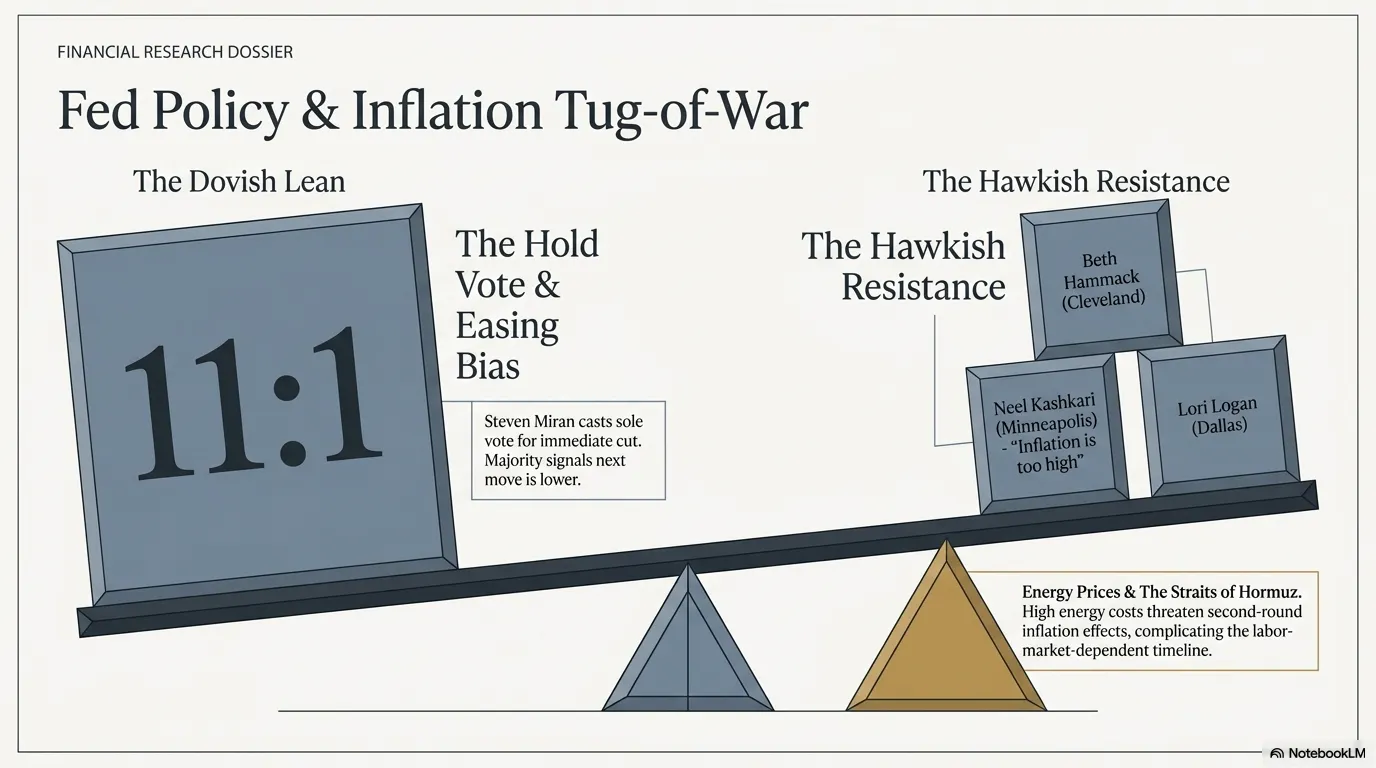
Beth Hammack of the Cleveland Fed, Neel Kashkari of the Minneapolis Fed, and Lori Logan of the Dallas Fed pushed back on that phrasing, due to concerns over high energy prices having second round effects in the coming months. This theme was reiterated this week by Kashkari when he stated “inflation is too high” and that with the Straits of Hormuz still closed the outlook for inflation remains uncertain, and has made the Fed’s job more challenging. It is hard to imagine what further light the minutes will shine on the outlook for rates, however as long as the labour market continues to hold up the Fed remains unlikely to cut in the near term.
Since reporting their Q4 and end of year results back in February, Home Depot shares have been on a slow decline, sliding to their lowest levels since November 2023, earlier this month. The catalyst for the recent weakness shouldn’t be too surprising coming as it has at around the same time as hostilities broke out in the Middle East. Nonetheless the weakness also came about despite a set of Q4 numbers which were largely better than expected with a 3.8% decline in net sales to $38.2bn.

Profits also came in better than forecasts, however the ongoing unrest in the Middle East has raised concerns about increasing costs of raw materials, as well as concerns about what higher interest rates are likely to have on the housing market, and construction sector. Ordinarily as investors look towards the spring and warmer weather you would expect some level of optimism in what tends to be a strong next couple of quarters for the US largest DIY retailer. Thus far there doesn’t appear to be much prospect of that given recent share price weakness, which suggests that perhaps the shares could be due a rebound.
When looking at online sales as well as comparable sales recent quarters have been positive which suggests the recent gloom may well be overdone as the shares head towards levels last seen in late 2023. For 2026 Home Depot says it hopes to open 15 new stores, and a gross margin of 33.1%. Total sales for 2026 are expected to grow between 2.5% and 4.5%, with comparable sales to range from flat to +2%.
When Nvidia reported at the end of February, we were witness to another set of blowout numbers with Q4 revenue of $68.13bn, up 30% on Q3, and 73% Y/Y. Data Centre revenue surged to $62.3bn, with profits coming in at $1.76c a share, and net income increasing 94% year over year to $43bn.

Full year revenue came in at $215.9bn, an increase of 65%. Gross margins rose to 75% for the quarter, with full year margins coming in at 71.1%. For the outlook, revenue for Q1 2027 was estimated to rise to $78bn, +/-2%, assuming no data centre revenue from China, with margins set to remain steady at 75%. Despite this the shares fell sharply, as once again concerns about a bubble along with concerns over supply chain risks prompted some caution and profit taking.
While these concerns initially saw the shares fall to a 9-month low in March, they didn’t last long, with the shares recently hitting fresh record highs this month. This in spite of the ongoing closure of the Straits of Hormuz, which remains a key conduit for helium and sulphur, and which is a key component in chip making. Investors appear almost indifferent to the prospect that this will lead to either chip shortages, or even more expensive hardware, at the expense of margins.
Are we finally starting to see a turnaround story for Target? Judging by recent share price performance that could well be the case, having seen the shares rally from 6-year lows in November 2025.
In that time having found a base at $83.50 the shares have risen to as high as $133 back in April, before seeing a modest retreat from those levels. This rebound has come about despite a weak set of Q4 numbers, back in March which saw revenue and store traffic decline in what should be a strong quarter for the retailer. Despite these trends revenues came in line with forecasts at $30.45bn, while profits were slightly ahead of expectations at $2.44 a share. Furthermore, new CEO Michael Fiddelke who started 1st February, said that sales momentum was starting to show signs of turning around, and that full year profits for 2026 were expected to be between $7.50 and $8.50 a share, as it looks to turn around a trend that has seen shoppers go elsewhere due to controversial social stances on DEI and led to market share losses. Same store sales are still trending below the industry average of -2.5% at -3.9%, while website transactions have also struggled. Fiddelke also said he would be looking to update some of the store real estate which has been variously described as tired and stale, with a commitment to spend $5bn this year to help in the turnaround plan in remodelling 130 stores as well as opening 30 new ones.
Walmart shares took a hit back in February, slipping from record highs when they reported their full year numbers, and have only really started to recover in the last few weeks or so. The US’ biggest retailer reported guidance that came in short of expectations, as new CEO John Furner took the reins in his first earnings report.

The Q4 numbers were solid with revenues of $190.66bn, a rise of just over 5% on last year, while profits came in at 74c a share. When adjusted for one off items, Walmart profits actually fell to 53c a share. Global ecommerce sales increased by 24%, with the US seeing a 27% increase, while gross margins rose 13bps. US same store sales rose by 4.6%, however for 2027, net sales guidance came in light at between 3.5% and 4.5%, with full year profits expected to come in between $2.75 and $2.85 a share, which was well short of what many had been expecting. Despite gasoline prices remaining high Walmart is well placed to ride out the increases in the cost-of-living through its own branded gasoline station convenience stores, however it’s still unlikely to escape completely as consumers become more discerning, as well as cautious in their spending habits.
The materials contained on this document should not in any way be construed, either explicitly or implicitly, directly or indirectly, as investment advice, recommendation or suggestion of an investment strategy with respect to a financial instrument, in any manner whatsoever. Any indication of past performance or simulated past performance included in this document is not a reliable indicator of future results. For the full disclaimer click here.
Join iFOREX to get an education package and start taking advantage of market opportunities.
 A beginner's e-book
 $5,000 practice demo account
 A 12-part video course
 Trusted partner
 Featured partner
 By
By 


