
Listed on 
 Years active
 English (Arabic)
 Chinese Simplified - 中文 (简体)
 Chinese Traditional - 中文 (繁體)
 English
 Japanese - 日本語
 Korean - 한국어 (대한민국)
 Portuguese - Português
 Russian - Русский
 Spanish - Español
 Thai - ไทย
 English (India)
Don't have an account?
Register via AppHave an account?
Login 24/05/2026 - 12:44 UTC

At a time when US markets have continued to remain resilient, despite increasing concerns about 2nd and 3rd round inflation risks the timing of new Fed chair Kevin Warsh being sworn in on Friday by President Trump could well turn out be rather awkward for the new incumbent.

_____________________________________________________________________________________________________
Brought in to deliver rate cuts by the US President this week’s latest economic data are likely to make it much more difficult for the new Fed chair to carry that argument at a time when US bond yields have already traded at multi year highs, in anticipation of more persistent inflation over the rest of this year.
As things stand, the US labour market is showing few signs of cracking, while inflation appears to have bottomed out, with this week’s latest iteration of Q1 GDP likely to get revised up and April PCE expected to show further evidence of a build up in inflationary pressure.
For the time being these concerns aren’t being reflected in US stock markets which appear to be caught up in a frenzy of speculation about the upcoming IPO of SpaceX as well as the prospect of OpenAI and Anthropic, which could also be announced in the coming weeks and months.
While the US economy managed to rebound significantly from the slowdown seen at the end of last year it was still below market expectations, coming in at 2%, up from 0.5% in Q4, but below forecasts of 2.3%. Some of the rebound came from a 4.4% increase in government spending, which appeared to be a mechanical recovery from a -5.6% contraction in Q4. What was more notable was a big jump in gross domestic private investment which increased by 8.7% and a surge in business investment and structures of 10.4%.

This was driven by capital flowing into AI technologies in a trend that shows little sign of slowing, and could drive inflation pressures going forward. Consumer spending on the other hand does appear to be showing signs of slowing demand albeit modestly, rising 1.6%, down from 1.9% in Q4, although that shouldn’t be surprising given Q4 has holiday season spending underpinning it. Net trade was a drag with imports rising by 21.4%, exports rising 12.9%. This week’s latest revisions aren’t likely to show a material change, although we could see an upward revision given stronger consumer spending patterns seen in February and March.
After a slow start to the year US personal spending has seen a pick up in the last couple of months, slowing to 0.4% at the start of the year, before picking up in February to 0.6% and then rising sharply to 0.9% in March. The increase was primarily driven by a sharp rise in gasoline sales, as well as sales of motor vehicles and parts, along with sales of food and beverages. Spending on services also saw a strong performance, primarily driven by healthcare services, followed by financial services. It was also notable that in recent months we’ve seen a pick-up in core PCE price pressures with the monthly number doubling from 0.2% to 0.4% at the end of last year, and only slowing modestly to 0.3% in March, although the annualised number rose to 3.2%, the highest level since November 2023. This recent acceleration doesn’t bode well for the prospect of future Fed rate cuts and also helps to account for the recent dissent on the FOMC with respect to the keeping of the easing bias that was kept in the Fed statement by a majority of 8-4. There are signs in recent numbers that US consumer spending is starting to show signs of slowing, albeit only gradually, but it does suggest that for now Fed policy is unlikely to change in the near term.
While the likes of Alphabet and Amazon shares have continued to push higher, the likes of Snowflake have struggled despite their position as a cloud services provider, albeit on a much smaller scale. When the company reported in Q4 total revenues rose 30% to $1.23bn, while profits came in at 34c a share, both in excess of expectations. Net Revenue Retention saw a 125% increase with 733 customers generating product revenues of over $1m.

With operating margins holding steady at 75% the company said it was continuing to spend on its AI push, as it looks to boost the +9,100 accounts it already has using AI features. For the outlook Snowflake said it expects Q1 revenue of between $1,262m and $1,267m, an increase of 27%. On an annualised basis revenues of $5.66m on a gross margin of 75%. While Snowflake has yet to generate an annual profit, there is a hope that 2027 could be the year that changes.
After an initial dip in the aftermath of their Q1 numbers, HP shares have managed to see a decent rebound from their lowest levels since October 2020. In so doing they’ve managed to move above their 50-day SMA and could be on the cusp of heading back towards the 200-day SMA currently close to $23. In Q1 HP posted a 6.9% increase in net revenue of $14.4bn, although profits slowed slightly to 58c a share. The main contributor was a 11% increase in PC and laptop sales to $10.3bn, with spending on peripherals/printing down 2%, at $4.2bn. There was also a strong improvement in cash flow, which increased to $383m from $175m. The initial dip in the shares back in February was perhaps caused by a cautious guidance outlook which saw management project annual EPS of between $2.90 and $3.20 a share due to concerns over increased memory costs, which may eat into profit margins. HP also said they expect free cash flow for 2026 to be between $2.8-$3bn. For Q2 HP said they expect to see net EPS to be in the range of 52-58c a share.
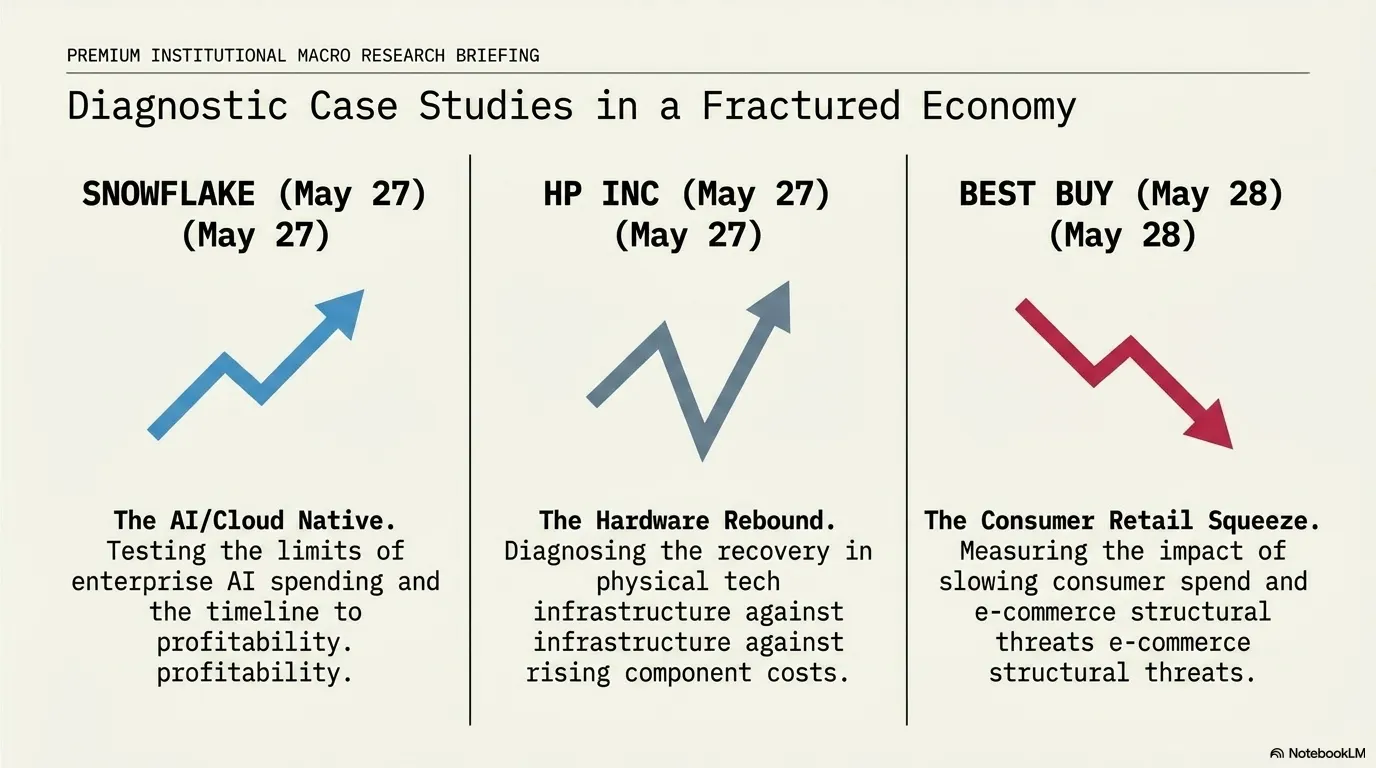
As electrical retailers go, Best Buy is one of the US biggest, however in a market where Amazon and Walmart also operate the challenges facing the business are high. With the shares finding support at the 2025 tariff Liberation Day lows of $55, the shares are vulnerable to further declines on a technical level. The share price weakness is all the more surprising given that Q4 profits came in ahead of forecasts at $2.61 a share. Net income saw a huge improvement, jumping to $541m, up from $117m a year before. Q4 revenues did come in light however at $13.81bn, while same store sales fell 0.8%. For 2027, Best Buy said it expected to see full year revenue of between $41.2bn and $42.1bn with same store sales expected to oscillate around 0%, at between -1% and 1%. On profits the company said it expects to see adjusted EPS of between $6.30 and $6.60 a share. For Q1 comparable sales are expected to see growth of 1%.
The upcoming week is expected to centre on the balance between resilient US economic growth and persistent inflation pressures. Newly appointed Federal Reserve Chair Kevin Warsh enters the role at a difficult moment, with rising bond yields, firm labour markets, and elevated inflation complicating expectations for future rate cuts.

Key economic data releases include revised US Q1 GDP figures and April PCE inflation data, both of which may reinforce concerns that inflation remains sticky. The article also highlights the growing influence of AI-related investment on economic growth and market sentiment, with speculation surrounding potential IPOs helping to support US equities.
Why is the latest PCE inflation report important?
The PCE report is closely watched because it provides insight into inflation trends and future Federal Reserve policy expectations. The article notes that core PCE inflation has recently accelerated, which could reduce the likelihood of near-term rate cuts.
What does the article say about inflation risks in 2026?
The article highlights concerns about “2nd and 3rd round inflation risks,” pointing to rising core PCE inflation, resilient labour markets, and strong AI-driven business investment as factors contributing to persistent inflation pressures.
What is expected from the revised US Q1 GDP report?
The article suggests the revised GDP figure is unlikely to change materially, although there could be an upward revision due to stronger consumer spending seen in February and March.
What is driving business investment growth in the US economy?
According to the article, business investment growth has been driven by capital flowing into AI technologies, particularly in structures and private investment.
What will investors focus on in Snowflake’s earnings report?
Investors will likely focus on Snowflake’s revenue growth, AI-related expansion, customer growth, and progress toward achieving annual profitability.
Why did HP shares initially decline after Q1 results?
The article states that cautious guidance tied to rising memory costs and concerns over profit margins contributed to the initial weakness in HP shares.
What challenges does Best Buy face?
Best Buy continues to face pressure from competition within the retail sector, particularly from Amazon and Walmart, alongside weak same-store sales performance.
The materials contained on this document should not in any way be construed, either explicitly or implicitly, directly or indirectly, as investment advice, recommendation or suggestion of an investment strategy with respect to a financial instrument, in any manner whatsoever. Any indication of past performance or simulated past performance included in this document is not a reliable indicator of future results. For the full disclaimer click here.
Join iFOREX to get an education package and start taking advantage of market opportunities.
 A beginner's e-book
 $5,000 practice demo account
 A 12-part video course
 Trusted partner
 Featured partner
 By
By 


