
Listed on 
 Years active
 English (Arabic)
 Chinese Simplified - 中文 (简体)
 Chinese Traditional - 中文 (繁體)
 English
 Japanese - 日本語
 Korean - 한국어 (대한민국)
 Portuguese - Português
 Russian - Русский
 Spanish - Español
 Thai - ไทย
 English (India)
Don't have an account?
Register via AppHave an account?
Login 17/07/2026 - 07:08 UTC
Following a two-day slide, the US Dollar Index (USDX) recovered with a 0.2% gain on Thursday—supported by upbeat US Initial Jobless Claims and safe-haven flows—and maintained its resilience around 100.80 early Friday as investors weighed escalating Middle East tensions after the US launched its sixth night of airstrikes in southern Iran, alongside reports that Iran instructed Houthi rebels to prepare to block the Red Sea oil route. This risk-off sentiment sent US stock futures down between 0.8% and 1.5% and kept major currency pairs under pressure, with EUR/USD pinned below 1.1450, GBP/USD declining toward 1.3450 after a 0.5% loss on Thursday, and USD/JPY consolidating under 162.50 as Japan’s Finance Minister Satsuki Katayama reiterated readiness to intervene, while safe-haven gold (XAU/USD) struggled to recover below $4,000 after plunging 2% on Thursday. Meanwhile, the USD showed broad strength against majors—notably gaining ground against the AUD, NZD, GBP, CHF, EUR, and JPY, while dipping slightly against the CAD—as market participants digested a balanced, data-dependent speech from Fed Vice Chair Philip Jefferson and looked ahead to Friday’s scheduled US data releases, including June Import/Export Price Indices, Housing Starts, and the preliminary July UoM Consumer Sentiment Index.
Despite a 0.62% decline on Thursday, West Texas Intermediate (WTI) crude oil hovered near $79.00 on Friday—heading for its largest weekly gain since April—as a sixth night of US airstrikes on Iran, a US naval blockade of the Strait of Hormuz, and threats of total export halts by Iran's Revolutionary Guard stoked severe energy security fears. These escalating geopolitical clashes, which included retaliatory Iranian strikes targeting US-allied Gulf nations, pushed weekly oil prices up over 10%, reviving inflation worries and fueling bets that the Federal Reserve will keep interest rates higher for longer. This hawkish policy outlook boosted the US Dollar and capped gold's (XAU/USD) attempt at a recovery, keeping the non-yielding metal highly vulnerable to fresh selling pressure as it struggled to maintain a fragile hold near the $4,000 psychological mark.
Most Asian stock markets declined on Friday, with Japan’s Nikkei 225 leading the regional downturn as tech and semiconductor shares extended a global, Wall Street-led selloff. This risk-averse atmosphere was further intensified by escalating U.S.-Iran tensions—marked by a sixth night of U.S. strikes—which pushed oil prices toward their largest weekly gains since April and revived worries of energy-driven inflation. Despite strong earnings and robust artificial intelligence (AI) demand projections, investors aggressively trimmed semiconductor holdings. In Taiwan, TSMC slid 7.47% as a sharp increase in its capital expenditure forecast spooked a market already anxious over sky-high AI spending. This tech rout spilled heavily into Japan, where Murata Manufacturing plunged 10.9% alongside losses in other major tech heavyweights, dragging the broader Nikkei and TOPIX down. Similar downward pressure was felt across Chinese and Hong Kong indices, as well as in Australia and Singapore—where key non-oil exports grew less than expected.
Looking ahead, market focus shifts entirely to next week's high-stakes economic calendar and a flood of corporate earnings from industry giants. Critical macroeconomic risk events are stacked across the week, beginning with the UK Claimant Count Change on Wednesday (expected at 31.2K), followed by the UK's annual CPI reading on Thursday (forecast at 2.8%), Australia's key employment data showing a projected 40.3K jobs added alongside a tight 4.4% unemployment rate, and the highly anticipated European Central Bank (ECB) monetary policy decision, featuring the Main Refinancing Rate decision (expected to hold at 2.40%), policy statement, and subsequent press conference. Simultaneously, the Q2 corporate earnings season kicks into high gear with heavyweights reporting, led by tech and EV pioneers Alphabet (GOOGL) and Tesla (TSLA), alongside sector leaders like tobacco giant Philip Morris (PM), energy transition player GE Vernova (GEV), semiconductor stalwart Texas Instruments (TXN), oil major ExxonMobil, and defense contractor Lockheed Martin, setting the stage for significant market volatility across global asset classes.
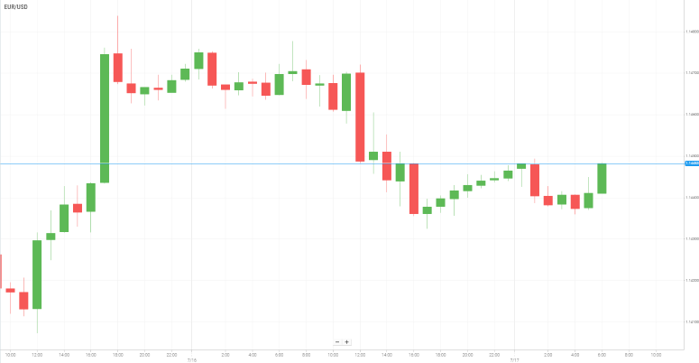
EUR/USD trades little changed around 1.1445 during Friday's early European session as investors assess escalating geopolitical tensions in the Middle East while awaiting the preliminary University of Michigan Consumer Sentiment Index for July later in the day.
According to Reuters, Iran has instructed Yemen's Houthi movement to prepare to close the Red Sea oil route if the United States attacks Iranian power infrastructure, raising fresh concerns over global energy supplies. Separately, Iran's Tasnim news agency reported explosions in Bandar Abbas, Qeshm, and Ahvaz, while loud blasts were also reported in Kuwait and Basra, highlighting the worsening regional security environment.
On the European side, the European Central Bank is widely expected to leave interest rates unchanged at next week's policy meeting. However, the recent surge in energy prices has strengthened market expectations that policymakers could deliver a second rate hike of the year in September as inflation risks intensify.
Meanwhile, Federal Reserve Governor Lisa Cook maintained a cautiously hawkish stance, stressing that one month of softer inflation data is insufficient to establish a lasting disinflation trend. She described monetary policy as only "mildly restrictive" and reiterated that the Fed can afford to wait for additional evidence before adjusting rates while remaining prepared to act if inflation progress stalls.
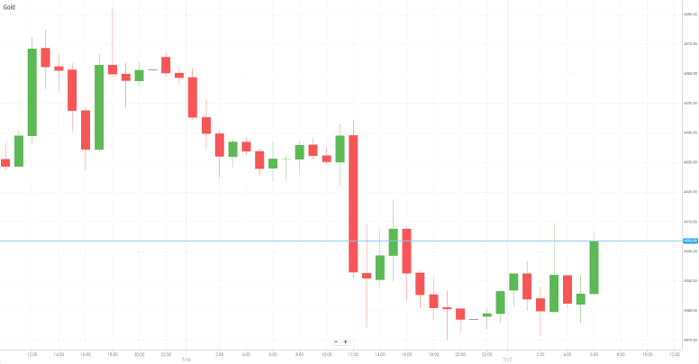
Gold struggles to build on a modest rebound above the $4,000 mark during Friday's European session, slipping back toward the lower end of its daily range. The precious metal remains pinned near its lowest level in a month as rising inflation concerns and expectations of tighter Federal Reserve policy continue to underpin the US Dollar, weighing on the non-yielding asset.
The conflict has intensified in recent days, with Iranian officials reporting strikes on civilian infrastructure in Bandar Abbas, including power facilities and a train station. Iran has responded with missile and drone attacks targeting US-allied Gulf nations, while tensions have also increased around the Strait of Hormuz.
Recent US economic data has further strengthened the case for higher interest rates. Initial Jobless Claims fell to 208,000 in the week ended July 11, signaling continued resilience in the labor market. Meanwhile, the Philadelphia Fed Manufacturing Index jumped to 41.4 in July, its highest reading since November 2021, with survey details pointing to persistent price pressures.
Federal Reserve officials have also maintained a hawkish tone. Dallas Fed President Lorie Logan argued that recent improvements in inflation data remain insufficient and suggested that modestly higher interest rates may still be necessary. Fed Vice Chair Philip Jefferson similarly said he would support additional policy tightening if inflation fails to improve in the near term.
Market participants now turn their attention to Friday's US economic calendar, which includes Building Permits, Housing Starts, Industrial Production, and the preliminary University of Michigan Consumer Sentiment and Inflation Expectations reports. The data, along with additional comments from Federal Reserve officials, could influence the US Dollar's direction and determine whether Gold extends its decline for a second consecutive week.
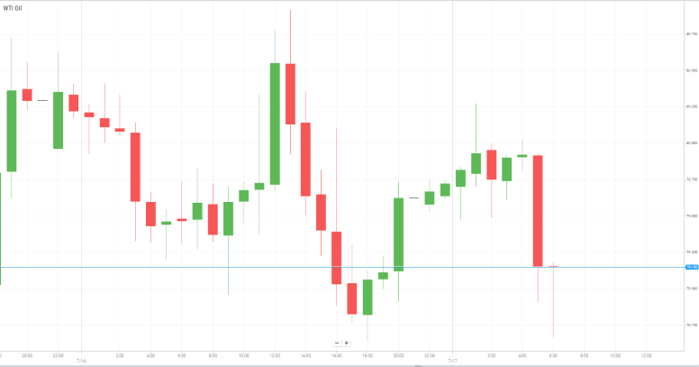
Oil prices remained elevated early on Friday as escalating hostilities between the United States and Iran heightened concerns over global crude supplies, with renewed threats to both the Strait of Hormuz and the Red Sea supporting the latest rally.
Market sentiment remained dominated by geopolitical risks after the United States intensified its military campaign against Iran, launching two major waves of airstrikes on Wednesday and continuing operations on Thursday. According to the US Central Command, the latest strikes were aimed at further degrading Iran's military capabilities.
Iran has responded with missile and drone attacks targeting US military assets across the region. Qatar's Defence Ministry said its forces intercepted an Iranian missile attack early Friday, while authorities reported that a child was injured by shrapnel resulting from the interception.
Supply concerns deepened after Reuters reported that Iran had instructed Yemen's Houthi movement to prepare to close the Red Sea oil route if the United States targets Iranian power infrastructure. The prospect of disruptions to both the Strait of Hormuz and the Red Sea—two of the world's most important energy shipping corridors—has significantly increased the geopolitical risk premium embedded in oil prices.
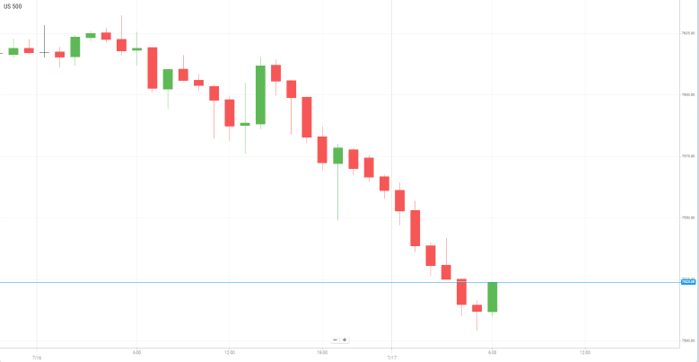
US stocks closed lower on Thursday, led by losses in technology shares as semiconductor stocks retreated despite strong earnings from Taiwan Semiconductor Manufacturing Co. Investor sentiment was also weighed down by renewed expectations of tighter Federal Reserve policy after Dallas Fed President Lorie Logan signaled support for higher interest rates.
TSMC reported a 77% year-over-year increase in quarterly net profit to T$706.6 billion ($22 billion), comfortably exceeding market expectations. As the world's largest contract chipmaker and a key supplier to Nvidia and Apple, the results reinforced the strength of artificial intelligence-related demand, with Chief Executive C.C. Wei indicating that robust AI-driven growth could continue through the end of the decade. Despite the strong earnings, TSMC's US-listed shares fell 2.3% as investors focused on the company's aggressive spending plans.
Attention is now shifting to the next wave of technology earnings, with results due from Alphabet, Intel, IBM, Texas Instruments, and Tesla next week, followed by Microsoft, Meta, Amazon, Qualcomm, Arm, and Apple. Investors will closely monitor capital expenditure plans and AI-related investments to assess whether elevated valuations remain justified.
Economic data released on Thursday pointed to continued resilience in the US economy. Retail sales rose 0.2% in June, matching expectations, while initial jobless claims fell to 208,000 in the week ended July 11, underscoring the strength of the labor market. The economic backdrop, combined with hawkish comments from Federal Reserve officials, reinforced expectations that interest rates could remain elevated for longer.
The combination of resilient economic data, persistent inflation concerns, and cautious Fed commentary prompted investors to trim exposure to high-growth technology stocks, even as corporate earnings continued to highlight strong demand for artificial intelligence infrastructure.
The materials contained on this document should not in any way be construed, either explicitly or implicitly, directly or indirectly, as investment advice, recommendation or suggestion of an investment strategy with respect to a financial instrument, in any manner whatsoever. Any indication of past performance or simulated past performance included in this document is not a reliable indicator of future results. For the full disclaimer click here.
Join iFOREX to get an education package and start taking advantage of market opportunities.
 A beginner's e-book
 $5,000 practice demo account
 A 12-part video course
 Trusted partner
 Featured partner
 By
By 


