
Listed on 
 Years active
 English (Arabic)
 Chinese Simplified - 中文 (简体)
 Chinese Traditional - 中文 (繁體)
 English
 Japanese - 日本語
 Korean - 한국어 (대한민국)
 Portuguese - Português
 Russian - Русский
 Spanish - Español
 Thai - ไทย
 English (India)
Don't have an account?
Register via AppHave an account?
Login 12/02/2026 - 08:00 UTC
Despite a significantly stronger-than-expected Nonfarm Payrolls (NFP) report on Wednesday, the USDX moved -0.62% lower, finishing the session under the 97.00 mark. The index continued to soften during Thursday's Asian session, trading near 96.80 as markets weighed the upbeat labor data against earlier disappointing retail figures and dovish commentary regarding future labor force growth.
The January employment report revealed an addition of 130,000 jobs—nearly double the anticipated 70,000—while the unemployment rate unexpectedly improved to 4.3%. While these figures provided a brief reprieve for the Greenback, Fed officials remain divided; Cleveland Fed President Beth Hammack noted a stabilizing labor market, whereas Kansas City Fed President Jeff Schmid advocated for restrictive rates to combat inflation. Current market sentiment, reflected in the CME FedWatch tool, now places a 94% probability on the Federal Reserve holding rates steady at the next meeting, as traders shift their focus to Friday's critical CPI inflation report.
Gold moved 0.37% up on Wednesday as persistent geopolitical friction between the U.S. and Iran drove a safe-haven bid that overshadowed the impact of a strong labor market. During a high-stakes three-hour meeting, President Donald Trump informed Israeli Prime Minister Benjamin Netanyahu that he insists nuclear negotiations continue, but he paired this diplomatic preference with a stark warning to Tehran, referencing "Operation Midnight Hammer" (the June 2025 strikes) and hinting at further consequences if talks fail. Market anxiety is compounded by a significant U.S. military build-up in the Middle East, with Trump considering the deployment of a second aircraft carrier strike group to maintain leverage. This tension is further strained by Netanyahu’s "red lines," which demand restrictions on Iran’s ballistic missiles and regional support.
Asian markets displayed a fragmented performance on Thursday as record-breaking surges in the tech sector were offset by a recalibration of US interest rate expectations following robust labor data. In South Korea, the KOSPI surged to an all-time high, fueled by an AI-driven rally where Samsung Electronics soared after revealing a competitive edge in next-generation HBM4 chips. Meanwhile, in Japan, the "Takaichi trade" sentiment briefly pushed the market above the 58,000-point threshold for the first time before those gains were trimmed as investors weighed the likelihood of the Federal Reserve maintaining higher rates for longer.In the technology sector, the focus remains on the "AI party" broadening beyond mega-caps, with SK Hynix climbing alongside Samsung.
Wall Street saw a mixed performance in its latest session as the "discerning" market sentiment continues to reward long-term outlooks while punishing immediate misses. Despite a blowout January jobs report that initially boosted futures, the main US equity indices moved sideways as traders scaled back expectations for Federal Reserve rate cuts. In corporate news, Ford shares climbed 1.66% up; while the automaker missed quarterly forecasts due to EV-related impairments and supply chain hurdles, investors were encouraged by management’s robust profit guidance for 2026 and a strategic shift toward more popular hybrid models. Conversely, Lyft saw its shares plummet -17.02% after a fourth-quarter revenue miss and weaker-than-expected rider metrics raised concerns about its ability to maintain growth momentum against larger competitors. These individual moves, alongside a decline in financial and communication services, ultimately left the benchmark indexes largely flat.
Market focus now shifts decisively to Friday's January inflation report, where traders will look for confirmation of cooling price pressures to support the case for 2026 interest rate cuts. The consensus estimate for Core CPI m/m is 0.3%, up slightly from the previous 0.2%, while the broader CPI m/m is also expected to hold steady at 0.3%. On an annual basis, headline CPI y/y is forecasted to moderate to 2.5% from the prior 2.7%.
The EUR/USD pair slipped below the 1.1900 mark on Wednesday as the US Dollar regained momentum following a resilient US labor market report. The latest data from the US Bureau of Labor Statistics (BLS) showed the economy added 130,000 jobs in January, underscoring ongoing labor market strength. Private sector hiring remained robust,
In addition, the BLS published its annual benchmark revision to Nonfarm Payrolls, significantly adjusting prior estimates. The March 2025 payroll figure was revised lower by 898,000 jobs. As a result, total job growth for 2025 now stands at 181,000, sharply reduced from the previously estimated 584,000 — pointing to weaker underlying hiring trends than earlier reported.
Additional pressure on EUR/USD came from hawkish remarks by Kansas City Fed President Jeffrey Schmid. He stated that inflation remains elevated and demand continues to outpace supply across much of the economy. Schmid warned that further rate cuts could risk prolonging above-target inflation.
On the European side, the economic calendar was light. However, previous remarks from European Central Bank (ECB) officials suggested policymakers remain confident that inflation is under control and are largely dismissive of the Euro’s recent strength — a view consistent with ECB President Christine Lagarrde.
In the Eurozone, markets will monitor speeches from ECB officials Mario Cipollone, Philip Lane, and Joachim Nagel. In the United States, attention will turn to Initial Jobless Claims data for the week ending February 7, housing market indicators, and comments from Federal Reserve policymakers Lorie Logan and Stephen Miran.
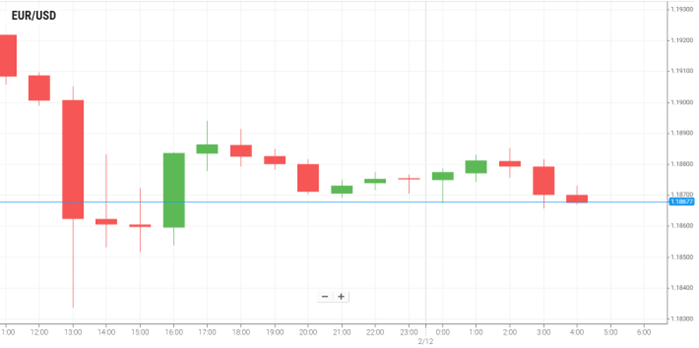
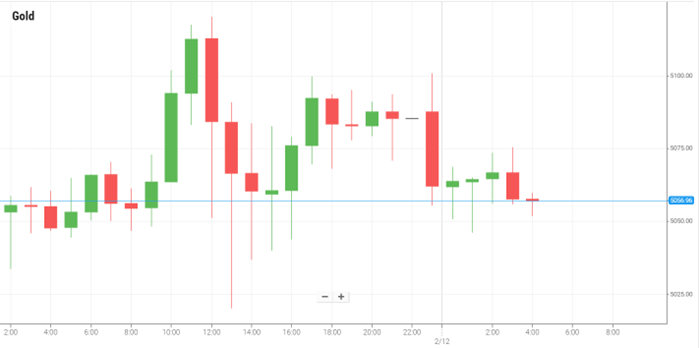
Gold prices retreated during Thursday’s Asian session, reversing part of the previous day’s advance that had lifted the metal to a near two-week high. The pullback follows a stronger-than-expected US Nonfarm Payrolls (NFP) report released on Wednesday, which prompted traders to scale back expectations of an imminent Federal Reserve rate cut.
Following the release, market participants swiftly adjusted their rate outlook. According to the CME FedWatch tool, traders now see roughly a 95% probability that the Fed will leave rates unchanged at its March meeting, up from around 80% the previous day.
At the same time, concerns over potential threats to the Federal Reserve’s independence have weighed on broader Dollar sentiment, helping to limit downside pressure on the non-yielding metal. This dynamic suggests that aggressive bearish positioning in Gold may remain constrained.
Investor attention now shifts to Friday’s US consumer inflation report, which could provide clearer guidance on the Fed’s policy trajectory and influence near-term USD demand. In the interim, Thursday’s Weekly Initial Jobless Claims data may offer short-term trading opportunities.
Overall, while the strong labor data has temporarily capped Gold’s upside, the broader macro backdrop — including expectations of policy easing later in the year and institutional uncertainty — may continue to provide underlying support for the precious metal.
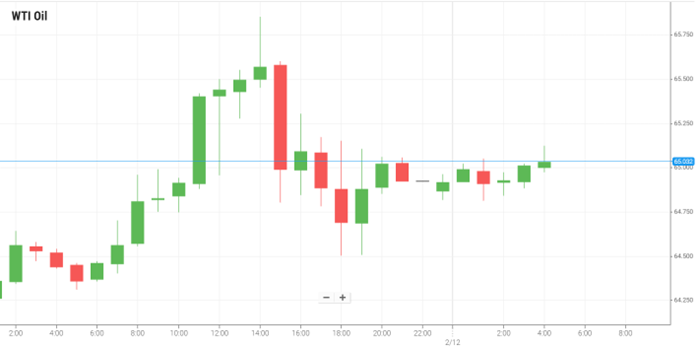
Oil prices moved modestly higher in Asian trading on Thursday as persistent geopolitical tensions between the United States and Iran prompted traders to factor in a higher risk premium. However, gains remained limited amid a sharp rise in US crude inventories.
Geopolitical concerns remained a key driver for the market. Reports earlier this week indicated that Washington is considering deploying a second aircraft carrier to the Middle East, heightening concerns about potential escalation in the region. Although US and Iranian officials signaled some progress in talks held over the weekend, no definitive agreement has been reached regarding Tehran’s nuclear program, keeping uncertainty elevated. Additional reports suggested that US authorities are weighing the possibility of seizing oil tankers transporting Iranian crude. Meanwhile, a meeting between US President Donald Trump and Israeli Prime Minister Benjamin Netanyahu offered limited clarity on the direction of regional policy. Markets remain wary that any military escalation in the Middle East could disrupt oil production or supply flows from one of the world’s most critical energy-producing regions, underpinning prices despite broader headwinds.
Further pressure came from inventory data showing an 8.5 million barrel increase in US crude stockpiles last week — significantly above expectations. The build suggests a partial normalization of supply after severe cold weather earlier in the year disrupted production and tightened inventories.
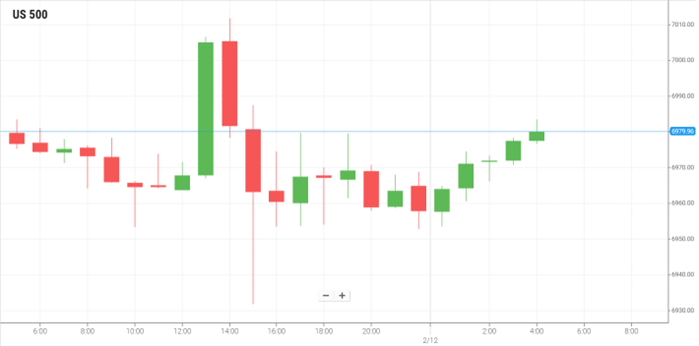
US equities ended Wednesday’s session on a mixed note, as gains fueled by a stronger-than-expected January jobs report were offset by weakness in financial and communication services stocks.
Stock futures had moved higher ahead of the opening bell following the release of the January nonfarm payrolls report. However, early momentum faded as traders reassessed the outlook for Federal Reserve policy. Markets scaled back expectations for near-term rate cuts, prompting a rally in bonds and a recalibration across asset classes.
The strong headline payrolls figure reinforced expectations that the Federal Reserve will maintain its current policy stance amid still-elevated inflation.
According to the CME FedWatch tool, the probability of the Fed leaving rates unchanged in March climbed to roughly 94%, up from around 80% the previous day. US Treasury yields moved higher following the report. The benchmark 10-year yield rose 3 basis points to 4.172%, while the more rate-sensitive 2-year yield advanced 6 basis points to 3.514%.
In corporate developments, Robinhood fell at the open after reporting earnings that disappointed investors, with softer revenue and user growth weighing on sentiment. Lyft shares also declined after the ride-hailing company posted results that fell short of expectations.
Ford Motor reported quarterly earnings below Wall Street forecasts, citing charges related to its electric vehicle operations, supply chain disruptions, and delays in tariff relief tied to the Trump administration. Despite the miss, Ford projected stronger earnings in 2026, offering some support to its stock.
The materials contained on this document should not in any way be construed, either explicitly or implicitly, directly or indirectly, as investment advice, recommendation or suggestion of an investment strategy with respect to a financial instrument, in any manner whatsoever. Any indication of past performance or simulated past performance included in this document is not a reliable indicator of future results. For the full disclaimer click here.
Join iFOREX to get an education package and start taking advantage of market opportunities.
 A beginner's e-book
 $5,000 practice demo account
 A 12-part video course
 Trusted partner
 Featured partner
 By
By 


