
Listed on 
 Years active
 English (Arabic)
 Chinese Simplified - 中文 (简体)
 Chinese Traditional - 中文 (繁體)
 English
 Japanese - 日本語
 Korean - 한국어 (대한민국)
 Portuguese - Português
 Russian - Русский
 Spanish - Español
 Thai - ไทย
 English (India)
Don't have an account?
Register via AppHave an account?
Login 30/07/2026 - 07:01 UTC
The US Dollar weakened sharply on Wednesday after the Federal Reserve kept interest rates unchanged, despite a divided policy vote. The Federal Open Market Committee (FOMC) voted 9-3 to maintain the federal funds rate at 3.50%-3.75%, with Cleveland Fed President Beth Hammack, Minneapolis Fed President Neel Kashkari, and Dallas Fed President Lorie Logan favoring a 25-basis-point rate hike. The Fed acknowledged that the US economy continues to expand at a solid pace but noted that inflation remains elevated, partly due to energy-related supply disruptions. The US Dollar Index (DXY) fell about 0.6% to around 100.70, as markets interpreted the decision to hold rates as reducing the likelihood of a September rate hike, despite the hawkish dissent. The move also pressured US Treasury yields lower and triggered broad-based selling of the Greenback.
Gold prices retreated from the $4,100 level on Thursday, extending the previous session's rejection and moving further away from a one-week high. Meanwhile, geopolitical tensions in the Middle East continue to intensify. The ongoing confrontation between the US and Iran, including heightened risks around the Strait of Hormuz and the Bab el-Mandeb shipping route, has fueled concerns over potential disruptions to global energy supplies. Recent US military strikes against Iran-backed groups, along with reports that Yemen's Houthi rebels may impose transit fees on commercial vessels in the Red Sea, have further elevated regional uncertainty and supported crude oil prices.
Bitcoin traded in a volatile range on Wednesday before edging modestly higher, as the Federal Reserve's decision to leave interest rates unchanged provided some support, while rising geopolitical tensions, higher oil prices, and weaker risk sentiment limited gains. The world's largest cryptocurrency was last trading near $63,980 as investors weighed the implications of the Fed's latest policy decision against a deteriorating macroeconomic backdrop.
Asian equities traded mostly lower on Thursday as investor sentiment remained fragile following the Federal Reserve's policy decision and renewed concerns over artificial intelligence-related spending. Escalating geopolitical tensions in the Middle East and higher oil prices further dampened risk appetite across the region. Korea 200 experienced sharp intraday volatility, reversing early gains to trade lower despite stronger-than-expected earnings from Samsung Electronics. Samsung Electronics reported a sharp increase in second-quarter earnings, with semiconductor operating profit rising more than 250-fold from a year earlier, driven by robust demand for high-bandwidth memory (HBM) chips used in artificial intelligence applications. In contrast, SK Hynix extended its recent losses after investors were disappointed by its quarterly outlook despite reporting record profits. The continued weakness in semiconductor stocks reflected growing concerns over whether massive AI-related capital expenditures by global technology companies will translate into sustained earnings growth.
Futures on the US 500, US Tech 100, and US 30 advanced late on Wednesday following regular’s session sharp selloff on Wall Street after Microsoft reported stronger-than-expected quarterly results, boosting investor confidence in the technology sector despite continued concerns over artificial intelligence (AI) spending, Federal Reserve policy uncertainty, and escalating geopolitical tensions.
Microsoft surged nearly 9% in after-hours trading after reporting better-than-expected fiscal fourth-quarter earnings. Strong growth in its Azure cloud business, fueled by continued AI demand, exceeded market expectations. The company also issued an upbeat revenue outlook for the current quarter while slightly lowering its calendar year 2026 capital expenditure guidance to $175 billion from $190 billion, easing investor concerns over excessive AI-related spending. First-quarter capital expenditure guidance also came in slightly below market expectations, further supporting sentiment.
In contrast, Meta Platforms fell about 7% in extended trading after reporting weaker-than-expected quarterly results and issuing a softer-than-anticipated outlook for the third quarter. Although Meta continued to generate healthy advertising revenue, the company raised the lower end of its 2026 capital expenditure forecast to $130-$145 billion, highlighting the ongoing financial burden of large-scale AI investments and restructuring initiatives.
Looking ahead, market participants will closely watch Thursday's US economic releases, including preliminary second-quarter GDP, the Fed's preferred Core PCE inflation gauge, Initial Jobless Claims, Personal Income, and Personal Spending.
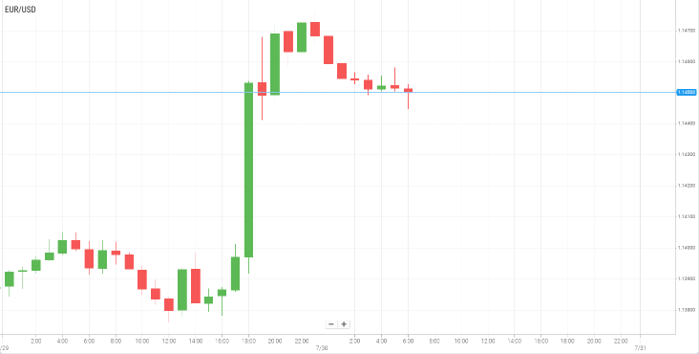
The euro weakened against the US dollar during Thursday's early Asian session after the Federal Reserve left interest rates unchanged while maintaining a hawkish tone. Investors are now turning their attention to preliminary second-quarter GDP figures from Germany and the Eurozone, due later in the day.
Speaking after the meeting, Fed Chair Kevin Warsh reiterated that policymakers would not provide forward guidance on future rate decisions but emphasized the central bank's commitment to returning inflation to its 2% target, reinforcing expectations that further tightening remains possible if inflation proves persistent.
Attention now shifts to key economic data from Europe. Economists expect the Eurozone economy to expand 0.2% quarter-on-quarter in the second quarter, following a 0.2% contraction in the previous quarter. Germany, meanwhile, is forecast to post 0.1% quarterly growth, slowing from 0.3% previously. Stronger-than-expected GDP readings could provide near-term support for the euro.
On the monetary policy front, ECB Governing Council member Peter Kazimir recently argued that the central bank will likely need to deliver at least one more rate hike to bring inflation under control, adding that a weaker economic outlook could require even tighter policy. Market pricing currently points to at least two additional ECB rate increases, with the first fully expected by October and another anticipated by March.
While policymakers kept rates unchanged, they maintained a tightening bias that leaves the door open for additional increases. Markets continue to price in at least one Fed rate hike before year-end, with the possibility of further tightening in 2027.
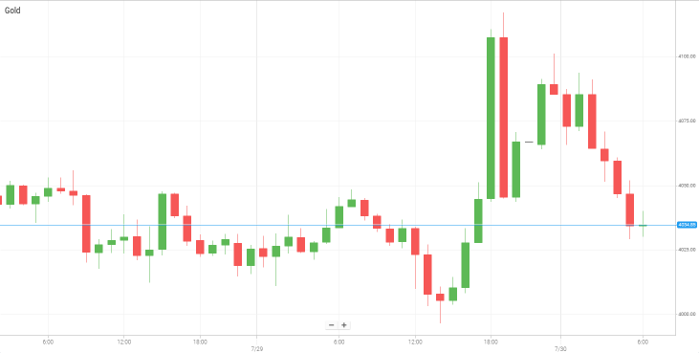
Gold prices retreated from the $4,100 level during Thursday's session, extending losses after failing to sustain gains near a one-week high. The pullback comes as the US Dollar regains strength on renewed expectations that the Federal Reserve could still deliver another interest rate hike this year, while escalating geopolitical tensions in the Middle East continue to support the greenback and weigh on the non-yielding precious metal.
Higher interest rate expectations have supported US Treasury yields and the US Dollar, reducing the appeal of gold, which does not generate interest income. The stronger dollar has also made the precious metal more expensive for holders of other currencies, adding further pressure to prices.
Geopolitical risks remain elevated following a sharp escalation in tensions between the United States and Iran. Recent US military strikes in response to Iranian missile attacks, along with joint US-Saudi operations targeting Iran-backed groups in Iraq, have heightened concerns over a broader regional conflict.
Looking ahead, traders will closely monitor the release of the US advance second-quarter GDP report and the Personal Consumption Expenditures (PCE) Price Index, the Fed's preferred measure of inflation. The data could provide fresh insight into the outlook for US monetary policy and determine the next direction for both the US Dollar and gold prices.
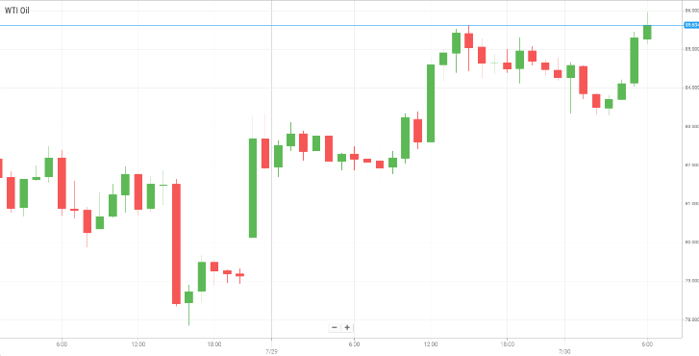
Oil prices edged slightly lower during Thursday's Asian session after posting their biggest gains in months, as traders locked in profits while continuing to monitor escalating geopolitical tensions in the Middle East and signs of tightening global crude supplies.
The sharp rally was driven by renewed concerns over potential supply disruptions following an escalation in hostilities between the United States and Iran. Iran launched ballistic missiles targeting US forces in the Middle East, prompting retaliatory strikes by US and Saudi forces against Iran-backed militias in Iraq. US President Donald Trump also warned that Iran would face a strong military response, further increasing fears of a broader regional conflict.
Tensions have expanded beyond the Gulf region. Egyptian authorities reported drone attacks on natural gas vessels operating off the country's coast, while Yemen's Iran-backed Houthis have intensified attacks on commercial shipping and Saudi-linked energy infrastructure around the Red Sea and the Bab el-Mandeb Strait. The group has also discussed imposing transit fees on commercial vessels using the strategic waterway, raising concerns over higher shipping costs and insurance premiums.
Oil also found support from bullish US inventory data. According to the US Energy Information Administration (EIA), crude oil inventories declined by 7.2 million barrels last week, far exceeding market expectations and bringing stockpiles to their lowest level since 2018. The larger-than-expected draw reinforced expectations of tighter near-term supplies in the world's largest oil-consuming nation.
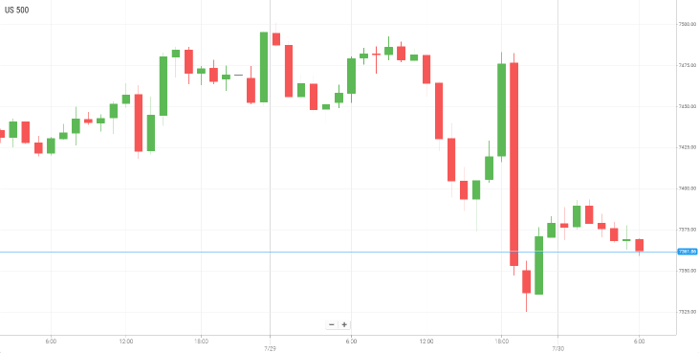
US equities ended sharply lower on Wednesday as investors weighed continued weakness in semiconductor stocks, rising crude oil prices, and a divided Federal Reserve decision that highlighted growing uncertainty over the inflation outlook.
The major indexes briefly recovered some losses after the Fed kept interest rates unchanged, easing concerns that policymakers could deliver an immediate rate increase. However, the decision was accompanied by three dissents from officials who preferred tighter policy, underscoring the challenge the central bank faces as higher energy prices threaten to reignite inflation.
Technology shares remained under pressure as the artificial intelligence trade continued to lose momentum. The Philadelphia Semiconductor Index recorded its longest losing streak since December, extending declines for a fifth consecutive session.
Recent concerns about excessive AI spending and stretched valuations have weighed on chipmakers. A report that Nvidia was considering a major investment tied to an OpenAI data-center project raised questions about the sustainability of large-scale AI infrastructure spending and potential circular investments within the sector.
Competition from China has also added pressure on US semiconductor stocks, with developments in Chinese AI models, domestic chip production, and advanced manufacturing capabilities raising concerns about future competition.
Markets now await further developments in geopolitical tensions, upcoming economic data, and major technology earnings to determine whether the recent equity pullback represents a temporary correction or the start of a broader shift in investor sentiment.
The materials contained on this document should not in any way be construed, either explicitly or implicitly, directly or indirectly, as investment advice, recommendation or suggestion of an investment strategy with respect to a financial instrument, in any manner whatsoever. Any indication of past performance or simulated past performance included in this document is not a reliable indicator of future results. For the full disclaimer click here.
Join iFOREX to get an education package and start taking advantage of market opportunities.
 A beginner's e-book
 $5,000 practice demo account
 A 12-part video course
 Trusted partner
 Featured partner
 By
By 


