
Listed on 
 Years active
 English (Arabic)
 Chinese Simplified - 中文 (简体)
 Chinese Traditional - 中文 (繁體)
 English
 Japanese - 日本語
 Korean - 한국어 (대한민국)
 Portuguese - Português
 Russian - Русский
 Spanish - Español
 Thai - ไทย
 English (India)
Don't have an account?
Register via AppHave an account?
Login 24/06/2026 - 07:26 UTC
Tuesday’s trading session was defined by an aggressive push into the US dollar, which weighed heavily on global commodities as hawkish Federal Reserve signals combined with easing Middle Eastern geopolitical tensions to shake up key asset classes. Driven by this building momentum, the US Dollar Index gained 0.4% on Tuesday to touch fresh highs not seen since May 2025. Investors aggressively ramped up their bets on upcoming Fed rate hikes following hawkish remarks from central bank committee members and Fed Chair Kevin Warsh, who strongly emphasized long-term price stability. Heading into Wednesday's early European session, the index continues to consolidate these gains near 101.50.
This surging greenback and climbing interest rate environment dealt a double whammy to precious metals, causing gold prices to plunge 2.11% on Tuesday and break down toward a two-week low below the $4,100 mark. The lack of yielding power left the bullion deeply exposed as traders shifted focus away from inflation hedges, completely unimpressed by easing consumer price anxieties. Although gold has shown a minor, weak bounce in early Wednesday trading, it remains fundamentally vulnerable as investors are continually pricing in a higher probability of central bank tightening. Markets eagerly await Thursday's US PCE Price Index data for fresh direction.
Simultaneously, West Texas Intermediate crude oil plummeted 2.0% on Tuesday, driven by a massive easing of global supply anxieties following critical diplomatic breakthroughs that eventually dragged prices to a three-month low before stabilizing around $72.50 per barrel on Wednesday morning. This multi-day losing streak reflects a rapid return of crude supply, highlighted by commercial maritime tankers safely resuming transit through the Strait of Hormuz under new security guarantees from US-Iran peace negotiations, alongside a swift recovery in UAE oil exports to nearly 85% of pre-conflict levels via alternative pipelines and shipping hubs. Global distribution expectations received an additional boost from the US Treasury Department's temporary 60-day sanctions waiver on Iranian crude, and while conflicting statements regarding Tehran's nuclear compliance and potential new transit fees keep minor geopolitical risks lingering, the influx of physical supply continues to dictate the downward trajectory of oil prices.
South Korea’s benchmark KOSPI index staged a dramatic recovery on Wednesday, clawing back a significant portion of its previous session’s steep tech and chipmaking losses. Despite this high-stakes volatility—exacerbated by South Korea’s rejection from the MSCI developed market watchlist and heavy selling in leveraged ETFs—the index remains the world's top performer this year, with strong year-to-date gains fueled by the artificial intelligence trade.
The rebound was driven by domestic chip giants reversing course after deep losses on Tuesday. Leading the charge, Samsung Electronics surged 7.78% in its latest session following reports that the tech titan is preparing a massive share buyback program valued at nearly 90 trillion won ($5.8 billion). Concurrently, fellow memory maker SK Hynix advanced 1.88% as investors reacted positively to progress regarding its planned listing of American Depository Receipts, a move expected to draw fresh international capital.
This domestic recovery occurred despite broader microchip anxieties vibrating through global tech sectors. Lingering concerns over the near-term pace of the AI trade were highlighted by reports that SK Hynix may balance its output with more traditional memory alongside its high-bandwidth components. This cooling sentiment in the broader AI supply chain was reflected across the Pacific, where market bellwether Nvidia dropped 4.17% in its latest trading session, proving that global semiconductor sentiment remains highly sensitive despite local technical bounces.
Looking ahead, macro sentiment and tech sectors face a critical testing ground with major data releases and corporate earnings on deck. Investors are closely watching the upcoming US economic data, featuring the Core PCE Price Index (expected at 0.3% month-over-month against a previous 0.2%) alongside the Final GDP print, which is projected to hold steady at 1.6% quarter-over-quarter. These metrics will arrive amid massive anticipation for Micron Technology's latest fiscal earnings results, an event poised to offer crucial, real-time insight into the pricing power, margins, and underlying demand driving the global artificial intelligence trade.
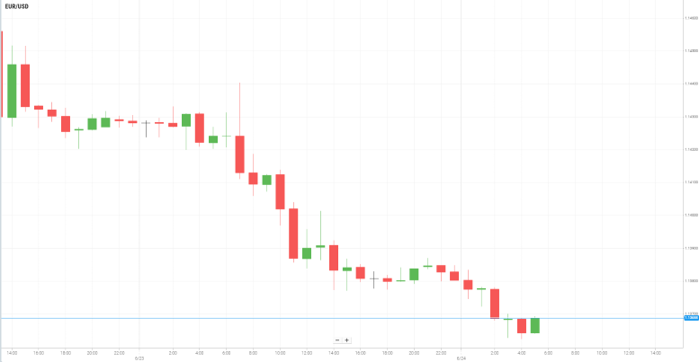
The EUR/USD pair moved lower during Wednesday’s early Asian trading session, trading around the 1.1370 level as the US Dollar strengthened on rising expectations of further Federal Reserve policy tightening.
The euro’s decline comes as markets continue to monitor developments surrounding the potential US-Iran peace agreement. US President Donald Trump said on Tuesday that Iran had “fully and completely” agreed to allow additional nuclear inspections. However, Iran’s Foreign Minister Abbas Araghchi stated that formal negotiations on the nuclear issue had not yet begun. Meanwhile, Iran’s chief negotiator warned that the Strait of Hormuz would not return to its previous conditions, suggesting continued uncertainty over the strategic waterway.
Elsewhere, a new round of discussions between Israel and Lebanon began in Washington, DC, on Tuesday, aimed at ending clashes between Israel and Iran-backed Hezbollah. Any signs of escalating tensions in the Middle East or limited progress in US-Iran negotiations could increase risk aversion and weigh on the Euro against the US Dollar in the near term.
The Greenback has also gained support from expectations of a more hawkish Federal Reserve stance. A surprise shift toward tighter policy at last week’s Fed meeting, led by Chair Kevin Warsh, increased speculation of a potential interest rate hike later this year. According to the CME FedWatch tool, markets are now pricing in around a 37% probability of a 25-basis-point rate increase at the July meeting, compared with just 8.5% a week earlier.
With stronger Fed hike expectations and ongoing geopolitical uncertainty, the EUR/USD pair remains under pressure as traders reassess the outlook for both currencies.
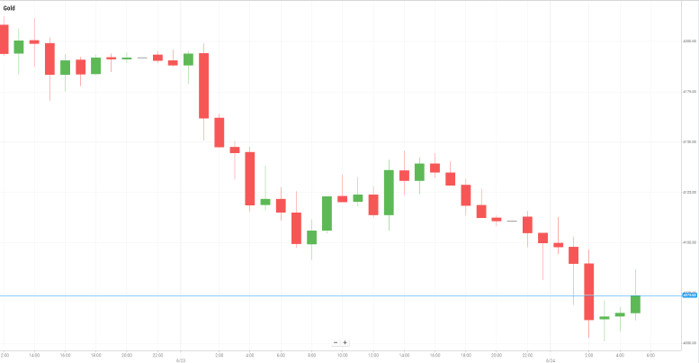
Gold prices extended its decline during Wednesday’s Asian session, falling to a nearly two-week low near the $4,050 mark. The precious metal remains under pressure as growing expectations of a Federal Reserve rate hike continue to support the US Dollar, reducing demand for non-yielding assets like gold.
The decline marks gold’s second consecutive losing session and its fifth daily drop in the past six trading days. Although easing inflation concerns following the recent decline in crude oil prices have provided some relief to markets, investors have focused more heavily on the possibility of tighter US monetary policy, which has lifted the Dollar to its strongest level since May 2025.
Despite softer inflation risks, traders have increased expectations that the Federal Reserve could raise interest rates by at least 25 basis points in 2026 following last week’s hawkish policy signals. Several Fed officials indicated concerns about persistent inflation, while new Fed Chair Kevin Warsh emphasized the importance of maintaining price stability and suggested that the central bank may not move quickly toward rate cuts even if economic growth slows.
Geopolitical developments surrounding US-Iran relations have also supported the Dollar and added pressure on gold. US Vice President JD Vance said that recent discussions in Switzerland resulted in Iran agreeing to invite International Atomic Energy Agency (IAEA) inspectors to its nuclear facilities. President Donald Trump also claimed Iran had accepted extensive future nuclear inspections. However, Iranian officials later disputed those claims, stating that no new commitments had been made.
The mixed signals surrounding the nuclear negotiations have kept geopolitical uncertainty elevated, limiting safe-haven demand for gold while supporting the US Dollar.
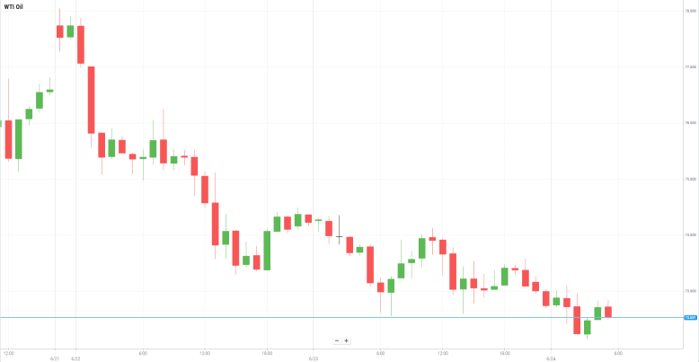
Oil prices continued their decline early on Wednesday, extending this week’s losses and trading near four-month lows as signs emerged that more stranded vessels could resume passage through the Strait of Hormuz following easing tensions between the US and Iran.
Crude prices have faced pressure after Washington approved a temporary 60-day sanctions waiver allowing Iran to resume certain oil sales, while reduced hostilities in Lebanon further improved market sentiment. Investors are increasingly optimistic that diplomatic progress could help restore oil flows through the key shipping route.
Iran and Oman have agreed to continue discussions over future navigation arrangements in the Strait of Hormuz, while US Secretary of State Marco Rubio warned that any attempt by Iran to impose transit fees would violate international law. Despite these developments, uncertainty remains over whether the diplomatic progress will hold, as Washington and Tehran continue to provide conflicting statements regarding nuclear negotiations.
Traders are also monitoring how quickly Middle Eastern producers can restore exports and whether additional vessels will be able to pass through the region.
Shipping data showed that three stranded supertankers successfully passed through the strait on Tuesday. Meanwhile, US crude inventories declined by 765,000 barrels in the week ending June 19, according to data from the American Petroleum Institute.
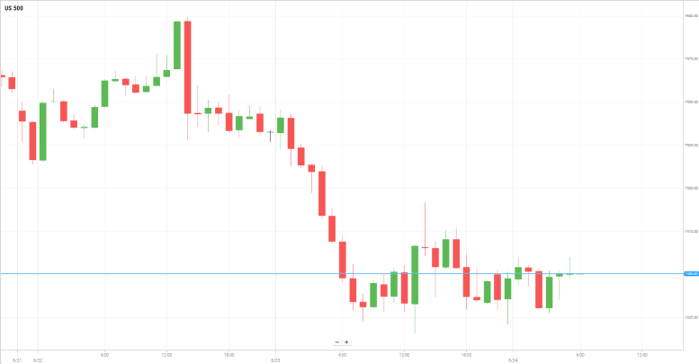
US stocks closed lower on Tuesday as a sharp decline in technology shares weighed on the broader market. A major sell-off in South Korea’s technology sector spilled over into global equities, pressuring US semiconductor companies and cooling investor enthusiasm around artificial intelligence (AI) stocks.
The recent strength in AI-related stocks had been a key driver of Wall Street’s rebound in April and May, helping investors look past concerns surrounding Middle East tensions and higher oil prices. However, with crude prices retreating closer to pre-conflict levels and geopolitical risks easing following the US-Iran ceasefire agreement, market attention has shifted back toward the sustainability of the technology rally.
Investors are increasingly questioning whether the high valuations attached to AI companies can be justified without clear evidence of earnings growth. After months of strong gains, traders are now looking for proof that the massive investments in data centers, advanced chips, and AI infrastructure will generate meaningful returns.
The broader macroeconomic environment has also become less supportive for technology shares. Investors are adjusting to expectations of a more hawkish Federal Reserve, with futures markets now indicating the possibility of two interest rate hikes this year rather than one.
Higher interest rate expectations have pushed Treasury yields higher, creating additional pressure on growth stocks whose valuations depend heavily on future earnings.
Markets are now awaiting updated US first-quarter GDP figures and the Personal Consumption Expenditures (PCE) inflation report, the Federal Reserve’s preferred inflation measure. The data could provide further clues on the central bank’s interest rate path.
The materials contained on this document should not in any way be construed, either explicitly or implicitly, directly or indirectly, as investment advice, recommendation or suggestion of an investment strategy with respect to a financial instrument, in any manner whatsoever. Any indication of past performance or simulated past performance included in this document is not a reliable indicator of future results. For the full disclaimer click here.
Join iFOREX to get an education package and start taking advantage of market opportunities.
 A beginner's e-book
 $5,000 practice demo account
 A 12-part video course
 Trusted partner
 Featured partner
 By
By 


