
Listed on 
 Years active
 English (Arabic)
 Chinese Simplified - 中文 (简体)
 Chinese Traditional - 中文 (繁體)
 English
 Japanese - 日本語
 Korean - 한국어 (대한민국)
 Portuguese - Português
 Russian - Русский
 Spanish - Español
 Thai - ไทย
 English (India)
Don't have an account?
Register via AppHave an account?
Login 10/07/2026 - 07:00 UTC
The US Dollar Index fell to a three-week low, sliding -0.12% for USDX as safe-haven demand cooled following signs of diplomatic de-escalation between the US and Iran. Despite recent severe military strikes and counter-attacks in the Middle East, markets breathed a sigh of relief after reports surfaced that Washington remains committed to its memorandum of understanding with Tehran, combined with remarks from President Trump that Iran has reached out to make a deal. This softening of the Greenback was heavily pronounced against the Japanese Yen, which served as the strongest major currency counterweight during the slump.
Crude markets experienced a sharp reversal, with a -3.41% drop for WTI oil as the geopolitical risk premium quickly evaporated from energy sectors. Although early-week airstrikes on Iranian infrastructure initially raised supply disruption fears, the sudden tilt toward diplomatic talks, alongside an OPEC+ production target increase, put heavy downward pressure on prices. Adding to the bearish momentum, the US Energy Information Administration reported a substantial, larger-than-expected commercial inventory build of nearly 3 million barrels, ending a multi-week streak of draws and capping oil's upside.
Gold managed a strong showing amid the turmoil, moving 1.16% up for Gold as it capitalized on the weaker US Dollar and residual geopolitical anxiety. However, the precious metal faced a fierce intraday tug-of-war and struggled to maintain its peak gains due to lingering hawkish sentiment from the Federal Reserve. Minutes from the recent FOMC meeting showed a divided central bank, but elevated inflation expectations and an 85% market probability of at least one more interest rate hike later this year continue to limit the non-yielding asset's upward trajectory.
Asian equity markets posted a robust recovery, propelled by a strong resurgence in technology and semiconductor shares. Investors effectively brushed off escalating geopolitical friction in the Middle East to double down on the long-term artificial intelligence investment narrative. This wave of optimism followed major capital expenditure commitments from global chipmakers, which reassured market participants that the AI spending cycle remains firmly intact and subsequently lifted US equity futures.
South Korea spearheaded the regional market rebound, clawing back a portion of its recent steep weekly losses. Tech giants Samsung Electronics and SK Hynix saw significant upward price action, with the latter drawing immense investor demand for its new US asset offering. Market sentiment received an additional boost from Micron Technology's massive long-term investment plans to expand memory-chip manufacturing, while Japan’s major indexes climbed on a mix of tech buying and reports that its government pension fund is considering expanding domestic equity allocations.
Looking ahead to the coming week, global financial markets face a massive dual catalyst of top-tier economic data and high-profile testimony. Traders will be micro-analyzing the US inflation landscape with the release of the Core CPI (expected at 0.2% month-over-month) and Headline CPI (projected at 4.2% year-over-year), closely followed by PPI metrics and UK GDP data. Volatility is bound to spike mid-week as Federal Reserve Chairman Kevin Warsh delivers highly anticipated testimonies, and Bank of England Governor Andrew Bailey takes the stage to clarify the global interest rate outlook.
The upcoming week also unofficially kicks off the corporate earnings season, shifting Wall Street's focus to the financial health of the banking sector. Institutional heavyweights including JPMorgan, Bank of America, Goldman Sachs, Wells Fargo, and Citigroup are all scheduled to report their quarterly results. Investors will be intensely listening to executive commentary regarding loan-loss provisions, consumer credit health, and net interest margins to gauge whether the broader economy can continue to withstand higher-for-longer monetary policies.
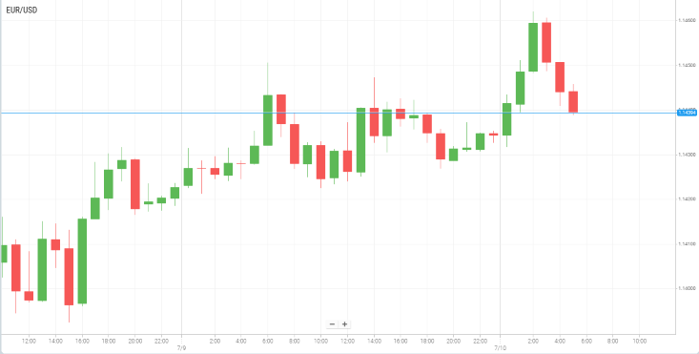
The euro traded modestly higher against the US Dollar on Friday, with EUR/USD hovering around 1.1430 during the early Asian session. The pair was supported by a softer greenback as investors increased their expectations for further European Central Bank (ECB) interest rate hikes amid persistent inflation concerns and renewed geopolitical uncertainty.
The ECB's latest meeting accounts, released on Thursday, showed that policymakers were presented with projections indicating inflation would remain above the central bank's target into next year despite the equivalent of nearly three additional rate hikes. After raising interest rates at its June meeting, the ECB is now widely expected to deliver two more increases over the next 12 months as it seeks to contain inflationary pressures, including those driven by higher energy prices linked to the Iran conflict.
Market expectations for additional ECB tightening have strengthened in recent days as hopes for a US-Iran agreement to end the conflict have faded. The prospect of prolonged geopolitical tensions has reinforced expectations that the ECB may need to keep monetary policy restrictive for longer, providing further support for the single currency.
Looking ahead, traders will closely monitor developments surrounding the US-Iran conflict. Any escalation in tensions could boost demand for safe-haven assets, potentially weighing on EUR/USD. However, a US official said on Thursday that Washington remains committed to the memorandum of understanding with Iran, despite President Donald Trump's remarks earlier this week that the proposed framework agreement to end the conflict was "over.
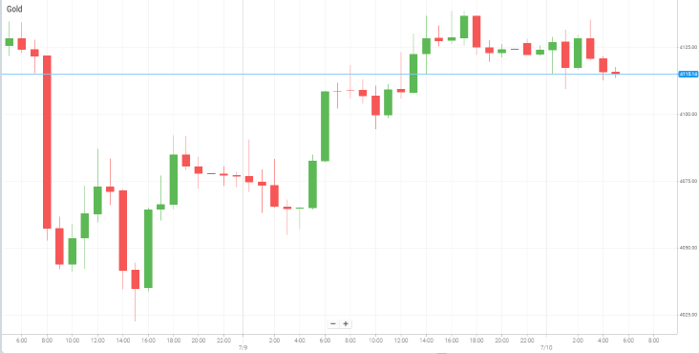
Gold prices hovered just above the $4,100 mark on Friday after recovering from a modest dip during the Asian session, although the precious metal continued to trade without strong directional momentum. A weaker US Dollar provided underlying support following the release of the Federal Reserve's less hawkish June meeting minutes, but expectations for further policy tightening and ongoing geopolitical tensions kept gains in check.
The minutes from the Federal Open Market Committee's (FOMC) June 16–17 meeting showed policymakers remained divided over the future path of interest rates. Reflecting that outlook, the CME FedWatch Tool continues to show markets pricing in a high probability of at least one Federal Reserve rate hike before the end of 2026.
Geopolitical developments also remained in focus. Tensions between the United States and Iran intensified after the US Central Command announced airstrikes targeting Iranian military infrastructure, including air defense systems, missile sites and naval logistics facilities.
However, market sentiment improved later after US President Donald Trump said Iran had reached out to pursue a deal with Washington. A White House official also reiterated that the United States remains committed to the existing memorandum of understanding with Tehran, offering investors some hope that diplomatic efforts could continue despite the recent escalation.
The conflicting signals have left investors cautious, with gold struggling to attract sustained buying interest despite the weaker dollar.
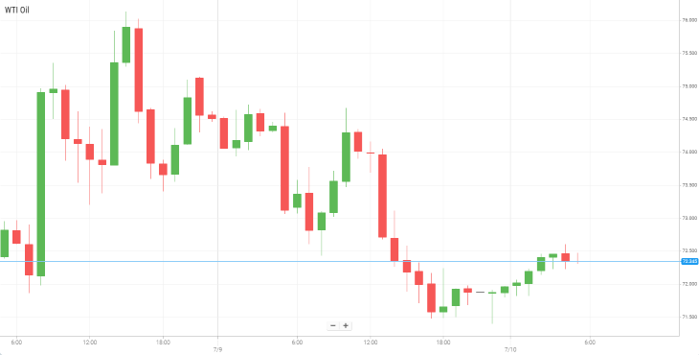
Oil prices edged lower in early Friday trading but remained on course for solid weekly gains as renewed military exchanges between the United States and Iran kept supply risks in focus. However, concerns that rising inflation could dampen global fuel demand limited further upside.
Geopolitical tensions escalated after Iranian armed forces launched attacks on US military facilities in Gulf states on Thursday in retaliation for American strikes on military targets in Iran's southern coastal and eastern provinces. Iranian media also reported multiple explosions across southern Iran, including in Bushehr, home to one of the country's nuclear power plants, adding to concerns over regional stability.
The renewed fighting has further delayed the full reopening of the Strait of Hormuz, one of the world's most important energy shipping routes, through which roughly one-fifth of global oil and gas supplies flowed before the conflict began. Continued disruptions to traffic through the strategic waterway have kept supply concerns elevated and supported oil prices.
Meanwhile, US economic data showed initial jobless claims declined last week, suggesting the labor market remains resilient despite signs of slower hiring. In China, producer price inflation accelerated to its highest level in four years in June, increasing pressure on manufacturers as weak domestic demand continued to limit pricing power, highlighting ongoing concerns about the outlook for global oil demand.
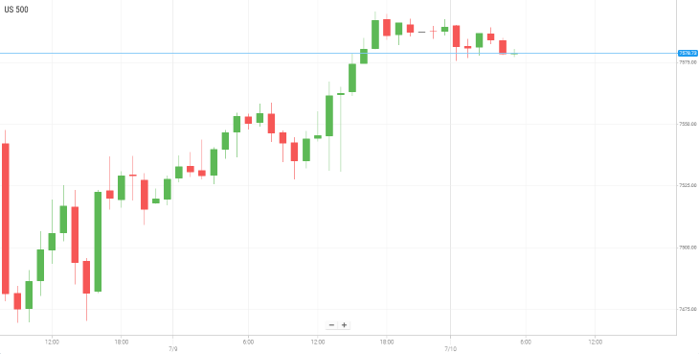
US stocks finished higher on Thursday, led by another strong advance in semiconductor shares, as investors continued to favor artificial intelligence-related stocks despite persistent geopolitical tensions in the Middle East.
Market sentiment remained firmly anchored by optimism surrounding artificial intelligence investment, with investors largely looking past geopolitical developments. Analysts noted that robust spending on AI infrastructure has continued to underpin equity markets, although concerns are gradually building over rising inflation, softer consumer demand and signs of a cooling labor market that could eventually challenge the current growth outlook.
Technology sentiment also received a boost from reports that Meta Platforms plans to begin production of its custom artificial intelligence chips in September while significantly expanding its computing capacity next year. In addition, enthusiasm surrounding SK Hynix's highly anticipated US stock listing supported the broader semiconductor sector, with reports indicating exceptionally strong investor demand for the offering.
Despite the upbeat performance in technology shares, investors continued to monitor developments in the Middle East. The conflict between the United States and Iran intensified after US forces carried out strikes on roughly 170 Iranian military targets in response to attacks on commercial oil tankers.
However, market sentiment improved after President Trump said Iran had contacted the United States seeking a new agreement. Although he questioned whether Tehran would honor any future deal, his remarks eased fears of an immediate escalation into a broader conflict.
Among individual companies, PepsiCo shares fell despite reporting second-quarter revenue that exceeded analysts' expectations, as earnings came in slightly below forecasts. Investors are now turning their attention to the upcoming second-quarter earnings season, with markets expected to remain focused on corporate guidance, AI-related spending trends and further developments surrounding US-Iran relations.
The materials contained on this document should not in any way be construed, either explicitly or implicitly, directly or indirectly, as investment advice, recommendation or suggestion of an investment strategy with respect to a financial instrument, in any manner whatsoever. Any indication of past performance or simulated past performance included in this document is not a reliable indicator of future results. For the full disclaimer click here.
Join iFOREX to get an education package and start taking advantage of market opportunities.
 A beginner's e-book
 $5,000 practice demo account
 A 12-part video course
 Trusted partner
 Featured partner
 By
By 


