
Listed on 
 Years active
 English (Arabic)
 Chinese Simplified - 中文 (简体)
 Chinese Traditional - 中文 (繁體)
 English
 Japanese - 日本語
 Korean - 한국어 (대한민국)
 Portuguese - Português
 Russian - Русский
 Spanish - Español
 Thai - ไทย
 English (India)
Don't have an account?
Register via AppHave an account?
Login 21/07/2026 - 07:27 UTC
The US Dollar Index (USDX) edged up 0.13% in its last trading session, remaining firmly supported by persistent inflation concerns and strong market expectations for additional Federal Reserve interest rate hikes later this year. Although diplomatic chatter surrounding the US-Iran conflict briefly tempered fears of an immediate regional escalation, safe-haven demand and a hawkish Fed outlook continued to underpin the Greenback.
Gold found renewed buyer interest despite the broader strength in the US dollar, gaining 0.36% in its last trading session to rise toward four-day highs near the $4,075 per ounce region. Safe-haven inflows stemming from ongoing Middle East tensions provided a solid floor for the precious metal, helping it offset pressure from elevated Treasury yields.
Crude oil prices pulled back from recent peaks as traders weighed potential mediation efforts against ongoing supply threats, with WTI dropping 1.63% toward the $82 per barrel mark. The temporary easing of geopolitical panic encouraged profit-taking, though active military friction and maritime blockade announcements in the Red Sea kept a firm baseline under energy prices.
Asian equity markets staged a sharp rebound from the prior session's steep selloff, with major regional benchmark indices across Japan, South Korea, mainland China, and Southeast Asia turning broadly higher or stabilizing. The regional recovery was spearheaded by a robust surge in South Korean semiconductor heavyweights, as investors stepped back into beaten-down technology assets, driving Samsung Electronics up 5.67% and SK Hynix up 4.06% in their last trading session.
On Wall Street, equity futures pointed toward a steadying trend as tech megacaps displayed a mixed performance across their latest trading sessions. Investors balanced ongoing geopolitical developments against upcoming quarterly updates, seeing Alphabet rise 1.53% and Nvidia record a modest 0.31% gain, while Tesla declined 2.92% and SpaceX slipped 3.43%.
The economic calendar is packed with market-moving data releases spanning several major economies, beginning on Wednesday with the UK Claimant Count Change, which is projected to show an increase of 31.2K. UK economic conditions will remain under intense scrutiny into Thursday with the release of the nation's annual Consumer Price Index (CPI), forecasted at 2.8%. Meanwhile, Asia-Pacific traders will be closely monitoring Australia’s labor market metrics, where expectations point to a solid 40.3K jobs added alongside a tight 4.4% unemployment rate.
All eyes this week are on the European Central Bank (ECB) monetary policy announcement. The central bank is widely expected to hold its Main Refinancing Rate steady at 2.40%, shifting the market's primary focus to the accompanying policy statement and subsequent press conference. Investors will be hanging on every word from policymakers to gauge the ECB's economic outlook, trajectory for future rate adjustments, and stance on euro-area inflation dynamics.
Running parallel to these economic catalysts, the Q2 corporate earnings season accelerates into high gear with a diverse mix of global heavyweights set to deliver their quarterly updates. Technology and electric vehicle giants Alphabet (GOOGL) and Tesla (TSLA) lead the earnings calendar, where executive commentary on artificial intelligence capital expenditures and EV demand will be critical for tech sentiment. The reporting slate is further complemented by major industry leaders across defensive, industrial, energy, and tech sectors—including tobacco giant Philip Morris (PM), energy infrastructure firm GE Vernova (GEV), analog chipmaker Texas Instruments (TXN), oil major ExxonMobil, and defense contractor Lockheed Martin.
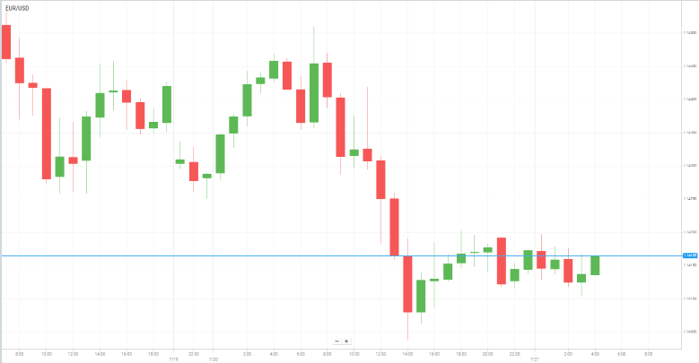
The EUR/USD pair trades with a modest negative bias near 1.1410 during the early Asian session on Tuesday as renewed geopolitical tensions in the Middle East underpin demand for the safe-haven US Dollar (USD). Investors will closely monitor the ZEW Economic Sentiment surveys from Germany and the Eurozone later in the day, while the US ADP employment report is also scheduled for release.
Risk sentiment deteriorated after the United States launched another round of military strikes against Iran on Tuesday, reportedly targeting military command centres, air defence systems, coastal surveillance sites, maritime assets, missile and drone launch facilities, as well as communications infrastructure.
Meanwhile, regional tensions intensified after Iran reportedly launched attacks on Bahrain and Kuwait, in addition to targeting tankers in the Strait of Hormuz. At the same time, Yemen's Iran-backed Houthi rebels announced a maritime embargo against Saudi Arabia. The escalating conflict has increased demand for safe-haven assets, lending support to the Greenback and weighing on the Euro (EUR) in the near term.
However, signs of easing US inflationary pressures could cap further USD gains by reinforcing expectations that the Federal Reserve will keep interest rates on hold. According to the CME FedWatch Tool, Fed funds futures imply an 84% probability that policymakers will leave rates unchanged at the July 29 meeting, up from 61.5% a month ago.
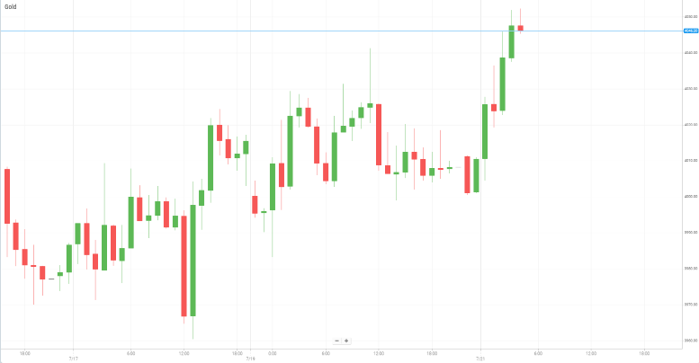
Gold attracts modest buying interest during the Asian session on Tuesday, recovering from the previous day's volatile trading. However, the precious metal struggles to build on its rebound and remains below the $4,050 mark as persistent demand for the US Dollar (USD) limits further gains.
Although tensions between the United States and Iran remain elevated following another exchange of military strikes, hopes for a diplomatic solution continue to provide some relief to financial markets. US Secretary of State Marco Rubio reiterated over the weekend that Washington remains open to negotiations with Tehran, helping to temper aggressive safe-haven flows into the Greenback and offering some support to Gold.
At the same time, growing concerns over energy-driven inflation continue to strengthen expectations that the Federal Reserve may maintain a restrictive monetary policy for longer. Disruptions to shipping through the Strait of Hormuz have intensified concerns over global oil supplies, while Yemen's Iran-backed Houthi rebels have announced a maritime blockade against Saudi Arabia.
The resulting rise in crude oil prices has reinforced inflation fears, prompting investors to price in a greater likelihood of higher US interest rates. According to the CME FedWatch Tool, markets currently see roughly an 84% probability that the Fed will raise interest rates before the end of the year, a backdrop that supports the USD and weighs on the non-yielding precious metal.
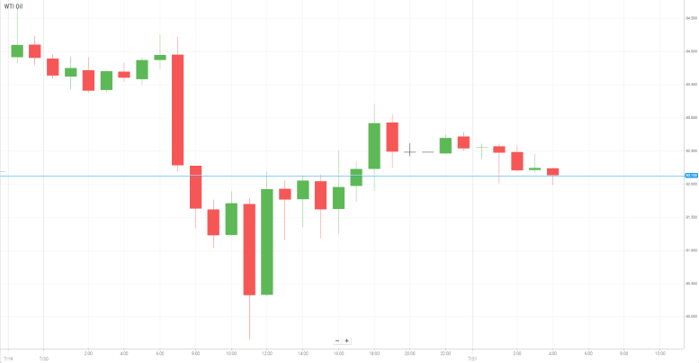
Oil prices edged lower during Tuesday's Asian session as investors balanced renewed geopolitical tensions in the Middle East against reports of diplomatic efforts aimed at easing the conflict between the United States and Iran.
Market sentiment remained cautious after Yemen's Iran-backed Houthi rebels announced plans to impose a naval blockade on Saudi Arabia, raising concerns over potential disruptions to another major oil exporter. The move has heightened fears of broader supply risks, adding to existing uncertainty surrounding energy markets and global trade routes.
At the same time, reports that Iran had received a proposal for a 10-day ceasefire through international mediators helped temper bullish sentiment. The proposal is reportedly intended to preserve an interim agreement reached in June and create a pathway toward a more lasting resolution to the conflict, offering some hope that tensions could eventually ease.
The combination of ongoing military action and tentative diplomatic progress has left oil markets searching for direction. While geopolitical risks continue to provide underlying support to crude prices, expectations that negotiations could eventually reduce tensions have limited further upside for the time being.
Meanwhile, investors are also awaiting fresh US inventory data after a preliminary Reuters survey suggested that US crude and gasoline stockpiles declined last week, while distillate inventories likely increased. The official inventory figures could provide additional direction for oil prices later in the week.
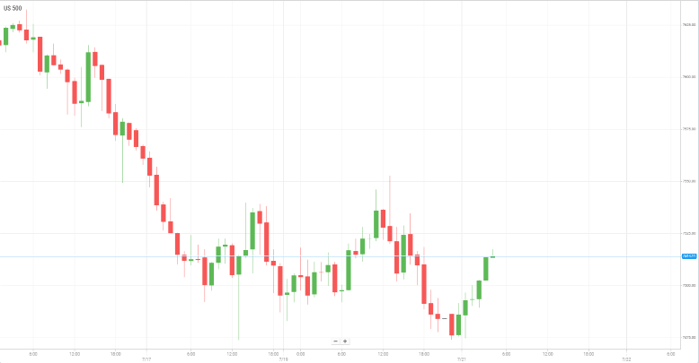
Wall Street closed lower on Monday as investors remained cautious amid ongoing geopolitical tensions in the Middle East and looked ahead to a busy week of second-quarter corporate earnings, particularly from major technology companies.
Investor focus has shifted firmly toward earnings season, with market participants awaiting quarterly results from major companies, including Alphabet, Tesla, Intel, and Texas Instruments while geopolitical developments also remained in focus
The prospect of de-escalation has become increasingly important for investors, as a reduction in hostilities could improve oil supplies by easing disruptions around the Strait of Hormuz and help limit further increases in energy prices, thereby reducing inflationary pressures on consumers and the broader economy.
Among individual stocks, Apple weighed heavily on the broader market, falling more than 2%, while Microsoft provided one of the strongest positive contributions to the US 500. Alphabet gained 1.5% following reports that its Google division is developing a Gemini-powered server chip designed to improve artificial intelligence efficiency and reduce computing constraints.
Trading activity was relatively subdued, reflecting investors' reluctance to take aggressive positions ahead of a heavy earnings calendar and further developments in the Middle East.
The materials contained on this document should not in any way be construed, either explicitly or implicitly, directly or indirectly, as investment advice, recommendation or suggestion of an investment strategy with respect to a financial instrument, in any manner whatsoever. Any indication of past performance or simulated past performance included in this document is not a reliable indicator of future results. For the full disclaimer click here.
Join iFOREX to get an education package and start taking advantage of market opportunities.
 A beginner's e-book
 $5,000 practice demo account
 A 12-part video course
 Trusted partner
 Featured partner
 By
By 


