
Listed on 
 Years active
 English (Arabic)
 Chinese Simplified - 中文 (简体)
 Chinese Traditional - 中文 (繁體)
 English
 Japanese - 日本語
 Korean - 한국어 (대한민국)
 Portuguese - Português
 Russian - Русский
 Spanish - Español
 Thai - ไทย
 English (India)
Don't have an account?
Register via AppHave an account?
Login 03/04/2026 - 07:16 UTC
The USDX retreated on Thursday, falling -0.28% to trade near the 99.30 level as the market navigated a complex web of geopolitical signals. Despite President Trump’s "Stone Age" warning to Tehran and his confirmation of a strike on a bridge near the Iranian capital, the Greenback’s safe-haven premium faced selling pressure following reports that the Iranian presidency had requested a ceasefire. While the administration’s new executive order regarding 100% tariffs on certain imported medicines introduced additional cross-currents, investors remained primarily focused on the potential for a diplomatic de-escalation ahead of the critical U.S. labor data.
Gold prices surged 1.87% on Thursday, reclaiming significant ground to trade near the $4,800 threshold. The bullion capitalized on the corrective pullback in both the U.S. Dollar and Treasury yields as market participants reacted to the possibility of a ceasefire. Although a spike in energy prices and a hawkish Federal Reserve outlook continue to act as long-term headwinds, the metal found strong support from the immediate easing of dollar demand. Trading activity began to thin ahead of the Good Friday holiday, with all eyes now on the pivotal Non-Farm Payrolls (NFP) release to determine if the upward momentum can be sustained.
WTI Oil prices surged on Thursday, climbing 13.27% to settle near the $104.00 mark as escalating tensions in the Middle East fueled a massive wave of buying. The rally was ignited by President Trump’s confirmation of military strikes on infrastructure near Tehran and his warning of intensified actions over a strict two-to-three-week timeline. These developments effectively overshadowed brief hopes for a ceasefire, refocusing the market on the critical blockade of the Strait of Hormuz. With the U.S. maintaining a hardline stance and threatening further strikes on Iranian energy hubs if negotiations fail, a substantial "war premium" remains firmly embedded in crude prices.
Asian equity markets remained under intense pressure on Friday morning as investors grappled with a volatile mix of escalating geopolitical rhetoric and disappointing corporate data. While some regional markets saw a technical bounce in thin holiday trade, the broader sentiment was marred by U.S. President Donald Trump’s late-Thursday warning on Truth Social that the military campaign in Iran has "not even started," with critical infrastructure now in the crosshairs. This follows a difficult session for individual stocks, most notably Tesla, which fell -5.47% on Thursday following lackluster first-quarter delivery figures and broader weakness in the consumer discretionary sector.
As of 06:47 AM GMT, mainland Chinese indices extended their retreat amid data showing a cooling services sector. The China SSE fell -0.99% and the China SZSE dropped -0.86%, as the RatingDog Services PMI retreated from its February highs In Japan, despite an initial attempt at a recovery in technology shares, the Japan 225 ultimately slid -2.04% as the surge in global oil prices above $110 per barrel heightened concerns over energy-driven inflation and its impact on the Bank of Japan's policy path. The most severe decline was recorded in South Korea, where the Korea 200 plummeted -4.81%. The index was hit hard by the combination of Trump’s intensifying threats against Iranian energy hubs and the lingering "war premium" that continues to overshadow recent diplomatic efforts by Iran and Oman to manage traffic through the Strait of Hormuz.
The week concludes with a crucial assessment of a U.S. economy currently seeing very little hirings or releases. At 3:30 PM, the release of the Non-Farm Payrolls (NFP) report is expected to show an addition of 65K jobs, a vital signal of stabilization following February's jarring contraction of 92K. While the Unemployment Rate is projected to hold steady at 4.4%, the Federal Reserve’s next move may hinge more heavily on the Average Hourly Earnings data. A forecast increase of 0.3% month-on-month will be closely scrutinized for signs of energy-driven wage inflation—a factor that, if persistent, could reinforce the Fed's "higher-for-longer" stance and delay any shift toward rate cuts.
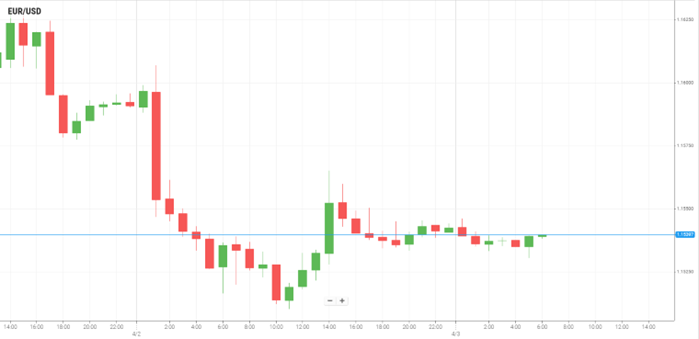
EUR/USD remained under pressure on Thursday, as persistent geopolitical tensions in the Middle East supported the US Dollar and weighed on the Euro.
Market sentiment continues to be driven by rapidly shifting headlines surrounding the US-Iran conflict. Earlier expectations of a potential de-escalation were dampened after US President Donald Trump signaled that military operations would continue, offering no clear timeline for resolution.
Following these remarks, oil prices resumed their upward trajectory amid renewed concerns over potential supply disruptions, particularly through the Strait of Hormuz. The move higher in crude also supported the US Dollar, which rebounded from a one-week low as demand for safe-haven assets increased.
Markets are currently pricing in two to three additional rate hikes from the European Central Bank by year-end. In contrast, expectations for the Federal Reserve point to a prolonged pause, with rates likely to remain unchanged through 2026.
The Eurozone is seen as more exposed to an energy shock due to its reliance on imported energy, while the United States, as a net exporter, is relatively better positioned to absorb rising oil prices.
At the same time, inflation in the Eurozone is closer to the ECB’s 2% target, whereas US price pressures remain comparatively elevated, reinforcing a cautious stance from the Federal Reserve.
Looking ahead, market focus shifts to Friday’s US Nonfarm Payrolls report, which is expected to provide further insight into the Federal Reserve’s policy path and could drive near-term direction in EUR/USD.
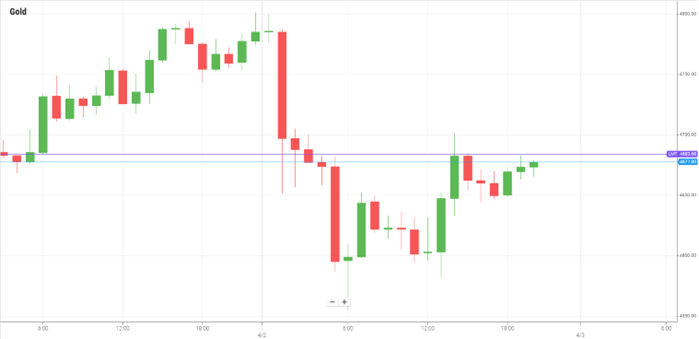
Gold prices edged lower on Thursday, with XAU/USD ending the session near $4,675 as markets remained cautious ahead of the US Nonfarm Payrolls report.
The precious metal came under pressure after US President Donald Trump signaled an escalation in the conflict with Iran, a move that drove oil prices higher and shifted expectations around US monetary policy.
In a televised address on Thursday, Trump stated that key objectives in Iran were “nearing completion,” but warned that the United States would intensify its actions over the next two to three weeks. The comments dampened hopes for a near-term de-escalation and reinforced concerns about prolonged geopolitical tensions.
Market participants now turn their attention to the US March employment report, which is expected to provide fresh guidance on the Federal Reserve’s policy outlook. Economists forecast Nonfarm Payrolls to rise by 60,000 in March, while the Unemployment Rate is projected to hold steady at 4.4%.
A weaker-than-expected labor market report could pressure the US Dollar and offer support to gold prices in the near term, while a stronger reading may reinforce the current bearish bias in the metal.
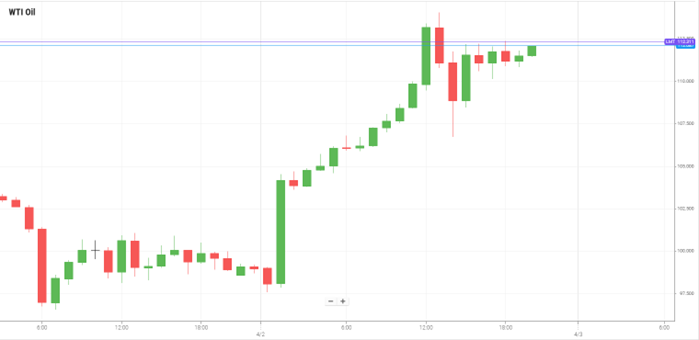
Oil prices rallied sharply on Thursday with US crude jumping more than 13% as markets reacted to escalating tensions in the Middle East.
The surge followed remarks from US President Donald Trump, who signaled that military operations against Iran would intensify, while offering no clear timeline for a resolution. The comments heightened concerns over prolonged supply disruptions, particularly through the strategically critical Strait of Hormuz.
The waterway, which handles roughly a fifth of global oil and liquefied natural gas shipments, has effectively been shut following Iranian retaliation to US-Israeli strikes. Efforts to reopen the passage are now a top priority for governments, as the disruption continues to drive energy prices higher.
Market participants are increasingly focused on the risk of damage to Iran’s oil infrastructure and the potential for extended delays in restoring regional supply flows. Even in the absence of further damage, uncertainty around the timing of a restart is keeping risk premiums elevated.
On the supply side, US oil rig counts rose modestly this week, signaling a potential increase in future production. However, producers remain cautious, indicating they would need to see sustained higher prices before committing to significant expansion.
Meanwhile, diplomatic efforts are underway to address the crisis. The UK is set to host talks with multiple countries on reopening the Strait of Hormuz, while OPEC+ is expected to consider additional output increases in the coming days, although any immediate impact on supply is likely to be limited.
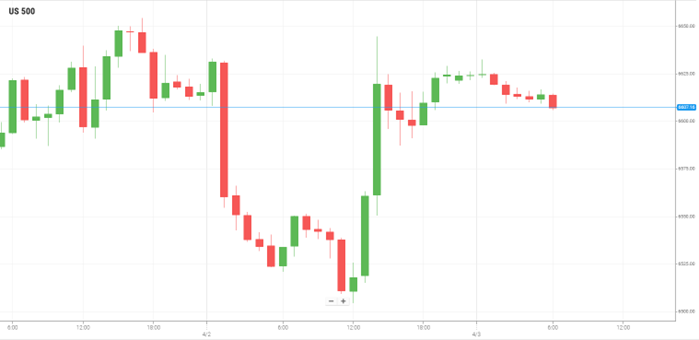
US equities closed marginally higher on Thursday, staging a late-session rebound after early losses as investors navigated conflicting signals on the Iran conflict.
Markets were initially pressured after US President Donald Trump dampened expectations for a near-term de-escalation with Iran, but sentiment improved later in the session following reports that Tehran is working with Oman on a framework to manage shipping through the Strait of Hormuz.
Despite the late recovery, overall sentiment remained cautious, with traders reluctant to take large positions ahead of the Good Friday holiday and the release of key US employment data.
The week has been marked by sharp swings in sentiment. Earlier optimism, driven by signs of potential diplomatic progress and reports of ceasefire discussions, fueled a strong rally in equities. However, that momentum faded as uncertainty around the conflict’s duration and impact resurfaced.
Attention now turns to the US Nonfarm Payrolls report, due Friday, which is expected to provide further clarity on the strength of the labor market and the Federal Reserve’s policy outlook.
In corporate news, Tesla shares fell 5.4% after the company reported weaker-than-expected vehicle deliveries for a second consecutive quarter.
The materials contained on this document should not in any way be construed, either explicitly or implicitly, directly or indirectly, as investment advice, recommendation or suggestion of an investment strategy with respect to a financial instrument, in any manner whatsoever. Any indication of past performance or simulated past performance included in this document is not a reliable indicator of future results. For the full disclaimer click here.
Join iFOREX to get an education package and start taking advantage of market opportunities.
 A beginner's e-book
 $5,000 practice demo account
 A 12-part video course
 Trusted partner
 Featured partner
 By
By 


