
Listed on 
 Years active
 English (Arabic)
 Chinese Simplified - 中文 (简体)
 Chinese Traditional - 中文 (繁體)
 English
 Japanese - 日本語
 Korean - 한국어 (대한민국)
 Portuguese - Português
 Russian - Русский
 Spanish - Español
 Thai - ไทย
 English (India)
Don't have an account?
Register via AppHave an account?
Login 19/03/2026 - 07:52 UTC
The USDX rose 0.76% on Wednesday, reclaiming the 100.10 level following a hawkish hold from the Federal Reserve. While the central bank kept interest rates unchanged at 3.50%–3.75%, Chair Jerome Powell warned that the Iran-Israel conflict has created "elevated upside risks" to inflation through surging energy costs. This sentiment was reinforced by Wednesday's PPI data, which showed wholesale inflation jumping to 3.4% YoY, the highest in a year, prompting markets to dial back expectations for imminent rate cuts and providing fresh momentum to the Greenback.
In the energy markets, WTI Oil gained 2.46% on Wednesday, trading near the $97.80 per barrel mark. While the White House granting a 60-day Jones Act waiver and allowing limited trade with Venezuela’s state oil firm provided some supply-side relief, these factors were overshadowed by a dangerous escalation in the Middle East. Iran launched missile strikes on a major Qatari LNG facility in retaliation for an Israeli hit on the South Pars gas field, ensuring that a significant geopolitical risk premium remains embedded in crude prices as regional energy infrastructure remains under direct threat.
Conversely, Gold fell 3.32% on Wednesday, tumbling toward the $4,830 level as the Federal Reserve’s "higher-for-longer" stance weighed heavily on the non-yielding asset. Despite the intense "flight to safety" triggered by the retaliatory cycle between Iran and Israel, the precious metal faced a sixth consecutive day of selling pressure. Investors prioritized the USD and cash positions as Chair Powell walked back previous dovish hopes, focusing on a restrictive policy path to combat energy-led inflation spikes and persistent wholesale price pressures.
Most Asian stock markets retreated on Thursday as investors processed a dual-policy shock from the U.S. Federal Reserve and the Bank of Japan amid an escalating energy crisis. In China, equities faced renewed selling pressure despite recent positive industrial output data, as the geopolitical risk premium continues to trigger foreign capital outflows. As of 06:12 AM GMT, the China SSE fell 0.97%, while the China SZSE dropped 1.50%. Hong Kong markets were also caught in the downturn, with the Hong Kong 50 slipping 0.23%. Investors remain focused on how Beijing will manage the inflationary impact of WTI Oil prices on domestic manufacturing margins, especially as global trade tensions persist.
The Japanese market led regional losses following the Bank of Japan’s decision to maintain its short-term policy rate at 0.75%. While the hold was expected, the board’s warning regarding "rising uncertainty" over inflation—and a notable dissent from board member Hajime Takata calling for a hike—signaled that a firmer policy response may be imminent. By 06:12 AM GMT, the Japan 225 fell 0.64%, as the surge in imported energy costs continues to cloud the outlook for the world's third-largest economy and complicates the timing for further policy normalization.
The South Korean market faced a significant downturn as high-tech exporters reacted to a more restrictive global monetary outlook. By 06:12 AM GMT, the Korea 200 plummeted 2.95%, lead by a sharp correction in semiconductor giants like Samsung Electronics and SK Hynix. Investors in Seoul are now recalibrating their expectations for the chip sector as fluctuating global demand and the persistent strength of WTI Oil prices continue to pressure manufacturing margins.
In the United States, corporate developments are dominated by intensifying competition and a strong retail performance. Meanwhile, the AI sector is bracing for results from Micron, which recently provided a rosy profit forecast supported by elevated memory chip prices. This comes as Microsoft considers legal action against the Amazon-OpenAI $50 billion cloud deal, a dispute centered on whether OpenAI’s new "Frontier" model violates existing exclusivity agreements. The outcome of this friction, alongside Micron’s upcoming supply guidance, will likely dictate the next direction for Wall Street’s technology benchmarks.
Thursday’s focus is on the Bank of England, where the Official Bank Rate is expected to hold at 3.75%. Markets will watch the MPC vote split, forecast at 0-2-7, for signs of a shift in policy stance amid global inflation risks. Later, U.S. unemployment claims (expected at 213K) will provide fresh insight into labor market strength following the Fed’s hawkish hold.
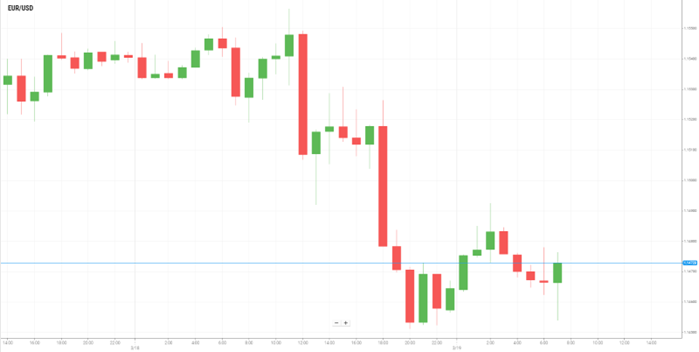
The EUR/USD pair weakened to around 1.1465 during Thursday’s early Asian session, pressured by a stronger US Dollar following a relatively hawkish stance from the Federal Reserve. Market attention now turns to the European Central Bank’s (ECB) upcoming interest rate decision later in the day.
As widely expected, the Federal Reserve left its benchmark interest rate unchanged at 3.5%–3.75% at its March policy meeting on Wednesday. However, policymakers signaled that potential rate cuts could be considered in 2026. Fed Chair Jerome Powell noted that while inflation is expected to ease, progress may be slower than previously anticipated. He also warned that rising oil prices, partly driven by geopolitical tensions involving Iran, could add upward pressure on inflation in the near term.
Powell further stated that he intends to remain in his role as Fed Chair until the conclusion of an ongoing investigation related to the central bank’s headquarters and will continue in the position until a successor is formally confirmed.
Meanwhile, the ECB is broadly expected to keep its key interest rates unchanged at its March meeting. Market sentiment has recently shifted, with investors scaling back expectations for additional rate cuts. This shift reflects persistent inflationary pressures in the Eurozone, which may limit the central bank’s room to ease policy in the near term. As a result, any deviation from the current policy stance could trigger increased volatility in the EUR/USD pair.
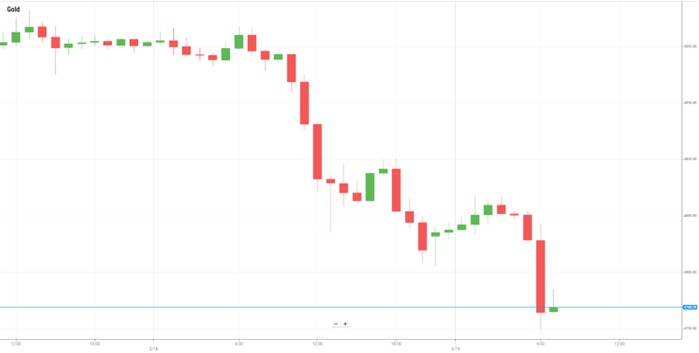
Gold erased its modest intraday gains and dropped to a fresh low not seen since early February, slipping below the $4,800 level heading into Thursday’s European session. A stronger US Dollar, supported by the Federal Reserve’s hawkish outlook, continues to pressure the non-yielding metal. However, rising geopolitical tensions may help limit deeper losses by sustaining demand for safe-haven assets.
Data released by the US Labor Department on Wednesday showed that the Producer Price Index (PPI) rose 0.7% in February, following a 0.3% increase in January. On an annual basis, PPI climbed to 3.4%, marking the largest increase since February 2025. In addition, the Federal Reserve raised its year-end inflation outlook, citing risks linked to higher energy prices amid escalating tensions involving Iran. The central bank also upgraded its 2026 growth forecast and signaled only one rate cut this year, followed by another in 2027. This outlook continues to support the US Dollar and caps any meaningful upside in Gold prices.
Meanwhile, geopolitical risks remain elevated after reported attacks on energy infrastructure in the Persian Gulf, following Israeli strikes on Iran’s South Pars gas field—the largest in the world. In response, US President Donald Trump warned of potential large-scale retaliation, while reports suggest the US may expand its military presence in the region. This escalation has unsettled investor sentiment and may continue to underpin demand for Gold as a traditional safe-haven asset.
Investors are also awaiting policy decisions from major central banks, including the Swiss National Bank (SNB), the Bank of England (BoE), and the European Central Bank (ECB), which could inject further volatility into global markets. Additionally, upcoming US data releases, such as Weekly Initial Jobless Claims and the Philly Fed Manufacturing Index, may influence short-term price action.
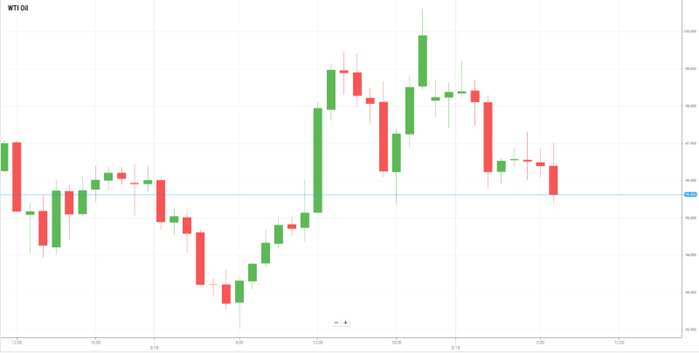
Oil prices settled higher on Wednesday following Iran’s attacks on key energy facilities across the Middle East. The escalation came in response to a strike on Iran’s South Pars gas field, marking a significant intensification of the conflict involving the United States and Israel.
The upward momentum in Brent prices was largely driven by fresh attacks on energy infrastructure across the region. Qatar reported extensive damage to facilities in Ras Laffan Industrial City following missile strikes, while Saudi Arabia confirmed it had intercepted multiple ballistic missiles targeting Riyadh, along with a drone attack on a gas installation in the country’s east.
Iran has also issued warnings indicating that additional strikes on energy infrastructure in Saudi Arabia, the United Arab Emirates, and Qatar could follow, further heightening concerns over regional stability. The escalation comes after an attack on Iran’s South Pars gas field, reportedly carried out by Israel with US backing, although neither country has officially confirmed involvement.
In response to rising fuel prices, US President Donald Trump’s administration introduced temporary measures aimed at easing domestic supply pressures. These include a 60-day waiver of the Jones Act, allowing foreign-flagged vessels to transport fuel between US ports, as well as a temporary relaxation of gasoline regulations. While these steps may help stabilize US fuel prices, market participants believe their impact on global oil markets will be limited.
Despite these efforts, US diesel prices surged, with futures reaching a substantial premium over WTI crude, highlighting ongoing tightness in refined fuel markets.
US inventory data showed mixed signals, with crude stockpiles rising by 6.2 million barrels last week, while gasoline and distillate inventories declined, reflecting ongoing demand strength. Overall, escalating geopolitical tensions continue to dominate the oil market outlook, with supply risks underpinning prices despite efforts to stabilize flows.
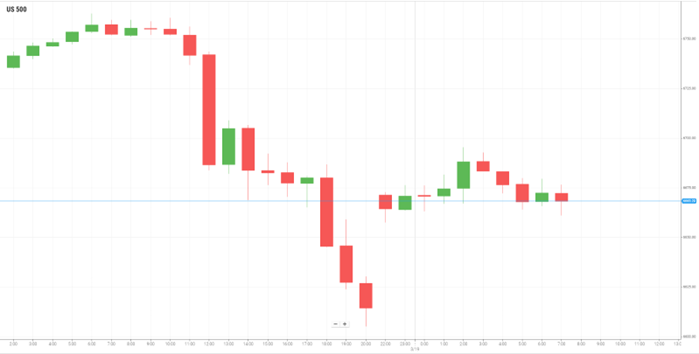
US stock index futures moved slightly lower on Wednesday evening after Wall Street posted sharp losses in the regular session, as investors reacted to a hawkish Federal Reserve stance and escalating tensions in the Middle East that kept oil prices elevated.
The Federal Reserve left interest rates unchanged, in line with expectations, but maintained a cautious tone. Policymakers raised their inflation outlook and signaled only limited monetary easing in the near term, reflecting concerns that higher oil prices could slow progress toward the central bank’s inflation target.
Federal Reserve Chair Jerome Powell highlighted energy markets as a growing source of uncertainty, warning that sustained increases in fuel costs may complicate efforts to achieve price stability. His remarks prompted traders to further dial back expectations for imminent rate cuts, even as the Fed continues to signal one reduction later this year.
Investor sentiment was also pressured by a sharp escalation in the Middle East, after Iran launched attacks on key energy infrastructure across the region following a strike on its South Pars gas field—one of the world’s largest. The attacks reportedly caused damage to facilities linked to Qatar’s Ras Laffan energy complex, heightening fears of supply disruptions.
Overall, a combination of persistent inflation concerns and rising geopolitical risks is likely to keep market sentiment fragile. In the near term, equities may remain under pressure as investors reassess interest rate expectations and monitor developments in global energy markets
The materials contained on this document should not in any way be construed, either explicitly or implicitly, directly or indirectly, as investment advice, recommendation or suggestion of an investment strategy with respect to a financial instrument, in any manner whatsoever. Any indication of past performance or simulated past performance included in this document is not a reliable indicator of future results. For the full disclaimer click here.
Join iFOREX to get an education package and start taking advantage of market opportunities.
 A beginner's e-book
 $5,000 practice demo account
 A 12-part video course
 Trusted partner
 Featured partner
 By
By 


