
Listed on 
 Years active
 English (Arabic)
 Chinese Simplified - 中文 (简体)
 Chinese Traditional - 中文 (繁體)
 English
 Japanese - 日本語
 Korean - 한국어 (대한민국)
 Portuguese - Português
 Russian - Русский
 Spanish - Español
 Thai - ไทย
 English (India)
Don't have an account?
Register via AppHave an account?
Login 21/08/2026 - 05:14 UTC
The US Dollar Index is trading around 98.80-98.75 during Asian hours on Friday, remaining close to its lowest level since mid-May after struggling to extend the previous session’s modest rebound. The index is down around 0.10% as seen on iForex platform at 04:30 GMT on the day and is heading for a significant weekly decline.
The Greenback remains under pressure as markets scale back expectations for an immediate Federal Reserve rate hike following softer-than-expected US inflation data. At the same time, the impact of the US Treasury’s decision to increase the size of certain long-dated debt buyback operations has faded, with renewed inflation concerns linked to elevated energy prices keeping US yields supported.
On the energy front, crude oil prices climbed to a three-week high on Thursday after President Donald Trump announced plans for a tougher economic campaign against Iran and threatened severe penalties against countries helping Tehran circumvent sanctions. The heightened geopolitical tensions continue to provide some safe-haven support for the US Dollar and could discourage traders from building aggressive bearish positions.
Gold rises to a fresh high since early June near $4,544, supported by renewed US Dollar weakness and fading Fed rate-hike expectations following softer US inflation data. However, higher oil prices and persistent US-Iran tensions are keeping inflation risks and US Treasury yields elevated, which could limit further USD losses. Markets still see around a 68% chance of at least one Fed hike by year-end, while geopolitical uncertainty continues to support safe-haven demand. Overall, Gold retains a bullish bias, though elevated yields and potential USD rebounds could cap further gains.
Bitcoin surged early on Friday, continuing the positive momentum from previous sessions, as optimism over clearer US cryptocurrency regulation boosted sentiment. President Donald Trump urged Congress to advance the Clarity Act, although the legislation remains stalled over disagreements about crypto classifications and stablecoin yields. Bitcoin is on track for its strongest weekly gain in more than two years, breaking above its previous 2026 trading range of $60,000-$70,000. Crypto-related stocks also rallied, while US spot Bitcoin ETFs recorded around $1 billion in inflows this week, marking their strongest weekly inflow since January.
Asian stocks broadly recovered on Friday, led by South Korea’s technology sector, but the rebound remained fragile as rising US Treasury yields, elevated oil prices and concerns over US fiscal sustainability kept regional markets on track for weekly losses.
The Korea 200 gained as semiconductor stocks recovered, with SK Hynix and Samsung Electronics supporting the rebound, while the Nikkei 225 remained under pressure amid stronger Japanese inflation and expectations that the Bank of Japan could raise rates as early as September.
US stock futures were largely steady early Friday after Wall Street suffered its sharpest decline in three weeks, as rising Treasury yields and higher oil prices renewed concerns over inflation and borrowing costs.
The selloff was also intensified by weakness in consumer stocks, with Walmart plunging 9.48% after weaker-than-expected sales growth and a cautious outlook. Amazon, Home Depot and American Express also declined, while Deere bucked the trend after raising the lower end of its full-year profit forecast.
Attention now turns to Nvidia’s earnings and next week’s Jackson Hole symposium, which could provide fresh direction for technology stocks and expectations for Federal Reserve policy.
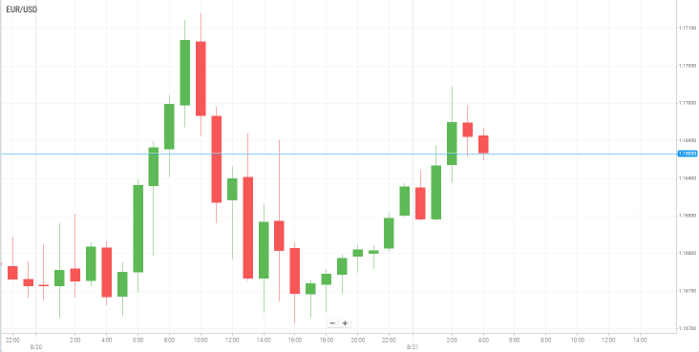
EUR/USD is extending its gains for a third consecutive session, trading around 1.1680 during Asian hours on Friday. The Euro is finding support from resilient economic fundamentals across the Eurozone, while markets await the latest HCOB Purchasing Managers’ Index (PMI) data from Germany and the broader Eurozone for fresh directional cues.
The Euro is also benefiting from renewed inflation concerns as European natural gas prices surge amid supply disruptions linked to the Middle East. Persistent energy price pressures could strengthen the case for the European Central Bank to maintain its hawkish stance and continue raising interest rates through the year.
Recent German data reinforce the inflationary outlook. Producer prices rose 3.0% year-on-year in July, exceeding expectations for a 2.7% increase and marking the fastest annual growth since April 2023. Prices also rebounded 1.1% month-on-month, pointing to continued inflationary pressure in the region.
However, further EUR/USD gains could be limited by renewed strength in the US Dollar.
Federal Reserve’s Musalem maintained a broadly neutral policy stance but struck a hawkish tone on inflation risks. He described monetary policy and financial conditions as accommodative while warning that underlying inflation of 2.5%-3% remains too high.
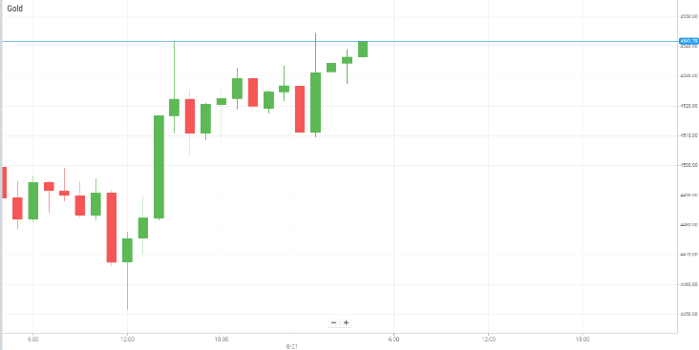
Gold prices are holding above the $4,500-an-ounce level on Friday, keeping the precious metal on track for a third consecutive weekly gain. The rally has been supported by a weaker US Dollar and efforts by the US Treasury to contain longer-term Treasury yields, which have improved the appeal of non-yielding bullion.
The precious metal has held most of its recent gains after breaking decisively above $4,500, extending its recovery from the late-June low near $3,940. The move has been closely linked to developments in US bond markets after the Treasury announced plans to double its purchases of longer-dated Treasury securities to at least $4 billion per operation over the next quarter.
The Dollar’s weakness has provided an additional boost to gold as markets reassess the appeal of US assets amid rising fiscal concerns. Meanwhile, US labor data showed weekly jobless claims edging lower, suggesting that the labor market remains relatively resilient despite July’s unexpected employment decline. Moreover, geopolitical developments are adding another layer of support to the precious metal.
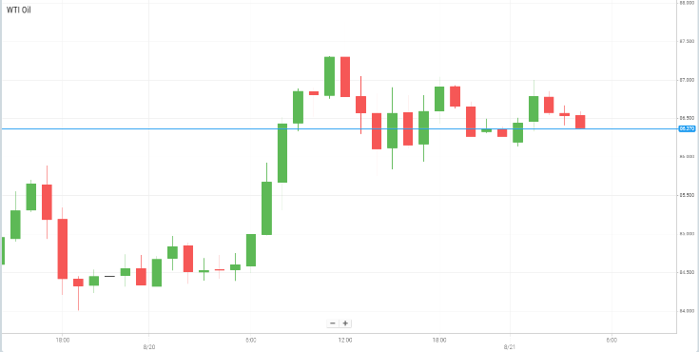
Oil prices were little changed on Friday but remained on track for a second consecutive weekly gain as the unresolved US-Iran conflict continued to disrupt crude supplies from the Middle East.
The rally has been driven by concerns that the ongoing conflict will keep supply from major producers, including Saudi Arabia, Iraq, the United Arab Emirates and Kuwait, constrained.
The latest peace agreement expired this week without either side showing willingness to resume negotiations, while US President Donald Trump threatened further economic retaliation against countries supporting Iran. The United Arab Emirates has also suspended financial and economic transactions with Iran, highlighting the escalating tensions between Tehran and a major Gulf oil producer.
Supply concerns have been reinforced by disruptions around the Strait of Hormuz, a critical route for global energy shipments. Only nine vessels transited the waterway on Wednesday, unchanged from the previous day and well below pre-war levels. Before the conflict began, the Strait of Hormuz handled volumes equivalent to around one-fifth of global oil consumption.
With the conflict showing little sign of a quick resolution and energy flows remaining disrupted, persistent supply risks are keeping upward pressure on crude prices and supporting expectations for further weekly gains.
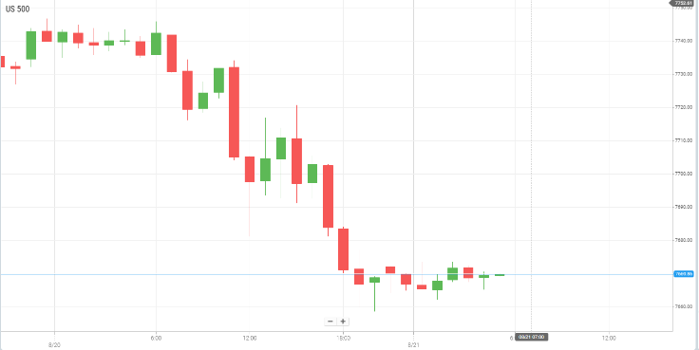
Wall Street closed lower on Thursday as an initial rally in US Treasuries faded, while rising oil prices and renewed concerns over inflation weighed on market sentiment.
The bond market remained at the center of attention after the US Treasury announced plans to increase purchases of longer-dated government debt to at least $4 billion from $2 billion. The announcement initially pushed Treasury yields lower, with the 30-year yield falling 9.1 basis points and the 10-year yield declining 5.3 basis points.
However, the bond rally proved short-lived as traders resumed selling on Thursday. The 30-year yield climbed 5.6 basis points to 5.250%, with concerns over US fiscal conditions resurfacing after total government debt surpassed $40 trillion.
Investors were also digesting the Federal Reserve’s July meeting minutes, which showed that many policymakers could support rate hikes if inflation fails to ease. Most officials backed the decision to keep rates unchanged in July, while several policymakers warned that inflation risks remained tilted to the upside.
The minutes also highlighted concerns that the renewed conflict in the Middle East could prolong supply-chain disruptions and increase inflationary pressures.
Corporate earnings added further pressure to equities. Walmart shares fell 9.48% after the retailer reported its weakest US comparable-sales growth in six years, missing market expectations.
The materials contained on this document should not in any way be construed, either explicitly or implicitly, directly or indirectly, as investment advice, recommendation or suggestion of an investment strategy with respect to a financial instrument, in any manner whatsoever. Any indication of past performance or simulated past performance included in this document is not a reliable indicator of future results. For the full disclaimer click here.
Join iFOREX to get an education package and start taking advantage of market opportunities.
 A beginner's e-book
 $5,000 practice demo account
 A 12-part video course
 Trusted partner
 Featured partner
 By
By 


