
Listed on 
 Years active
 English (Arabic)
 Chinese Simplified - 中文 (简体)
 Chinese Traditional - 中文 (繁體)
 English
 Japanese - 日本語
 Korean - 한국어 (대한민국)
 Portuguese - Português
 Russian - Русский
 Spanish - Español
 Thai - ไทย
 English (India)
Don't have an account?
Register via AppHave an account?
Login 20/03/2026 - 09:00 UTC
The USDX saw a significant decline of -1.05% on Thursday, trading near the 100.10 level. This followed a period of strength where the index had gained 0.75% in the previous session. While the Federal Reserve maintained interest rates at 3.50%–3.75% during its March meeting and adopted a more hawkish tone, the Greenback remained under pressure. Fed Chair Jerome Powell noted that the pace of disinflation might be slower than expected, particularly as oil price increases driven by the Iran conflict are likely to push inflation higher in the near term. Persistent inflationary pressures were further evidenced by February’s Producer Price Index (PPI), which rose 0.7% month-over-month, marking its largest increase in seven months.
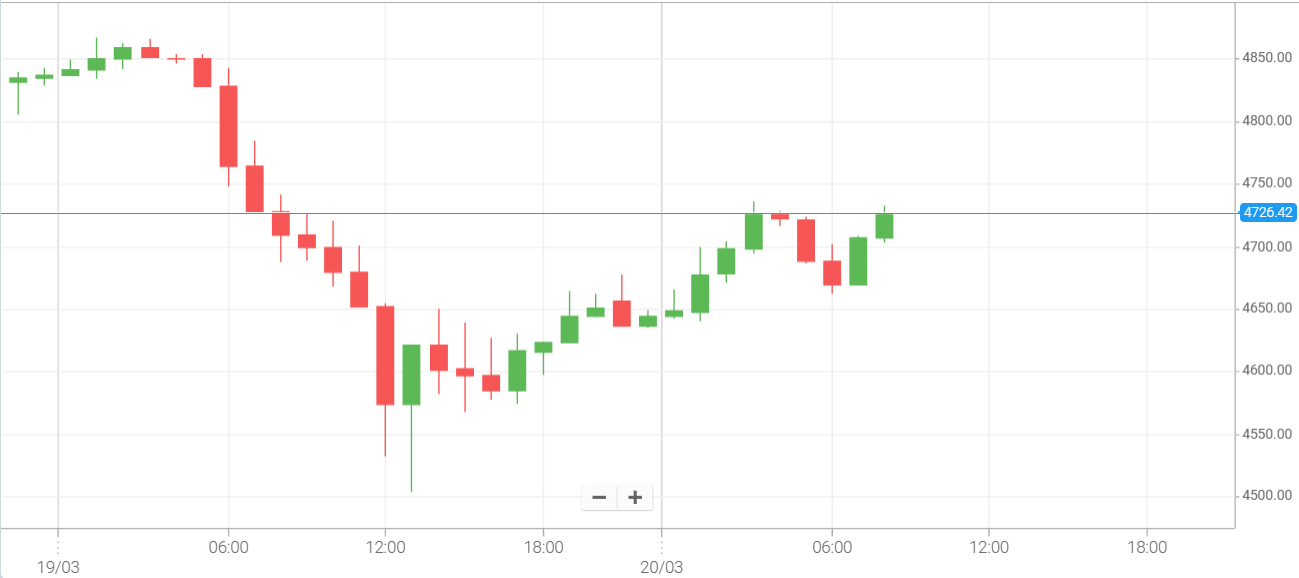
Gold prices faced a sharp sell-off on Thursday, dropping -3.99% to settle near $4,670. Despite the ongoing conflict between the US and Iran providing some fundamental support for safe-haven assets, the precious metal was weighed down by a "liquidity squeeze." Market participants reportedly sold liquid assets, including the yellow metal, to cover margin calls and raise cash amid broader market volatility. Furthermore, hawkish remarks from the Fed regarding potential rate hikes to combat energy-driven inflation have made non-yielding assets less attractive to investors.
WTI Oil prices also plummeted on Thursday, falling -4.45% to trade around $93.50. The decline was largely driven by efforts from US and Israeli leaders to calm market fears regarding the Middle East war. US President Donald Trump signaled a lack of intent to deploy ground forces, while Israeli Prime Minister Benjamin Netanyahu stated that Israel would refrain from further attacks on Iranian energy facilities. This de-escalation in rhetoric followed a massive surge in US crude oil inventories, which climbed by 6.156 million barrels for the week ending March 13—significantly higher than the anticipated 400,000-barrel increase.
Regional markets across Asia showed mixed results in choppy Friday trading as investors weighed the impact of volatile energy prices and the People’s Bank of China’s decision to maintain its benchmark lending rates. Sentiment remained fragile following a weak lead from the US, where the main US equity indices moved lower overnight due to renewed inflation concerns. While Wall Street futures ticked higher during Asian hours, the broader market continued to grapple with the Federal Reserve's cautious stance on rate cuts, especially as earlier spikes in crude prices toward $119 per barrel reinforced fears that energy-driven inflation could persist for major Asian importers.
In China, the central bank kept its loan prime rates steady for a tenth consecutive month, holding the one-year LPR at 3.00% and the five-year rate at 3.50%. Amid this neutral monetary backdrop, the China SSE declined by -1.26% and the China SZSE dropped -0.34% as of 07:46 AM GMT. Performance in Hong Kong was similarly weighed down, with the Hong Kong 50 falling -0.08%. A notable drag on the region came from Alibaba, which saw its shares slide following a reported profit drop attributed to heavy spending and a sluggish e-commerce environment.
Elsewhere in the region, Japan 225 edged up by 0.11% in thin holiday trading despite the broader regional uncertainty. In South Korea, the Korea 200 index slipped -0.22% by 07:46 AM GMT, though it had previously found some support from gains in the technology sector. Markets across the continent have generally scaled back expectations for near-term monetary easing as geopolitical tensions and supply disruption fears around the Strait of Hormuz continue to dominate the outlook for global inflation.
Looking ahead to next week, the market focus shifts to a heavy slate of economic data, beginning with Flash Manufacturing and Services PMI readings for both the UK and the US. The UK expects figures of 51.7 and 53.9 respectively, while the US anticipates a steady 51.6 and 51.7. On Wednesday, March 25, the UK CPI y/y is projected at 3.0%, followed by US Unemployment Claims on Thursday. The week concludes on Friday, March 27, with the release of the UK Retail Sales m/m data.
The EUR/USD experienced a notable rally on Thursday, climbing 0.99% after rebounding from daily lows near 1.1440. This surge was primarily driven by reports suggesting that European Central Bank (ECB) policymakers are prepared to discuss interest rate hikes as early as April, despite officially holding rates steady at their recent meeting. The ECB expressed significant concern regarding the Eurozone's import-intensive economy, noting that the ongoing Middle East conflict is likely to exert upward pressure on inflation through spiked energy prices. ECB President Christine Lagarde emphasized a data-dependent, meeting-by-meeting approach, suggesting the central bank is well-positioned to handle external shocks.
In contrast, the US dollar faced downward pressure, sliding over 1% to settle near 99.2 on Thursday. The decline occurred despite relatively strong US labor data, as Initial Jobless Claims for the week ending March 14 dipped to 205K, outperforming forecasts. However, other economic indicators were less supportive; New Home Sales for January saw a sharp contraction of -17.6% month-over-month, largely attributed to severe snowstorms. As US Treasury yields retreated across the curve, market expectations for Federal Reserve rate cuts throughout 2026 remained low, with the Greenback's trajectory appearing increasingly tied to evolving geopolitical developments.
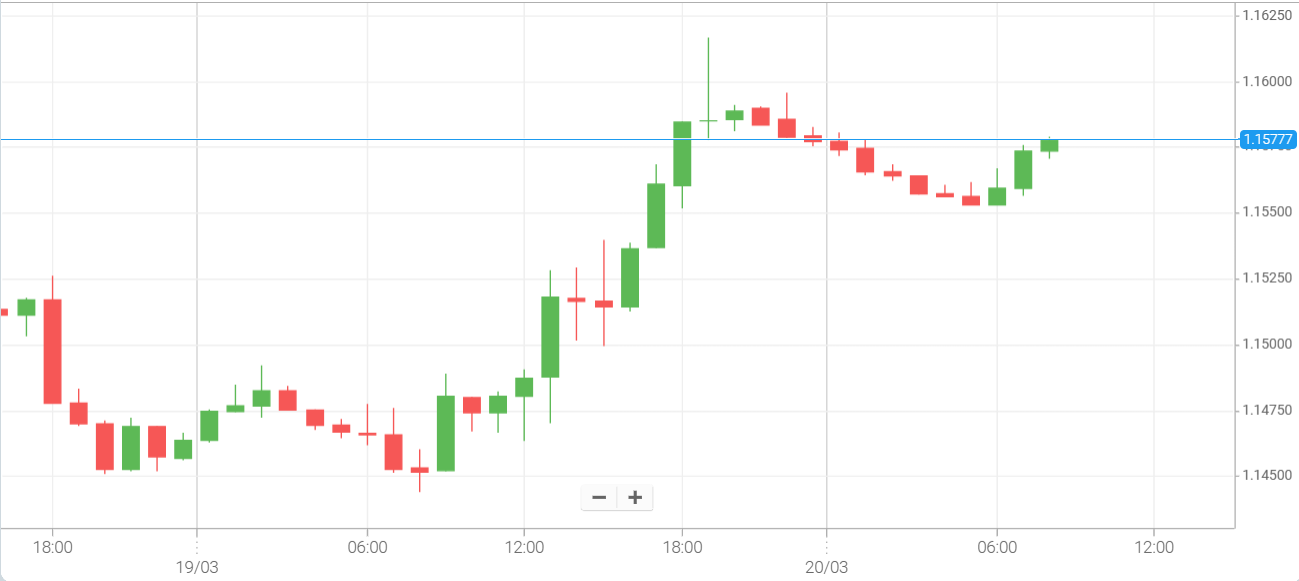
The precious metal saw a sharp move of -3.99% as it struggled to maintain a floor near $4,670 in early European trading this Friday. While the ongoing US-Iran conflict has spiked demand for safe-haven assets—particularly following "zero restraint" warnings from Iranian officials and potential military responses from Saudi Arabia—Gold's recovery remains fragile. The market is currently caught between these geopolitical tailwinds and a broader "liquidity squeeze," where investors are selling off liquid assets to raise cash and cover margin calls during heightened market volatility.
Adding to the downward pressure are renewed inflation fears driven by soaring energy costs, which have prompted a more hawkish tone from the Federal Reserve. Fed Chair Jerome Powell recently signaled that rate hikes are being discussed to combat persistent price pressures, a move that has bolstered the USDX and increased the opportunity cost of holding non-yielding commodities. Consequently, the metal's attempt to snap its seven-day losing streak faces significant headwinds from both a stronger dollar and the urgent need for market liquidity.
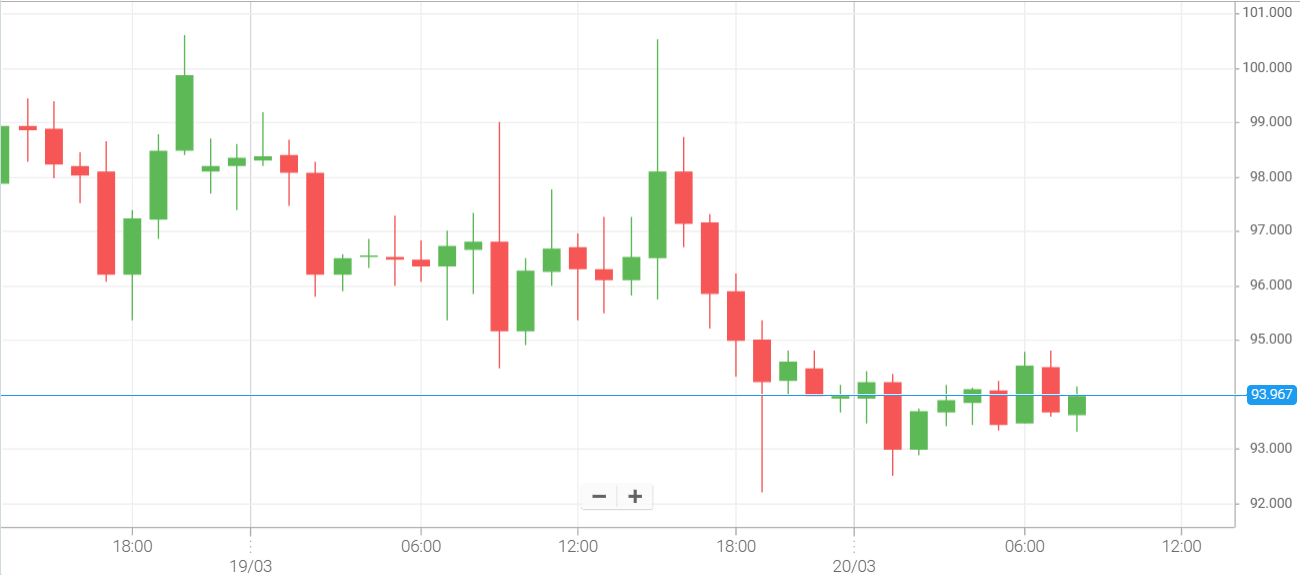
WTI Oil faced a sharp decline of -4.45% on Thursday, with prices drifting toward the $93.50 level during early Friday trading. This downward move was largely driven by concerted efforts from US and Israeli leaders to soothe markets following the most significant strikes on energy infrastructure since the conflict began. While US President Donald Trump downplayed the possibility of deploying ground troops, Israeli Prime Minister Benjamin Netanyahu signaled a halt to further attacks on Iranian energy sites. Additionally, the US Treasury suggested that sanctions on Iranian oil already at sea could be lifted, potentially releasing 140 million barrels of supply to temper the recent price rally.
Further weighing on the commodity was a substantial build in US crude inventories. According to the EIA, stockpiles surged by 6.156 million barrels for the week ending March 13, far exceeding the expected 400,000-barrel increase. Despite these cooling factors, the market remains on edge; Saudi Arabian officials have warned that a prolonged conflict could eventually push prices toward $180 per barrel. With the Strait of Hormuz remaining largely blocked and several central banks warning of potential rate hikes to combat energy-driven inflation, the outlook for WTI Oil remains highly sensitive to geopolitical developments.
After Wall Street closed lower on Thursday, US stock index futures remained relatively stable as investors processed a volatile trading session marked by dramatic swings in energy prices. Sentiment was primarily driven by concerns that a spike in crude costs—which at one point approached significant highs due to Middle East tensions—could reignite inflationary pressures. While supply disruption fears were somewhat eased by diplomatic signals regarding the reopening of critical shipping routes and calls for restraint concerning energy infrastructure, the underlying market anxiety persisted.
The Federal Reserve’s recent decision to maintain interest rates further weighed on risk appetite, as policymakers continue to balance persistent inflation against geopolitical uncertainty. Chair Jerome Powell cautioned that rising energy costs could complicate the path toward price stability, leading investors to further scale back their expectations for monetary easing. With the market now pricing in a "higher-for-longer" interest rate environment, the main US equity indices moved with caution as participants adjusted to the prospect of delayed rate cuts well into the future. In corporate news, Google has launched private beta testing for a dedicated Gemini AI app designed for Apple Mac computers. This move directly challenges competitors like OpenAI and Anthropic, who already provide standalone desktop applications for their respective chatbots. While the current early version is limited to critical features, the testing program allows Google to gather user feedback and refine the software before its official public release. In corporate news, Google has launched private beta testing for a dedicated Gemini AI app designed for Apple Mac computers. This move directly challenges competitors like OpenAI and Anthropic, who already provide standalone desktop applications for their respective chatbots. While the current early version is limited to critical features, the testing program allows Google to gather user feedback and refine the software before its official public release.
The materials contained on this document should not in any way be construed, either explicitly or implicitly, directly or indirectly, as investment advice, recommendation or suggestion of an investment strategy with respect to a financial instrument, in any manner whatsoever. Any indication of past performance or simulated past performance included in this document is not a reliable indicator of future results. For the full disclaimer click here.
Join iFOREX to get an education package and start taking advantage of market opportunities.
 A beginner's e-book
 $5,000 practice demo account
 A 12-part video course
 Trusted partner
 Featured partner
 By
By 


