
Listed on 
 Years active
 English (Arabic)
 Chinese Simplified - 中文 (简体)
 Chinese Traditional - 中文 (繁體)
 English
 Japanese - 日本語
 Korean - 한국어 (대한민국)
 Portuguese - Português
 Russian - Русский
 Spanish - Español
 Thai - ไทย
 English (India)
Don't have an account?
Register via AppHave an account?
Login 01/07/2026 - 07:26 UTC
The US Dollar Index (DXY) advanced past the 101.00 mark on Wednesday, catching a tailwind from strong domestic economic indicators and a hawkish pivot by the Federal Reserve. Momentum was boosted after a 0.08% uptick on Tuesday, fueled by a multi-year high in May JOLTS job openings and a rising US Consumer Confidence Index. Investors are aggressively pricing in higher borrowing costs under the new Fed leadership, keeping a close eye on the impending employment data and central bank commentary to gauge the exact interest rate trajectory.
Gold fell under persistent selling pressure, hovering near $4,060 on Monday following a -0.23% decline on Tuesday. Despite the asset's traditional appeal as an inflation hedge, the combination of rising interest rate expectations and a hardening dollar has dimmed its allure, since bullion yields no interest. While Washington and Tehran have temporarily lowered tensions, safe-haven premium continues to leak out of the market as traders shift their focus back to tight monetary policy.
West Texas Intermediate (WTI) crude oil slumped to a four-month low near $69.40 on Wednesday, building on a modest -0.03% dip on Tuesday. Prices dropped as ship traffic through the critical Strait of Hormuz showed strong signs of recovery, with commodity carriers and supertankers actively resuming transits. This revival in maritime flows has successfully quieted fears of widespread energy supply disruptions, offsetting a massive, larger-than-expected 6.072-million-barrel draw in US crude stockpiles reported by the API.
Asian equity markets kicked off the new quarter on a highly tentative note on Wednesday, exhibiting mixed performance across major regional indices. Japan's Nikkei 225 managed a 1% rally on the back of resilient domestic manufacturing data, while South Korea's Kospi shed more than 1% as institutional investors aggressively locked in profits following a historic preceding quarter. Broad market optimism remained strictly capped by lingering Middle East risks and the stark reality of elevated borrowing costs worldwide.
In US economic news, negotiators Jared Kushner and Steve Witkoff arrived in Doha to tackle ongoing regional developments, though the prospects for an official peace framework hit early hurdles as Tehran denied any immediate high-level meetings. On the domestic front, economic resilience was reinforced by solid consumer data and a tight labor market, giving Federal Reserve officials room to threaten further interest rate hikes. Market participants are now universally focused on the upcoming nonfarm payrolls report and crucial central bank updates to navigate the macro landscape.
corporate developments took center stage with notable moves from Apple and Nike. Apple shares advanced 2.72% as institutional investors cheered strategic price hikes across several device lines implemented to protect premium gross margins against rising memory and hardware component costs. Meanwhile, Nike shares climbed 1.72% during the main trading session after reporting fourth-quarter revenue of $11.0 billion and adjusted earnings of 20 cents per share, both beating Wall Street expectations with an additional bottom-line boost from a 52-cent per share tariff refund. However, this regular session optimism for Nike was quickly undercut in premarket trading by a nearly 3% slide after the sportswear giant issued a weak forward outlook projecting a revenue contraction for the first half of fiscal 2027, driven by a 12% drop in digital sales and ongoing demand weakness in Greater China.
Attention then shifts to Thursday's high-impact economic data, headlined by the ISM Manufacturing PMI's reflection of industrial stability. Most critically, the holiday-shortened week culminates in Thursday's crucial June employment report—featuring Non-Farm Employment Change, Average Hourly Earnings, and the Unemployment Rate—which will offer definitive clues regarding labor market strength and the Federal Reserve's future interest rate path.
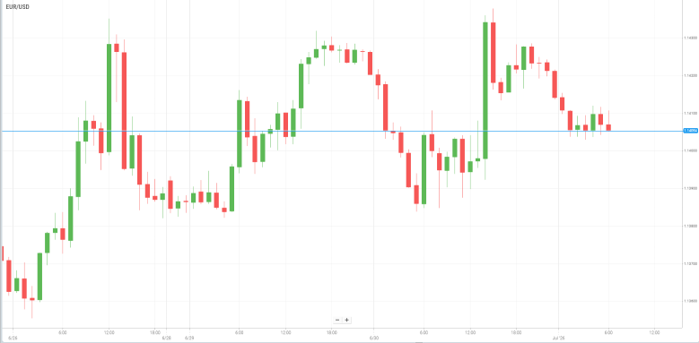
EUR/USD edged lower toward the 1.1400 region during Wednesday’s early Asian trading session as the Euro came under pressure from declining expectations of aggressive monetary tightening by the European Central Bank (ECB). Traders are now focused on upcoming economic releases, including the preliminary Eurozone Harmonized Index of Consumer Prices (HICP) data and the US Manufacturing Purchasing Managers’ Index (PMI) report, for fresh market direction.
The Euro weakened after signs of cooling inflation across major European economies, including Germany, France, and Italy, reduced expectations for a more restrictive ECB policy stance. Data released by Germany’s federal statistics office, Destatis, showed that consumer price inflation slowed to 2.3% in June from 2.6% in May, below market forecasts of 2.5%.
The softer-than-expected inflation reading has strengthened expectations that the ECB will keep interest rates unchanged at its July meeting. ECB President Christine Lagarde recently indicated that there was no need for “forceful” action, citing falling energy prices and the absence of second-round inflation effects, such as stronger wage pressures that could push prices higher.
Meanwhile, the US Dollar continues to benefit from a resilient US economy and expectations that the Federal Reserve will maintain a hawkish policy stance. The Fed kept its benchmark interest rate unchanged at 3.50%-3.75% during its June meeting and removed language suggesting it was leaning toward future rate cuts. Market pricing, according to the CME FedWatch tool, indicates around a 63% probability of a Fed rate hike by September. This outlook has provided additional support to the Dollar and kept pressure on the EUR/USD pair.
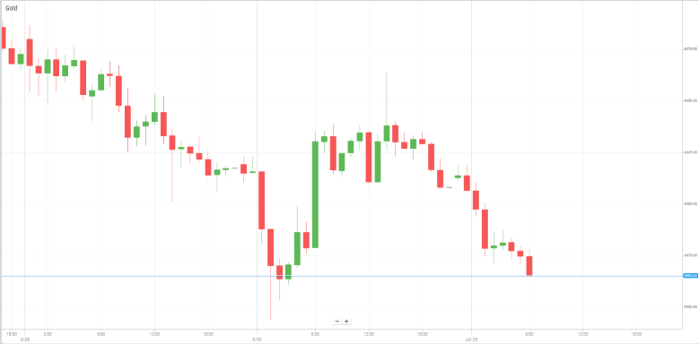
Gold continued to face selling pressure during Wednesday’s Asian session, extending its decline for a third consecutive day and trading below the key psychological level of $4,000. The precious metal remains close to its lowest level since November 2025, reached on Tuesday, as a stronger US Dollar and expectations of further Federal Reserve tightening continue to weigh on bullion demand.
The US Dollar has gained support from renewed Federal Reserve rate hike expectations and uncertainty surrounding US-Iran negotiations. The ongoing geopolitical risks have kept investors cautious, while concerns over potential disruptions in the Strait of Hormuz have added to inflation fears. These factors, combined with a resilient US labor market, have strengthened expectations that the Fed could maintain a more hawkish policy stance, providing further support to the safe-haven Dollar.
US data released on Tuesday showed that job openings increased to 7.594 million in May, reaching a two-year high, according to the Job Openings and Labor Turnover Survey (JOLTS). Meanwhile, the Conference Board’s Consumer Confidence Index improved to 91.2 in June from 90.6 in May, reflecting continued strength in the US economy.
The positive Dollar outlook has increased pressure on Gold, as a stronger US currency typically makes the metal more expensive for international buyers. However, traders may remain cautious ahead of key US events, including Federal Reserve Chair Kevin Warsh’s speech at the European Central Bank (ECB) Forum in Sintra.
Market participants will also monitor upcoming US economic releases, including the ADP private-sector employment report and the ISM Manufacturing PMI, for additional clues about the strength of the economy and the Fed’s policy path. Attention will then turn to the monthly Nonfarm Payrolls (NFP) report on Thursday.
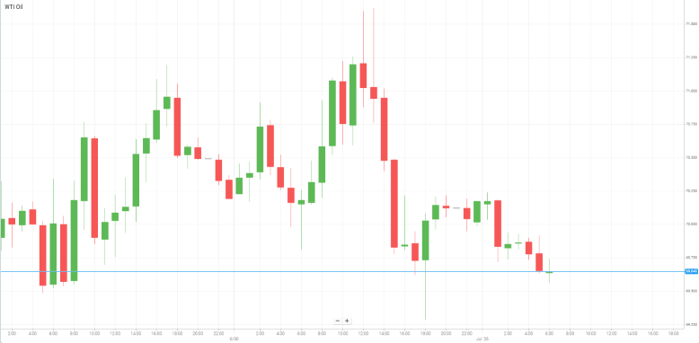
Oil prices moved slightly higher earlier on Wednesday as concerns over stalled negotiations between Iran and the United States raised the possibility of prolonged supply disruptions in the key Middle East oil-producing region.
Market participants remained focused on developments surrounding the Strait of Hormuz, a critical oil transit route that has gradually reopened but continues to face uncertainty. Diplomatic efforts continued on Tuesday as US envoy Steve Witkoff and Jared Kushner arrived in Doha for what the White House described as high-level discussions aimed at advancing a deal to end the Iran conflict. However, Iran and Qatar indicated that meetings would take place through mediators rather than direct talks between US and Iranian officials. Qatar’s Prime Minister Sheikh Mohammed bin Abdulrahman al-Thani was among those involved in discussions with Witkoff and Kushner.
US Vice President JD Vance said Iran would not be allowed to impose tolls on ships passing through the Strait of Hormuz, adding that oil flows through the waterway had returned to pre-conflict levels. Tanker traffic has shown signs of recovery, further reducing concerns about extended supply disruptions.
Meanwhile, US crude inventories declined again last week, while gasoline stocks also decreased, according to data from the American Petroleum Institute (API). Crude inventories fell by 6.1 million barrels for the week ending June 26, according to market sources.
Traders are now awaiting the official US inventory report from the Energy Information Administration (EIA) for further direction. While geopolitical risks continue to provide support for oil prices, improving supply conditions and uncertainty over global demand remain key factors limiting the upside.
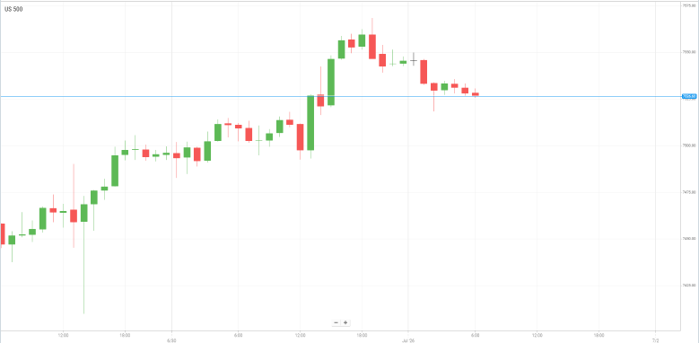
US stocks ended the final trading session of the second quarter and the first half of the year on a positive note Tuesday, supported by stronger-than-expected labor market data and continued momentum in technology shares. Investors also adjusted their portfolios at the end of a period marked by geopolitical uncertainty, shifting Federal Reserve expectations, and ongoing debate over the long-term impact of massive artificial intelligence investments.
Market attention remained focused on US labor market indicators, which are expected to provide further clues about the Federal Reserve’s future interest rate decisions. The central bank has maintained its focus on controlling inflation, with traders closely watching economic data for signs of whether policymakers will have room to adjust rates.
Tuesday’s Job Openings and Labor Turnover Survey (JOLTS) report showed that job openings increased to 7.594 million in May, exceeding expectations of 7.296 million and rising from April’s revised figure of 7.585 million. The reading marked the highest level since May 2024, suggesting continued strength in labor demand.
Meanwhile, Wall Street recorded strong gains during the second quarter and first half of 2026. Artificial intelligence remained a major driver of market performance, though investors continued to debate whether the massive spending on AI infrastructure will generate sufficient returns.
Geopolitical developments also influenced market sentiment during the quarter, particularly ongoing tensions surrounding the US and Israeli conflict with Iran. Although a framework agreement between the US and Iran helped ease some concerns, uncertainty remains over key issues, including the future status of the Strait of Hormuz, a crucial route for global oil shipments.
Investors will now turn their attention to upcoming economic data, Federal Reserve commentary, and corporate earnings, including quarterly results from Nike following the market close.
The materials contained on this document should not in any way be construed, either explicitly or implicitly, directly or indirectly, as investment advice, recommendation or suggestion of an investment strategy with respect to a financial instrument, in any manner whatsoever. Any indication of past performance or simulated past performance included in this document is not a reliable indicator of future results. For the full disclaimer click here.
Join iFOREX to get an education package and start taking advantage of market opportunities.
 A beginner's e-book
 $5,000 practice demo account
 A 12-part video course
 Trusted partner
 Featured partner
 By
By 


