
Listed on 
 Years active
 English (Arabic)
 Chinese Simplified - 中文 (简体)
 Chinese Traditional - 中文 (繁體)
 English
 Japanese - 日本語
 Korean - 한국어 (대한민국)
 Portuguese - Português
 Russian - Русский
 Spanish - Español
 Thai - ไทย
 English (India)
Don't have an account?
Register via AppHave an account?
Login 11/12/2025 - 08:22 UTC
The US Dollar Index (DXY) posted a sharp decline on Thursday ending the session 0.60% lower as markets digested the Federal Reserve’s latest policy decision. As anticipated, the Fed lowered its benchmark interest rate by 25 basis points to a target range of 3.50%–3.75% at its December meeting—marking a third consecutive cut since September. Chair Jerome Powell noted that policymakers are now “well positioned to wait and see how the economy evolves,” adding that another rate hike is not part of the central bank’s base-case outlook.
Fresh economic projections showed Fed officials still anticipate just one rate cut in 2025, unchanged from September. However, the accompanying statement signaled a more cautious tone, reinforcing expectations that the central bank may hold rates steady in the near term. The softer outlook weighed on the US Dollar, pushing the USDX lower. Market pricing now reflects roughly a 78% probability that the Fed will keep rates unchanged at its next meeting, up from about 70% prior to Wednesday’s announcement, according to the CME FedWatch tool.
Most major Asian markets moved lower on Thursday as technology shares slumped, with lackluster earnings from Oracle reigniting concerns about the durability of the broader artificial intelligence rally.
Japan’s equity benchmarks lagged regional peers, with the Nikkei 225 down 1.09% and the Japan 100 1.28% as of 07:30 AM GMT. AI-related tech and industrial stocks drove the decline after Oracle’s disappointing results and cautious capital spending outlook deepened concerns about stretched valuations across the AI sector.
Geopolitical tensions added to the pressure, as Japanese stocks continued to face headwinds from an ongoing diplomatic dispute between Tokyo and Beijing following comments by Prime Minister Sanae Takaichi regarding Taiwan.
Australia 200 edged up 0.72% on Wednesday after softer-than-expected labor market figures bolstered expectations that the Reserve Bank of Australia may soon be pushed toward rate cuts. India’s Nifty 50 also gained almost 0.2%, supported by its relatively lower weighting of tech stocks.
U.S. equity futures declined on Wednesday evening as disappointing results from Oracle reignited worries about the sustainability of artificial intelligence–related spending, overshadowing the Federal Reserve’s dovish policy signals.
Oracle’s sharp post-earnings selloff—along with weakness across AI and semiconductor names—pulled futures lower as investors questioned how the cloud computing giant plans to finance its expanding data center ambitions. Selling pressure accelerated during Thursday’s Asian session. Oracle shares tumbled as much as 10% in after-hours trading after the company issued a softer earnings outlook for the current quarter and sharply raised its capital expenditure plans for fiscal 2026. Second-quarter results also missed expectations.
Despite the downturn in futures, major U.S. indexes finished Wednesday’s session higher after the Federal Reserve delivered an expected 25-basis-point rate cut. Chair Jerome Powell signaled that further cuts will require clearer evidence of slowing inflation but also announced that the Fed will begin purchasing roughly $40 billion in short-dated Treasuries per month to bolster market liquidity.
Attention now turns to the US Initial Jobless Claims report due later on Thursday. Economists expect new unemployment filings to rise to 220,000 from 191,000 a week earlier. A stronger-than-forecast reading could help stem the Dollar’s losses in the short term.
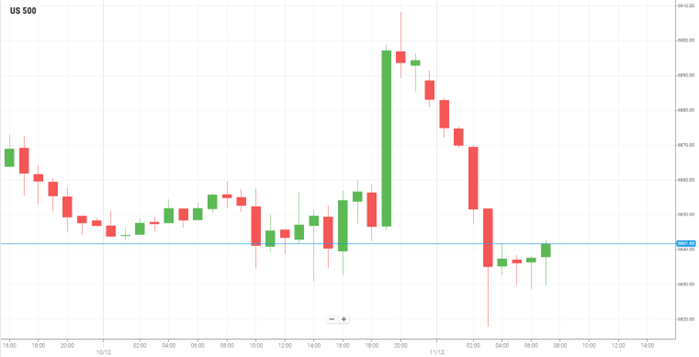
The EUR/USD pair rallied on Wednesday, touching an eight-week high around 1.1700 after the Federal Reserve delivered a widely expected 25-basis-point rate cut. The move, interpreted by markets as a “dovish hold,” triggered broad selling of the US Dollar and lifted the Euro across the board.
The Fed’s decision came with three dissenting votes, including Governor Stephen Miran, who pushed for a larger 50-basis-point reduction. Meanwhile, Regional Fed Presidents Jeffrey Schmid and Austan Goolsbee opted to maintain current rates.
Fed Chair Jerome Powell acknowledged this delicate balance, stressing that policy is now roughly neutral and that upcoming decisions will be shaped by economic data, which he noted may be “distorted” in the near term.
With no major data releases in the Eurozone, comments from European Central Bank officials helped support the currency’s upward momentum. ECB Governing Council member Gabriel Makhlouf expressed confidence that medium-term inflation will return to the 2% target, according to Bloomberg.
Lagarde noted that monetary policy is “in a good place,” hinting that the central bank may upgrade its forecasts in December—adding to the Euro’s tailwind.
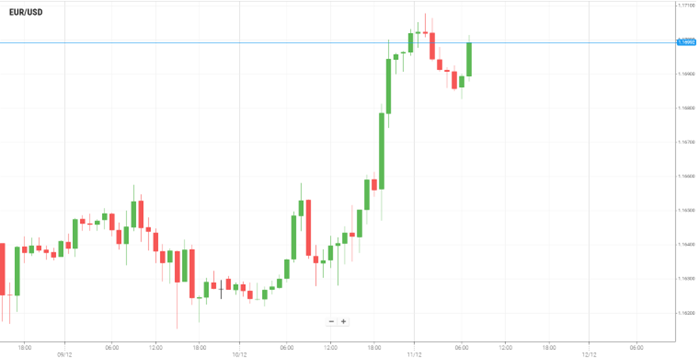
Bitcoin retreated early on Thursday as markets digested the Federal Reserve’s latest interest rate cut, which was overshadowed by a cautious policy tone and visible divisions among U.S. central bankers. The uncertainty weighed on expectations for meaningful monetary easing next year.
A clearer commitment to sustained monetary loosening typically supports speculative assets such as cryptocurrencies by lowering borrowing costs and boosting overall liquidity. The Fed’s cautious stance, however, tempered those expectations.
Bitcoin’s decline also mirrored broader risk-off sentiment across financial markets, driven in part by renewed concerns over the profitability of artificial intelligence investments. Technology shares weakened after U.S. cloud-computing firm Oracle issued guidance that fell short of expectations and warned of increased capital spending on AI infrastructure—raising doubts about how quickly heavy investment in the sector will translate into earnings.
Altcoins traded broadly lower, with Cardano among the notable laggards, sliding more than 7% during the session.
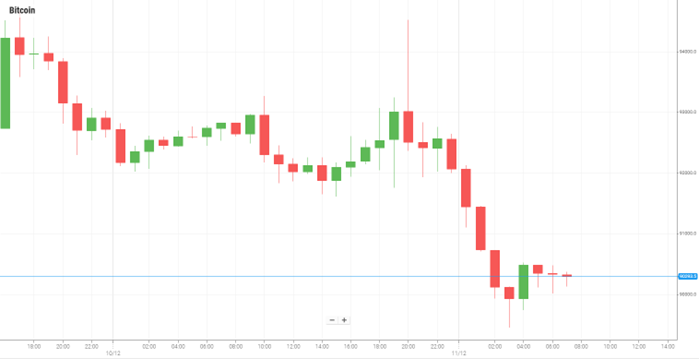
Oil prices climbed on Wednesday after the U.S. seized a sanctioned oil tanker off Venezuela’s coast, stoking concerns over potential supply disruptions. The seizure, reportedly involving the tanker Skipper, comes amid heightened U.S. military presence in the Caribbean and growing loading risks in Venezuela. Analysts also noted that recent attacks by Ukrainian sea drones on Russian oil vessels provided additional support to crude markets.
Traders remain cautious as geopolitical tensions and ongoing Ukraine peace talks influence risk sentiment. Meanwhile, U.S. Energy Information Administration (EIA) data showed a decline in commercial crude inventories by 1.812 million barrels, exceeding forecasts and signaling slightly tighter supply. Gasoline and distillate stocks, including diesel and heating oil, rose modestly, reflecting seasonal shifts in consumption.
On the economic front, a divided U.S. Federal Reserve cut interest rates, potentially supporting oil demand by lowering borrowing costs. Market watchers say these combined geopolitical and economic factors are likely to keep oil prices supported into year-end.
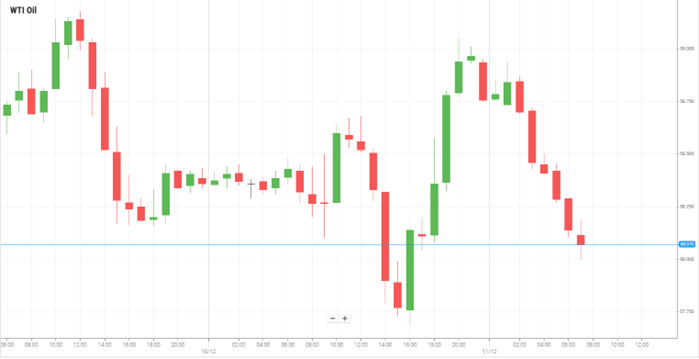
U.S. equities closed higher on Wednesday following the Federal Reserve’s third rate cut of the year, though concerns over the central bank’s cautious outlook kept markets on edge.
The Federal Reserve lowered interest rates by 25 basis points to a range of 3.50%–3.75%, bringing the cumulative easing this year to three cuts. Fed Chair Jerome Powell said the current rate sits within the “range of plausible estimates of the neutral rate,” emphasizing that future policy moves will depend on incoming economic data.
President Donald Trump is set to begin the final round of interviews for the next Fed Chair, according to the Wall Street Journal. Candidates include former Fed Governor Kevin Warsh and White House economic adviser Kevin Hassett, widely viewed as the frontrunner to succeed Powell next year.
Oracle reported fiscal second-quarter results late Wednesday after the bell, sending shares down as much as 10% in after-hours trading. The company forecast weaker-than-expected earnings for the current quarter and significantly raised its capital expenditure outlook for fiscal 2026, fueling concerns over its ability to convert massive AI spending into revenue. Rising debt levels, after billions in bond issuance this year, added to investor caution.The broader tech and AI sector also felt the impact in aftermarket trading.
The materials contained on this document should not in any way be construed, either explicitly or implicitly, directly or indirectly, as investment advice, recommendation or suggestion of an investment strategy with respect to a financial instrument, in any manner whatsoever. Any indication of past performance or simulated past performance included in this document is not a reliable indicator of future results. For the full disclaimer click here.
Join iFOREX to get an education package and start taking advantage of market opportunities.
 A beginner's e-book
 $5,000 practice demo account
 A 12-part video course
 Trusted partner
 Featured partner
 By
By 


