
Listed on 
 Years active
 English (Arabic)
 Chinese Simplified - 中文 (简体)
 Chinese Traditional - 中文 (繁體)
 English
 Japanese - 日本語
 Korean - 한국어 (대한민국)
 Portuguese - Português
 Russian - Русский
 Spanish - Español
 Thai - ไทย
 English (India)
Don't have an account?
Register via AppHave an account?
Login 06/08/2026 - 07:16 UTC
The US Dollar Index (USDX), which tracks the Greenback against a basket of major currencies, remains under pressure for a third consecutive session, trading around 99.65 during Thursday’s Asian session. The index stays close to its lowest level since June 17 as markets await further developments on US-Iran diplomatic efforts and Friday’s key US jobs report.
Optimism over progress toward easing tensions in the Middle East continues to weigh on the safe-haven US Dollar. Iran’s Foreign Ministry spokesperson Esmaeil Baghaei said Iran and Oman are close to finalizing a proposed framework for commercial shipping through the Strait of Hormuz, adding to hopes for progress toward ending the five-month-old US-Iran conflict.
Meanwhile, weaker-than-expected US economic data has reduced expectations for further Federal Reserve tightening. The ADP report showed that private-sector employment increased by just 44K in July, down from 98K in June and well below market expectations. The ISM Services PMI also came in below forecasts at 54.1, although it edged up from 54.0 in June.
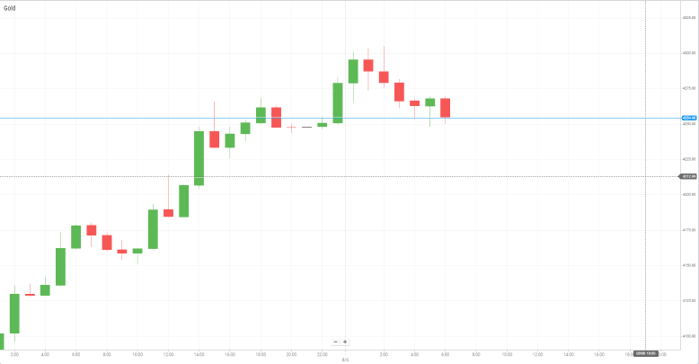
Gold extends its gains for a fourth consecutive session, trading just below the $4,300 mark during Thursday’s Asian session. The precious metal remains close to its highest level since June 18, supported by a softer US Dollar and expectations that easing inflation pressures could reduce the likelihood of aggressive Federal Reserve tightening. meanwhile, optimism surrounding potential progress toward a US-Iran peace deal and the reopening of the Strait of Hormuz continues to underpin demand for Gold as geopolitical uncertainty remains elevated. Iran said it is in the final stages of drafting an agreement with Oman concerning the strategic waterway, raising hopes for a diplomatic resolution to the conflict.
In the crypto front, Bitcoin edged higher by around 1% on Wednesday as optimism over a potential deal to reopen the Strait of Hormuz supported broader risk sentiment. However, the largest cryptocurrency remained rangebound as investors continued to assess recent market developments and ongoing selling by major corporate Bitcoin holder Strategy. Elsewhere, Ethereum gained around 2% to trade near $1,910, while XRP declined around 1%. Among meme coins, Dogecoin edged lower, while TRUMP also remained under pressure.
Asian stocks moved lower on Thursday, led by sharp declines in South Korea and Japan as renewed weakness in semiconductor shares prompted investors to lock in profits following the previous session’s AI-driven rally.
Korea 200 fell more than 5%, with SK Hynix and Samsung Electronics among the biggest decliners. The selloff followed sharp overnight declines in US semiconductor shares, including Advanced Micro Devices, Sandisk and Western Digital, after their earnings and outlooks failed to sustain investor enthusiasm.
Hong Kong 50 also declined nearly 1%, led by losses in insurance stocks following reports that Chinese authorities had begun enforcing taxes on investment income from offshore insurance policies.
Thursday’s Initial Jobless Claims data and comments from Fed officials will also be monitored for additional signals. Attention then turns to Friday’s US Nonfarm Payrolls (NFP) report, which could provide fresh clues on the Fed’s policy path and determine the Dollar’s near-term direction. Meanwhile, developments surrounding the Middle East could continue to drive volatility across financial markets.
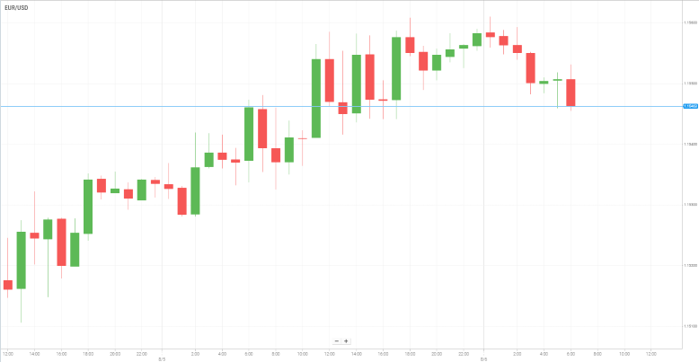
The Euro remains broadly steady against the US Dollar, with EUR/USD holding near 1.1550 in Thursday’s European session after rising from last week’s lows. The common currency continues to benefit from stronger Eurozone data and lower Oil prices, while caution ahead of Friday’s US Nonfarm Payrolls report is limiting demand for the Greenback.
German Factory Orders rose 3.1% in June, significantly exceeding the 0.3% market forecast and following a downwardly revised 0.3% increase in May. The data came after an upward revision to Germany’s HCOB Services Purchasing Managers’ Index (PMI) on Wednesday, reinforcing expectations that the European Central Bank (ECB) could raise interest rates in September.
US economic data has offered little support to the Dollar. ADP Employment increased by just 44K in July, well below the 98K gain recorded in June and the 70K expected by economists. Meanwhile, the ISM Services PMI edged up to 54.1 from 54.0 but missed expectations of 54.5, while rising price pressures and weaker employment components pointed to a mixed outlook for the US economy.
Attention now turns to Friday’s Nonfarm Payrolls report, with the weaker ADP reading raising concerns that the official employment figures could also disappoint.
Gold prices remain near a seven-week high after paring earlier gains on Thursday, supported by optimism over a potential agreement to reopen the Strait of Hormuz. Hopes of easing disruptions to global energy supplies have pushed Oil prices lower, reducing inflation concerns and prompting markets to scale back expectations for further Federal Reserve tightening.
Reuters reported that a proposed agreement between Iran and Oman aimed at ending the five-month conflict between Tehran and Washington could give Iran control over vessels entering the Gulf through the Strait of Hormuz. The prospect of a deal has increased expectations that energy supply disruptions could ease, weighing on Oil prices and reducing inflationary pressures.
Markets now price around a 55% probability of a Federal Reserve rate hike in September, down from roughly 67% earlier this week. Lower US Treasury yields and a subdued US Dollar have also supported Gold by reducing the opportunity cost of holding the non-yielding asset.
Attention now turns to Friday’s US Nonfarm Payrolls (NFP) report, the next major catalyst for Gold and broader financial markets. The latest ADP report showed a slowdown in private-sector hiring in July, reinforcing concerns that the official employment figures could also disappoint.
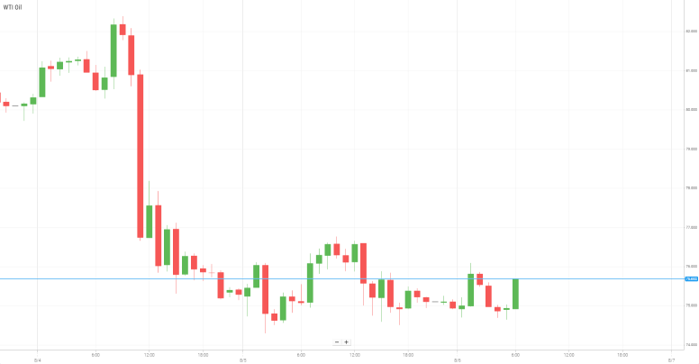
Oil prices extend their decline on Wednesday, adding to sharp losses earlier this week as optimism over a potential agreement to facilitate shipping through the Strait of Hormuz outweighed lingering geopolitical risks and a surprise increase in US crude inventories.
Market sentiment improved after Iran said it had reached an agreement with Oman on the coordinates of a proposed shipping route through the Strait of Hormuz, a key waterway that handles around one-fifth of global Oil and LNG trade. However, the agreement does not represent a full reopening, with negotiations over cargo fees, inspections and broader security arrangements still unresolved.
US President Donald Trump said Wednesday that Washington was holding talks with Tehran, although Iran has publicly denied that peace negotiations are underway. Nevertheless, the prospect of increased tanker traffic through Hormuz has eased concerns over prolonged supply disruptions that had pushed Oil prices sharply higher in recent weeks.
US government data provided another bearish signal, with crude inventories unexpectedly increasing by around 2.5 million barrels last week, compared with expectations for a 1.5 million-barrel drawdown. Stockpiles at the Cushing, Oklahoma delivery hub also rose, pointing to softer near-term demand and adding pressure on Oil prices.
Elsewhere, Houthi attacks on Red Sea shipping, disruptions to Russian and Ukrainian maritime trade and uncertainty surrounding Kazakhstan’s main Oil export route continue to highlight risks to global energy supplies.
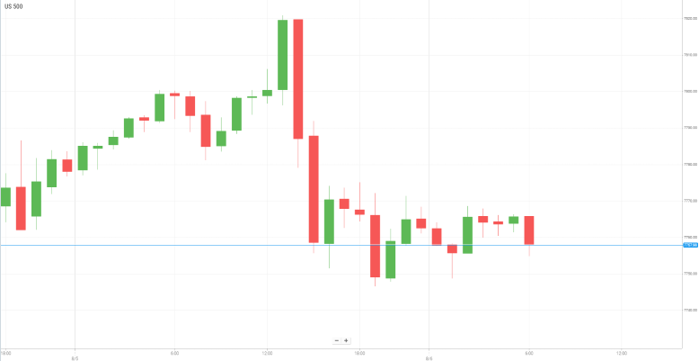
Wall Street took a breather on Wednesday after a strong start to August pushed major US indexes back toward record levels. The US 500 and US Tech 100 closed lower, while the US 30 reached a fresh record close, as investors weighed strong corporate earnings, softer US employment data and hopes for progress toward reopening the Strait of Hormuz.
The recent rebound in technology stocks has helped restore confidence in the AI trade after a sharp July selloff. Strong results from Microsoft and Amazon helped revive demand for chipmakers, with the Philadelphia Semiconductor Index rising nearly 15% since Microsoft’s earnings report. However, the latest earnings reaction was more mixed, with SpaceX shares falling 13.8% and AMD dropping 7% despite both companies reporting better-than-expected results.
SpaceX declined after reporting stronger-than-expected revenue and a narrower loss, although elevated spending on AI infrastructure raised concerns over free cash flow. AMD also came under pressure despite beating quarterly estimates and providing upbeat guidance, as investors appeared to expect stronger results following the stock’s substantial gains this year.
With major indexes near record highs, investors now turn to Friday’s US employment report for further clues on the Federal Reserve’s policy outlook and the strength of the economy.
The materials contained on this document should not in any way be construed, either explicitly or implicitly, directly or indirectly, as investment advice, recommendation or suggestion of an investment strategy with respect to a financial instrument, in any manner whatsoever. Any indication of past performance or simulated past performance included in this document is not a reliable indicator of future results. For the full disclaimer click here.
Join iFOREX to get an education package and start taking advantage of market opportunities.
 A beginner's e-book
 $5,000 practice demo account
 A 12-part video course
 Trusted partner
 Featured partner
 By
By 


