
Listed on 
 Years active
 English (Arabic)
 Chinese Simplified - 中文 (简体)
 Chinese Traditional - 中文 (繁體)
 English
 Japanese - 日本語
 Korean - 한국어 (대한민국)
 Portuguese - Português
 Russian - Русский
 Spanish - Español
 Thai - ไทย
 English (India)
Don't have an account?
Register via AppHave an account?
Login 12/08/2026 - 07:47 UTC
The US Dollar Index, which measures the Greenback against six major currencies, extended gains for a third consecutive session to trade around 99.90 during Wednesday's Asian hours, following a slight retreat of -0.01% in the prior session. Investors are closely monitoring the upcoming inflation report, which is expected to play a decisive role in shaping the Federal Reserve’s next interest rate decision.
Commerzbank analysts noted that the core question for US markets is whether inflation is slowing fast enough to deter further Fed rate hikes, keeping the trajectory of price pressures central to the Dollar’s medium-term yield backdrop.
The index drew support from heightened safe-haven demand amid renewed uncertainty surrounding Middle East peace talks. Although Pakistan’s defence minister indicated that Washington and Tehran were nearing an agreement regarding the Strait of Hormuz—alongside advancing parallel negotiations via Oman—US President Donald Trump insisted that Tehran pay reparations to attack victims, injecting fresh caution into global markets.
Market expectations remain divided over the Fed's policy path following its decision to hold rates steady in July. While surging crude oil prices have bolstered the case for further tightening, the CME FedWatch Tool shows the odds of a 25-basis-point rate hike in September easing to nearly 48%, down from 52% in the prior session.
West Texas Intermediate crude oil attracted steady buying for a third straight session, riding a +1.58% gain from the previous day to trade just below $83.00 during Wednesday's Asian session, near two-week highs. An advisor to Iran’s Supreme Leader Mojtaba Khamenei stated on Tuesday that the Strait of Hormuz will remain closed until Washington satisfies Tehran's demands. Compounding supply concerns, fresh strikes by Iran-backed Houthi rebels on Red Sea shipping lanes further fueled fears of regional energy disruptions, reinforcing the commodity's upward momentum.
Gold pared early intraday gains to trade below $4,400 heading into Wednesday's European session. Despite pulling back -0.70% yesterday, the precious metal remains up 0.50% for the day and sits near its highest level since June 5, as markets await the US Consumer Price Index print for guidance on monetary policy amid volatile energy markets.
These geopolitical tensions offset signs of a cooling US labor market, reinforcing arguments for higher interest rates. The CME FedWatch Tool indicates a 75% chance of at least one more Fed rate hike before year-end, which continues to bolster Treasury yields and support the safe-haven US Dollar alongside broader geopolitical jitters—including a North Korean ballistic missile test and planned Chinese naval exercises off Taiwan.
Asian equity markets mostly advanced on Wednesday as a fresh rally in technology shares lifted South Korea and Japan, though rising oil costs and geopolitical risks capped broader enthusiasm ahead of US inflation data. In Asian trade, Nasdaq 100 Futures added around 0.3% and S&P 500 Futures rose 0.1%, following a lower finish on Wall Street on Tuesday driven by retreats in key tech leaders including Nvidia (-0.01%), Alphabet (-3.63%), Amazon (-2.08%), and SpaceX (-3.65%).
The technology sector rebound gathered steam after CoreWeave climbed 2.76% in extended trading following strong sales figures, while Super Micro Computer gained 0.76% after its revenue outlook beat expectations, signaling sustained demand for AI infrastructure. Additionally, Nvidia announced partnerships with six major financial institutions to establish compute-financing platforms aimed at mobilizing over $500 billion in private capital for AI infrastructure.
Looking ahead, market participants are turning their attention toward upcoming corporate earnings from Lumentum, Rocket Lab, and Cisco Systems to gauge the resilience of enterprise technology spending. On the economic front, investors will focus on incoming US CPI and PPI prints, along with Thursday’s monthly UK GDP data, for fresh macroeconomic direction.
EUR/USD trades with a cautious undertone, hovering near the 1.1534 region during Wednesday’s early European session after posting a minor decline of 0.08% on Monday and a modest drop of -0.02% on Tuesday. The major currency pair edges lower as market participants move to the sidelines ahead of the high-stakes United States Consumer Price Index report for July. The shared currency remains trapped in a tight consolidation range as the US Dollar holds onto its recent recovery momentum, leaving spot prices anchored just below recent multi-week peaks.
The Greenback continues to derive underlying support from persistent Middle East geopolitical friction, where supply disruptions along critical maritime choke points—such as the Strait of Hormuz and Bab al-Mandeb Strait—have driven a sharp rebound in energy prices. Because the Eurozone relies heavily on energy imports to meet its domestic demand, higher crude oil prices present a double-edged sword: they rekindle broader market inflation fears—sustaining prospects for further Federal Reserve rate hikes—while simultaneously acting as a direct drag on the Euro's medium-term economic outlook.
Investors are turning their primary focus toward Wednesday’s release of the July US Consumer Price Index (CPI) report, followed by Thursday's Producer Price Index (PPI)
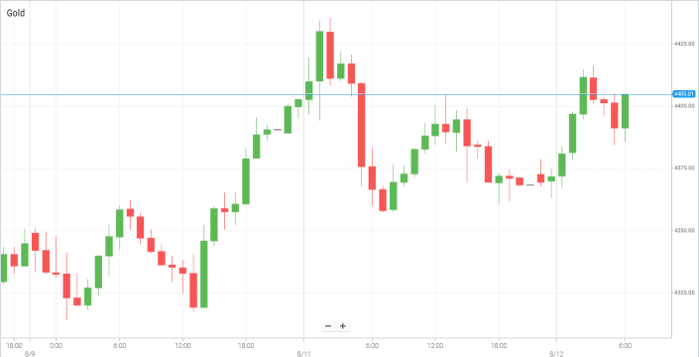
Gold (XAU/USD) trims a portion of its intraday advance to trade back below the $4,400 level heading into Wednesday’s European session, though it maintains a modest gain of 0.50% for the day following a retreat of -0.7% on Tuesday. Despite the mild pullback, the precious metal remains anchored near its highest levels since June 5—a peak reached earlier in the week—as market participants show restraint ahead of the upcoming US Consumer Price Index release.
The pause in bullion's upward trajectory comes as elevated crude oil prices continue to fuel underlying inflation fears, preserving expectations for a potentially hawkish Federal Reserve stance through year-end.
Geopolitical friction in the Middle East remains a central driver of market sentiment, as dimming prospects for a swift agreement on the Strait of Hormuz and ongoing attacks in the Red Sea and Bab el-Mandeb Strait sustain elevated risk premiums.
Looking ahead, market participants are turning their focus toward upcoming US inflation data later this week. Wednesday’s Consumer Price Index (CPI) and Thursday’s Producer Price Index (PPI) prints are expected to offer critical guidance on the Federal Reserve’s monetary policy trajectory.
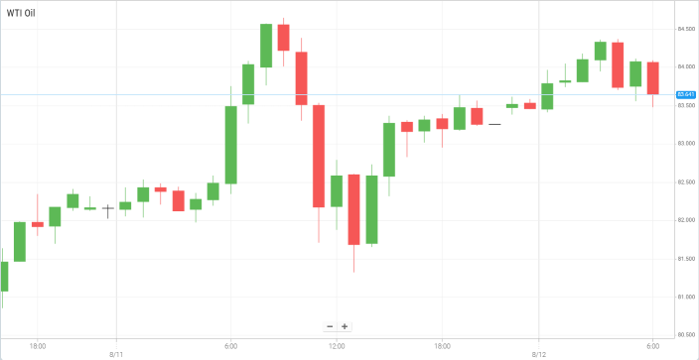
West Texas Intermediate (WTI) Crude Oil maintained its strong upward trajectory midweek, advancing for the third consecutive session after rallying 1.58% on Tuesday to extend its broader recovery. The US benchmark black liquid traded just beneath the $83.00 region during Wednesday's Asian session, lingering close to a two-week peak set in the prior session as bullish momentum continued to anchor price action.
The sustained upside comes as market participants grapple with escalating supply disruption risks in West Asia following hardened rhetoric in the ongoing US-Iran standoff. Tensions intensified further after an advisor to Iran’s Supreme Leader Mojtaba Khamenei asserted that the critical Strait of Hormuz will remain closed until Washington fully satisfies Tehran's demand
The ongoing geopolitical impasse across key Middle Eastern maritime corridors continues to preserve a firm war-risk premium in energy markets while fueling broader inflationary concerns.
Looking ahead, market participants will monitor incoming US macroeconomic releases, including Tuesday's mid-tier housing and business optimism data, alongside fresh developments across the Middle East to gauge the next directional move for Crude Oil prices.
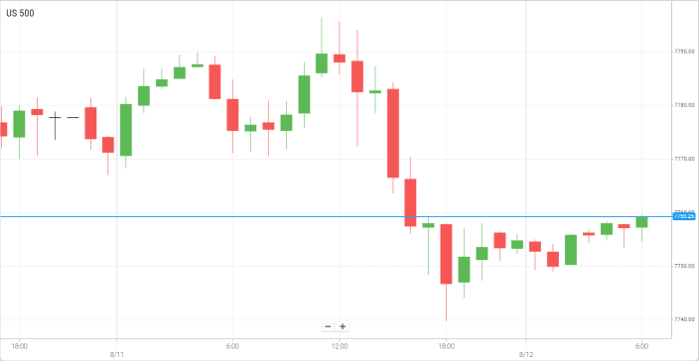
US equities pulled back on Tuesday, taking a breather as the US 500 fell 0,21% alongside broader market declines. Main averages treaded water for much of the day before sliding late in the session, pressured by rising energy prices and a lack of fresh catalysts ahead of high-impact inflation data.
Market participants weighed ongoing geopolitical friction surrounding the Strait of Hormuz after Iranian officials reiterated that the strategic waterway would remain closed until Tehran's strict conditions were met. The resulting jump in crude oil prices re-ignited underlying inflation concerns, complicating the Federal Reserve’s interest rate outlook and weighing on key technology heavyweights—including Nvidia (-0.01%), Alphabet (-3.63%), Amazon (-2.08%), and SpaceX (-3.65%)—even as broader market breadth remained surprisingly resilient.
Despite the recent retreat, broader sentiment stays supported by a strong earnings season, where the vast majority of reporting companies have beaten expectations. Moreover, the market continues to navigate the fallout from Friday's surprisingly weak July US Nonfarm Payrolls report, which tempered hawkish Fed expectations and helped keep equity pullbacks relatively contained.
Looking ahead, market focus shifts squarely to Wednesday’s July US Consumer Price Index (CPI) and Thursday's Producer Price Index (PPI) releases for fresh signals on the path of inflation, alongside Thursday’s UK monthly GDP report. On the corporate front, investors continue to brace for quarterly results from tech leaders including Lumentum, Rocket Lab, Cisco Systems, and Applied Materials to gauge the ongoing strength of enterprise AI spending.
The materials contained on this document should not in any way be construed, either explicitly or implicitly, directly or indirectly, as investment advice, recommendation or suggestion of an investment strategy with respect to a financial instrument, in any manner whatsoever. Any indication of past performance or simulated past performance included in this document is not a reliable indicator of future results. For the full disclaimer click here.
Join iFOREX to get an education package and start taking advantage of market opportunities.
 A beginner's e-book
 $5,000 practice demo account
 A 12-part video course
 Trusted partner
 Featured partner
 By
By 


