
Listed on 
 Years active
 English (Arabic)
 Chinese Simplified - 中文 (简体)
 Chinese Traditional - 中文 (繁體)
 English
 Japanese - 日本語
 Korean - 한국어 (대한민국)
 Portuguese - Português
 Russian - Русский
 Spanish - Español
 Thai - ไทย
 English (India)
Don't have an account?
Register via AppHave an account?
Login 03/08/2026 - 07:04 UTC
The US Dollar Index (USDX) slipped below the 100.00 level, trading around 99.70 during Monday’s Asian session as improving risk sentiment weighed on the safe-haven US Dollar. US President Donald Trump said on Sunday that he had called off a planned attack on Iran, with new talks between Washington and Tehran expected to begin Monday. Trump also suggested that progress could be made toward reopening the Strait of Hormuz while maintaining efforts to address Iran’s nuclear program. The prospect of renewed diplomatic engagement between the US and Iran has eased geopolitical concerns, reducing demand for the US Dollar and putting further pressure on the USDX.
Gold started the new week on a positive note, holding above the $4,050 level despite struggling to sustain momentum above $4,100. Falling crude oil prices have eased concerns over renewed inflationary pressures following OPEC+’s decision to increase production in September. This has also reduced expectations for a more aggressive Federal Reserve policy stance, limiting the potential for further US Dollar gains and supporting non-yielding Gold.
Bitcoin posted modest gains on Sunday as traders assessed growing losses linked to a vulnerability in Coldcard hardware wallets. Meanwhile, activity surrounding corporate Bitcoin holdings remained in focus. Trump Media & Technology Group reportedly transferred 2,628 BTC worth around $165 million to a cryptocurrency exchange, although the company clarified that the coins were transferred rather than sold. The company’s Bitcoin-related losses have reportedly reached around $555 million. Broader crypto markets also traded mostly higher, with Ethereum and XRP gaining around 2%, while Solana advanced more than 2% and Cardano surged over 7%.
Asian stocks started the new week under pressure, with Korea 200 tumbling around 5% as renewed selling in artificial intelligence-related shares overshadowed easing Middle East tensions, lower oil prices and firmer US equity futures.
The Korea 200 extended its decline after surging a record 18% on Friday, with investors continuing to reassess elevated valuations across the AI sector. Samsung Electronics and SK Hynix both fell sharply despite strong recent earnings, weighing heavily on the benchmark as the two chipmakers account for more than half of the KOSPI’s market capitalization. Japan’s Nikkei 225 and Japan 100 also remained under pressure as investors assessed the Bank of Japan’s outlook for gradual policy normalization. Sony and other technology stocks came under pressure, although gains in Kioxia and TDK provided some offset.
US stock index futures moved higher on Sunday evening as renewed hopes for US-Iran negotiations supported risk sentiment, while technology stocks looked to recover from a difficult July.
Trump said US-Iran negotiations would begin Monday, raising hopes of de-escalation and a possible agreement on reopening the Strait of Hormuz. Technology stocks will remain in focus this week following heavy losses during July. The US Tech 100 fell last month, while stronger-than-expected earnings from major technology companies, including Microsoft and Amazon, helped support a late-month recovery.
Markets will also focus on a busy earnings calendar, with Palantir reporting Monday and AMD and SpaceX scheduled to release results Tuesday. Caterpillar, Merck and McDonald’s are also among the major companies reporting this week. Beyond earnings, attention will turn to Friday’s US Nonfarm Payrolls report, with markets looking for further clues on the strength of the labor market and the Federal Reserve’s interest-rate outlook.
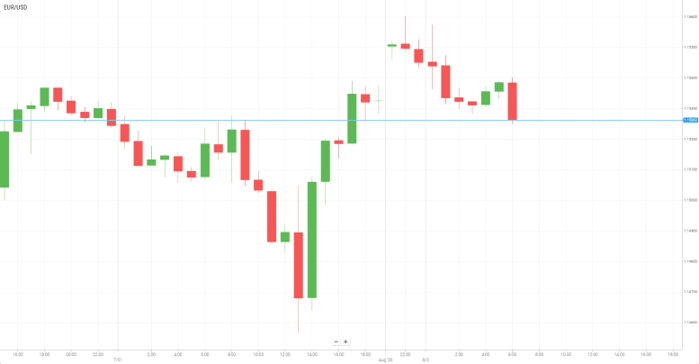
EUR/USD extends its gains for a fifth consecutive session, holding near the mid-1.1500s and reaching its highest level since June 17 during Monday’s Asian session.
Lower crude oil prices have eased concerns over inflation and reduced expectations for aggressive Federal Reserve tightening, weighing on the USD. Hopes for a potential US-Iran agreement, alongside OPEC+’s decision to increase oil production in September, have further pressured oil prices and reduced demand for the safe-haven Dollar. The USD remains under pressure as markets reassess the outlook for US monetary policy and the sustainability of its recent recovery.
The Euro is also supported by resilient Eurozone inflation data, which has strengthened expectations that the European Central Bank could raise interest rates again in September. Meanwhile, further short-covering in the Japanese Yen has added to pressure on the USD.
Attention now turns to the latest US economic data, with the ISM Manufacturing PMI due later Monday, as traders look for fresh clues on the Federal Reserve’s policy outlook.
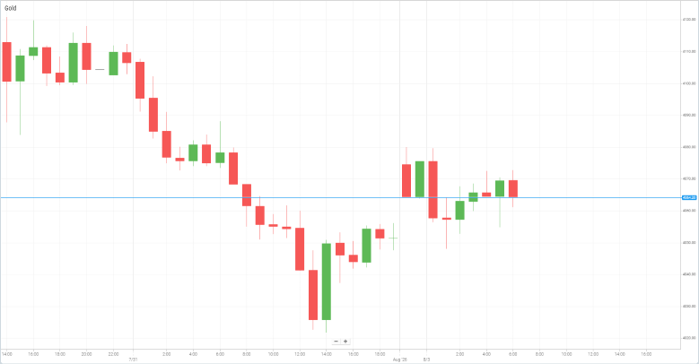
Gold (XAU/USD) advances around 0.5% to above $4,060 on Monday morning, extending its recovery as the softer US Dollar provides support to dollar-denominated bullion. However, gains remain limited as traders assess whether the recent rebound has enough momentum to develop into a broader recovery.
Gold also benefited from easing geopolitical concerns after US President Donald Trump said Iran and other Middle Eastern countries had requested additional time to finalize an agreement aimed at reopening the Strait of Hormuz and addressing Tehran’s nuclear program. The comments triggered a sharp decline in oil prices, with crude falling more than $5 per barrel in early Asian trading.
However, gains in gold remained limited by renewed concerns over the Federal Reserve’s policy outlook. Three Fed officials who dissented at last week’s meeting reiterated that inflation remains too high and supported an immediate rate increase, highlighting the uncertainty surrounding the central bank’s next move.
Attention now turns to a busy US data calendar, including JOLTS job openings, the ADP employment report, weekly jobless claims and Friday’s Nonfarm Payrolls, which could provide further direction for Gold.
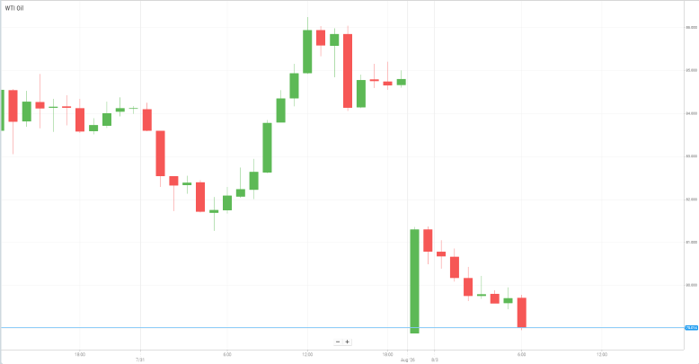
Oil prices fell nearly 5% in Asian trading on Monday, reaching their lowest levels in three weeks as expectations of renewed US-Iran negotiations reduced concerns over further escalation and potential disruptions to regional energy supplies.
The decline followed US President Donald Trump’s decision to call off a planned military strike on Iran and announce that negotiations would resume on Monday. Talks are expected to focus on reopening the Strait of Hormuz and addressing Iran’s nuclear ambitions, easing fears of a wider conflict that could disrupt oil shipments across the region.
Oil prices had briefly climbed above $90 per barrel last week as the conflict expanded, with attacks targeting energy infrastructure and shipping routes in the Gulf and Red Sea.
Additional downward pressure came from OPEC+’s decision to increase production quotas by around 188,000 barrels per day from September, continuing the gradual unwinding of voluntary output cuts introduced in 2023. The move reinforced expectations of higher supply as geopolitical risks begin to ease.
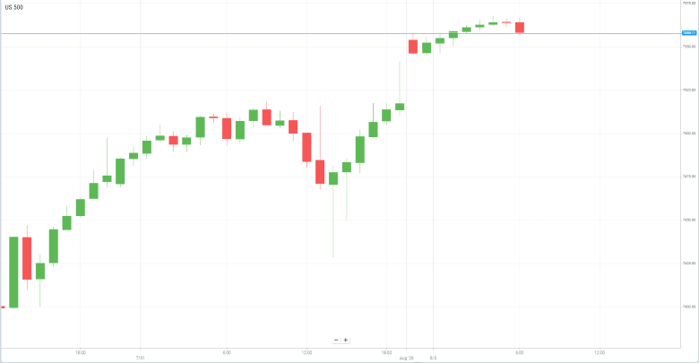
Wall Street ended higher on Friday, supported by gains in consumer discretionary and chip stocks, while stronger Treasury yields and a sharp decline in Apple limited the advance.
Technology stocks were among the weakest performers during the month as the AI rally lost momentum. The Philadelphia Semiconductor Index fell 20.6% in July, marking its worst monthly performance since October 2008. Concerns over elevated valuations, heavy AI spending and uncertainty over the timing of returns weighed on semiconductor stocks.
Big Tech earnings provided some support toward the end of the month. Microsoft’s results and strong Azure cloud growth helped revive interest in the AI trade, while Amazon surged more than 15% after reporting a 37% increase in AWS sales. Apple, however, fell more than 7% after issuing a weaker-than-expected outlook for the September quarter.
US monetary policy also remained a key market focus. The Federal Reserve kept interest rates unchanged at its latest meeting, but three officials dissented in favor of a 25-basis-point rate increase, citing persistent inflation pressures. The comments pushed Treasury yields higher and added to concerns over the outlook for interest rates.
The materials contained on this document should not in any way be construed, either explicitly or implicitly, directly or indirectly, as investment advice, recommendation or suggestion of an investment strategy with respect to a financial instrument, in any manner whatsoever. Any indication of past performance or simulated past performance included in this document is not a reliable indicator of future results. For the full disclaimer click here.
Join iFOREX to get an education package and start taking advantage of market opportunities.
 A beginner's e-book
 $5,000 practice demo account
 A 12-part video course
 Trusted partner
 Featured partner
 By
By 


