
Listed on 
 Years active
 English (Arabic)
 Chinese Simplified - 中文 (简体)
 Chinese Traditional - 中文 (繁體)
 English
 Japanese - 日本語
 Korean - 한국어 (대한민국)
 Portuguese - Português
 Russian - Русский
 Spanish - Español
 Thai - ไทย
 English (India)
Don't have an account?
Register via AppHave an account?
Login 02/07/2026 - 07:39 UTC
The U.S. Dollar Index (USDX) logged a modest gain of 0.25% on Wednesday, finding late-session support despite facing early pressure from disappointing domestic economic data. The currency initially sagged after the ADP private payrolls report missed expectations at 98K and the ISM Manufacturing PMI cooled to 53.3. However, the greenback stabilized as hawkish remarks from Federal Reserve Chair Kevin Warsh—who reiterated a firm commitment to the 2% inflation target despite political pressure for rate cuts—reinforced expectations that the Fed will likely raise borrowing costs by the end of the year.
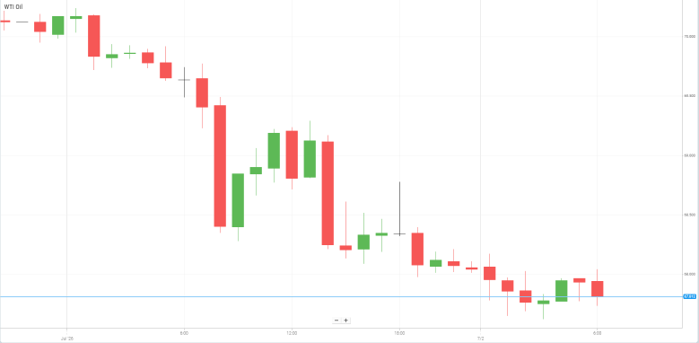
Crude oil took a sharp hit as West Texas Intermediate (WTI) tumbled -3.04% for the session, sliding well below the $68.00 threshold to trade around $67.80. This steep decline marks the commodity's lowest price point since hostilities began in February, driven by cooling geopolitical risks and looming supply increases. Sentiment turned decidedly bearish following reports from Qatari mediators pointing to tangible progress in indirect peace talks between the U.S. and Iran in Doha. Selling pressure was further amplified by news that OPEC+ plans to boost its production quotas by 188K barrels per day in August, effectively calming near-term inflation fears.
Gold managed to buck the broader commodity weakness, advancing by 0.73% on Wednesday to hold its ground above the $4,050 level. The precious metal capitalized on the softer U.S. macroeconomic prints and the plunging oil prices, which temporarily kept aggressive dollar buyers at bay. While the safe-haven asset benefited from residual geopolitical uncertainties, upside momentum remained somewhat capped as bullion investors hesitated to place massive directional bets ahead of major monetary policy catalysts.
A sharp wave of skepticism over global artificial intelligence infrastructure spending triggered a massive selloff across Asian technology markets on Thursday, heavily bruising major semiconductor manufacturers. South Korean equities led the regional downturn as investors questioned whether the blistering pace of the AI-driven chip rally could realistically be sustained. Driving the anxiety were reports that Meta Platforms Inc (+8.77%) is looking into launching its own cloud infrastructure business to lease out AI computing capacity. Ironically, while this news sparked fears that hyper-scalers are turning highly disciplined with their hardware budgets—sending shockwaves through the supply chain—Meta's stock surged dramatically as investors cheered the company's potential new high-margin revenue stream.
The ripples of this infrastructure anxiety immediately slammed the hardware providers and foundries powering the AI ecosystem. Taiwan Semiconductor Manufacturing Co (TSMC), the world's leading chip foundry, dipped -1.19%, while AI bellwether Nvidia slipped -1.20% as investors actively reassessed sky-high sector valuations. Meanwhile, South Korea's dominant memory producers faced an additional headache: reports surfaced that Apple Inc (+1.77%) is exploring the use of memory chips from Chinese suppliers. This potential loss of market share, paired with a weak overnight session on Wall Street, sent SK Hynix crashing -12.97% to its lowest point since mid-June, while Samsung Electronics plummeted -9.77%.
This was deeply synchronized across the broader hardware and advanced technology landscape, mimicking a punishing U.S. trading session where memory maker Micron Technology plummeted -10.10%. Even speculative and private tech ventures felt the pressure of the broader market recalibration, with SpaceX dropping -7.76% in secondary trading circles. Despite the sea of red, a few bright spots emerged: SoftBank Group managed to buck the trend, gaining 1.5% after reviving talks to secure a $10 billion loan backed by its stake in OpenAI to continue funding its aggressive AI roadmap, proving that targeted bets on core AI developers are still finding traction even as hardware manufacturers take a necessary breather.
Looking forward, the market's primary focus shifts heavily toward the upcoming June Nonfarm Payrolls (NFP) report. Consensus estimates project the U.S. economy added 110K jobs, reflecting a slowdown from May's robust 172K increase, while the unemployment rate is tipped to hold steady at 4.3%. Investors will also critically scan the Average Hourly Earnings data, expected to tick up to 3.5% year-on-year, for fresh clues on inflation. Given the Fed's rigid hawkish stance under Chair Warsh, a strong labor print could heavily reinforce the 85% market probability of an upcoming rate hike, triggering substantial volatility across the dollar, gold, and energy sectors.
The euro traded modestly higher against the US dollar during Thursday's early Asian session, with EUR/USD hovering near 1.1380 as investors reacted to a less hawkish tone from Federal Reserve Chair Kevin Warsh. Market attention has now shifted to the release of the US June employment report later in the day, which could provide fresh clues on the Federal Reserve's policy outlook.
Speaking at the ECB Forum on Central Banking on Wednesday, Warsh declined to offer any indication of what policymakers might decide at the Fed's July meeting. He reiterated that monetary policy decisions would continue to be made on a meeting-by-meeting basis, while emphasizing the central bank's independence and its commitment to returning inflation to the 2% target. Although he acknowledged that inflation remains above the desired level, his remarks stopped short of signaling any urgency to tighten policy.
Warsh also reiterated his preference for gradually reducing the Federal Reserve's balance sheet, noting that any move to scale back bond holdings would only come after extensive communication with financial markets. The comments were widely interpreted as providing little support for expectations of a near-term interest rate hike.
However, the euro's upside may remain limited after softer-than-expected inflation data reinforced expectations that the European Central Bank will proceed cautiously with any further policy tightening.
According to Eurostat, the Eurozone's Harmonized Index of Consumer Prices (HICP) slowed to 2.8% year-over-year in June from 3.2% in May, coming in below market expectations of 3.0%. Meanwhile, core HICP inflation, which excludes food and energy prices, eased to 2.4% from 2.6%, also undershooting economists' forecasts of 2.6%.
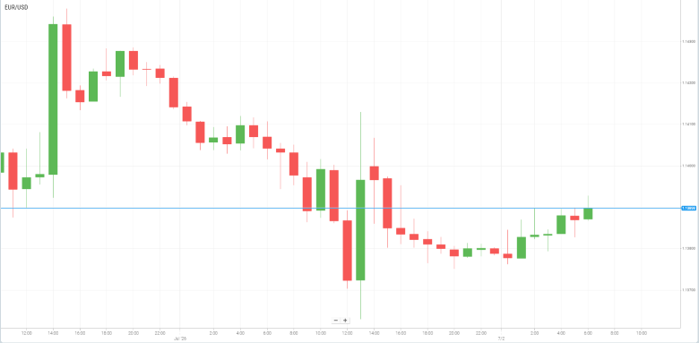
Gold prices remained supported above the $4,050 mark for a second consecutive session on Thursday, although gains were limited as investors refrained from taking aggressive positions ahead of the closely watched US Nonfarm Payrolls (NFP) report. A modest pullback in the US dollar following weaker-than-expected US economic data helped underpin bullion, but expectations for further Federal Reserve rate hikes continued to cap upside momentum.
The dollar came under pressure after data released on Wednesday showed signs of cooling economic activity. According to Automatic Data Processing (ADP), US private-sector employment increased by 98,000 jobs in June, down from 122,000 in May and below economists' expectations of 113,000. Meanwhile, the Institute for Supply Management (ISM) reported that its Manufacturing PMI slipped to 53.3 in June from 54.0 previously. The Prices Paid Index also declined sharply to 73 from 82.1, while the Employment Index improved modestly to 49.7 from 48.6. In addition, falling crude oil prices have eased near-term inflation concerns, further weighing on the greenback and providing support for gold.
Despite the softer economic data, markets continue to expect additional monetary tightening from the Federal Reserve. Those expectations were reinforced by Federal Reserve Chair Kevin Warsh, who reiterated on Wednesday that the central bank remains firmly committed to its 2% inflation target despite political pressure for lower interest rates.
Geopolitical tensions also remain in focus. Indirect talks between the United States and Iran in Qatar ended without any meaningful progress toward easing tensions surrounding the Strait of Hormuz. Meanwhile, Russia launched another wave of missile and drone attacks on Kyiv early Thursday, keeping geopolitical risks elevated.
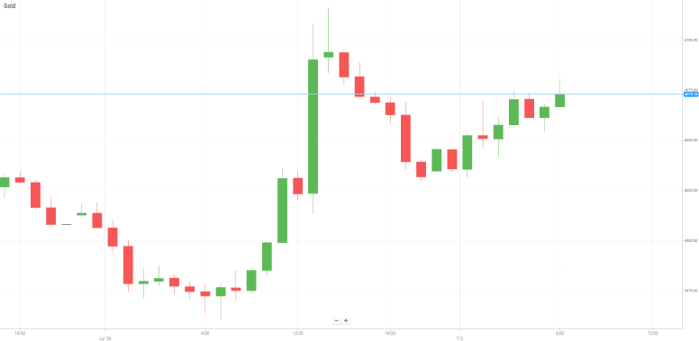
Oil prices moved lower early on Thursday as investors continued to assess the easing risk of supply disruptions in the Middle East. While geopolitical tensions remain unresolved, improving expectations for crude flows and abundant global supplies kept pressure on the market.
Market participants also digested the outcome of indirect US-Iran negotiations held in Doha. The two-day round of technical discussions concluded without a breakthrough toward a lasting agreement, although Qatari officials described the talks as constructive and confirmed that both sides had agreed to continue negotiations.
Attention remains focused on the Strait of Hormuz, a critical transit route for global oil supplies. Although recent diplomatic efforts have helped ease immediate concerns over potential disruptions, traders continue to monitor developments closely, as any escalation in regional tensions could quickly threaten crude shipments. At the same time, crude exports through the Strait of Hormuz have climbed above 10 million barrels per day, reinforcing confidence that supply flows remain uninterrupted despite lingering geopolitical uncertainty.
On the supply side, fresh data from the US Energy Information Administration showed domestic crude production reached a record 13.93 million barrels per day in April, adding to expectations of ample global supply and weighing on oil prices.
Looking ahead, investors are also evaluating expectations that OPEC+ could announce another production increase in August. Upcoming US crude inventory data and further developments in US-Iran negotiations are expected to provide additional direction for oil prices in the coming sessions.
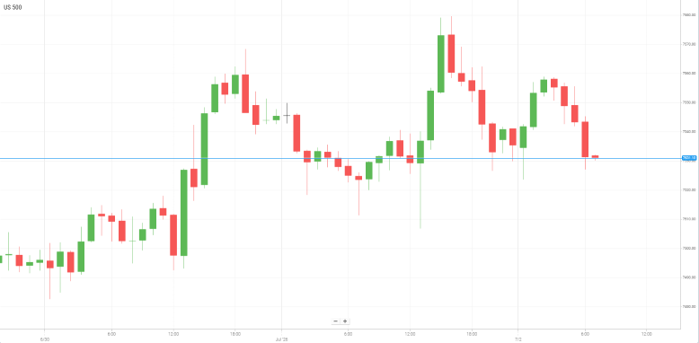
US stocks finished mostly lower on Wednesday after a choppy trading session, as investors took profits following a strong second quarter and awaited the release of the closely watched June Nonfarm Payrolls report. Markets also weighed mixed economic data and the first public remarks from Federal Reserve Chair Kevin Warsh since last month's hawkish policy shift.
Stocks opened lower as investors digested a mixed batch of US labor market data but briefly recovered after the release of manufacturing figures and a rally in Meta Platforms. Sentiment remained volatile throughout the session before major indexes retreated in the final hour of trading.
Market participants also monitored developments in indirect US-Iran negotiations, with President Donald Trump saying efforts toward the "denuclearization of Iran" were progressing well, although uncertainty surrounding broader geopolitical tensions remained.
Despite Wednesday's pullback, Wall Street remains on track after one of its strongest quarters in recent years. The US 500 gained around 15% during the second quarter, while the Nasdaq surged approximately 21%, driven largely by continued enthusiasm surrounding artificial intelligence.
Among individual stocks, Nike reversed early losses to finish more than 5% higher after reporting quarterly results that exceeded revenue expectations, despite warning that its turnaround efforts, particularly in China, will take time. Meta Platforms jumped nearly 9% following a report that the company is exploring plans to enter the cloud infrastructure market by offering excess AI computing capacity, potentially challenging major cloud providers such as Amazon Web Services and Microsoft Azure.
The materials contained on this document should not in any way be construed, either explicitly or implicitly, directly or indirectly, as investment advice, recommendation or suggestion of an investment strategy with respect to a financial instrument, in any manner whatsoever. Any indication of past performance or simulated past performance included in this document is not a reliable indicator of future results. For the full disclaimer click here.
Join iFOREX to get an education package and start taking advantage of market opportunities.
 A beginner's e-book
 $5,000 practice demo account
 A 12-part video course
 Trusted partner
 Featured partner
 By
By 


