
Listed on 
 Years active
 English (Arabic)
 Chinese Simplified - 中文 (简体)
 Chinese Traditional - 中文 (繁體)
 English
 Japanese - 日本語
 Korean - 한국어 (대한민국)
 Portuguese - Português
 Russian - Русский
 Spanish - Español
 Thai - ไทย
 English (India)
Don't have an account?
Register via AppHave an account?
Login 27/03/2026 - 08:06 UTC
The dollar index (USDX) softened on Thursday, losing 0.28% as it settled near the 99.90 mark. This slight depreciation followed an announcement by President Trump to pause potential strikes on Iran’s energy infrastructure for ten days, a move that temporarily eased the demand for safe-haven assets. However, the Greenback's downside remains limited as Federal Reserve officials, including Vice Chair Philip Jefferson, warned that persistent energy price shocks could fuel inflation. With market participants increasingly pricing out future rate cuts and eyeing a potential hike by year-end, the dollar continues to find underlying support despite the brief improvement in global risk sentiment.
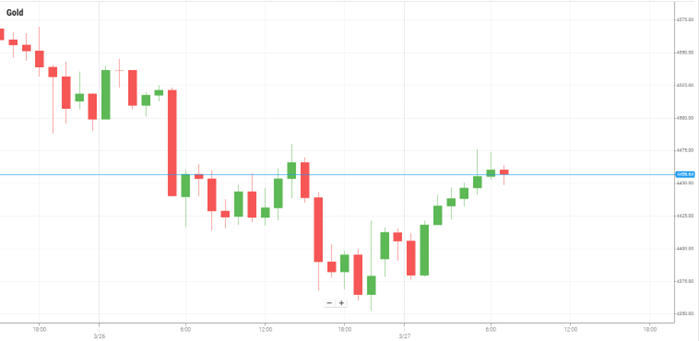
Gold faced significant selling pressure throughout the session, dropping -2.07% as it struggled to maintain its recent recovery momentum. While the pause in geopolitical escalations initially provided a floor for the metal, the broader shift toward a hawkish monetary outlook acted as a major headwind. Investors are increasingly concerned that the Federal Reserve will maintain a restrictive stance to combat energy-driven inflation, driving up Treasury yields and reducing the appeal of non-yielding bullion. Despite the ongoing uncertainty in the Middle East, the technical setup remains bearish, with the metal currently trading in the $4,465 region after failing to clear key resistance levels.
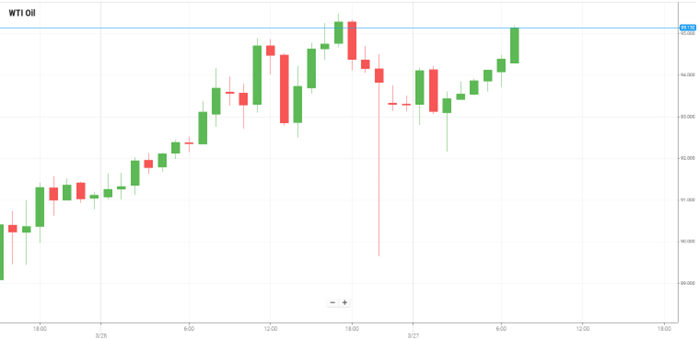
WTI crude oil prices climbed 2.38% on Thursday, with the benchmark nearing the $94.00 level as the market braced for a potentially protracted conflict. Although a temporary 10-day pause on energy site attacks was signaled, reports of the Pentagon considering the deployment of 10,000 additional troops to the region reinforced fears of a full-scale ground war. The continued blockade of the Strait of Hormuz remains a critical tailwind for crude, keeping the psychological $100 mark in focus for 2026. While news of a small tanker convoy being allowed passage provided brief relief, the overall supply outlook remains tight as investors weigh the reality of ongoing missile exchanges and the lack of a formal ceasefire.
Asian equity markets staged a recovery during Friday’s session as investors reacted to a temporary de-escalation in geopolitical rhetoric. the regional outlook remains clouded by the conflict entering its fifth week and the persistent blockade of the Strait of Hormuz, which continues to threaten global energy flows. X`In mainland China, the China SSE gained 0.66% while the China SZSE climbed 1.10% by 07:47 AM GMT, as domestic markets clawed back a portion of their weekly losses. The Hong Kong 50 followed suit with a 0.51% advance, supported by the broader stabilizing trend in regional risk appetite. In Japan, the Japan 225 remained nearly unchanged, inching up 0.06% as the market weighed the relief of the strike postponement against the ongoing release of national oil reserves to combat supply shocks.
The Korea 200 remained the regional laggard, declining -0.53% and heading for a sharp weekly loss. While the index recouped significant intraday losses after an initial 3% plunge, the technology sector continues to grapple with the implications of Google’s "TurboQuant" algorithm. This new technology has sparked structural concerns regarding long-term demand for high-end memory chips, keeping heavyweights like Samsung and SK Hynix under pressure. Overall, while the Friday bounce provided short-term relief, importers across Asia remain vigilant as military hostilities in the Middle East show few signs of a permanent resolution.
In corporate news, Meta and Nvidia served as significant weights on the Nasdaq during Thursday's session, falling -7.93% and -4.08% respectively. Meta faced intense selling pressure following two separate legal verdicts finding the social media giant liable for harming young users. Meanwhile, Nvidia slid amid mounting concerns over heightened competition in the artificial intelligence sector after chip designer Arm Holdings unveiled a new data center processor.
Carnival Corp (CCL) also saw its shares drop -1.74% on Thursday as investors braced for the company’s first-quarter earnings report, scheduled for release before the market open on Friday, March 27. While analysts expect earnings of $0.18 per share on revenue of $6.13 billion—marking solid year-over-year growth—the market remains wary of potential guidance cuts. The primary headwind for the Miami-based cruise operator is the surge in fuel costs driven by the ongoing Iran conflict
The Euro weakened further against the US Dollar on Thursday as heightened geopolitical tensions continue to underpin demand for the Greenback.
Ongoing conflict involving the United States, Israel, and Iran remains a key driver of market sentiment. Efforts to de-escalate tensions have stalled after Iran rejected a proposed US-led framework aimed at ending hostilities, insisting that any agreement must align with its own strategic conditions, including security assurances and control over the Strait of Hormuz.
Market expectations now suggest that the Federal Reserve will hold interest rates steady through 2026 as it navigates a complex macroeconomic backdrop. Inflation remains above the central bank’s 2% target, with upside risks persisting, while the labor market shows signs of softening. This dual pressure is expected to keep the Fed firmly data-dependent, balancing inflation control with emerging growth risks.
Meanwhile, the European Central Bank faces its own policy challenges. Although inflation in the Eurozone is relatively contained, the region’s heavy dependence on energy imports leaves it particularly vulnerable to sustained increases in oil prices, which could weigh on economic growth and consumer spending.
Economic indicators released this week have reinforced concerns about slowing momentum in the Eurozone. Germany’s GfK Consumer Confidence index for April declined to -28, falling short of expectations, while the Ifo Business Climate index dropped to 86.4 in March, its lowest level in over a year. Additionally, recent PMI readings point to weakening business activity, further highlighting downside risks to growth.
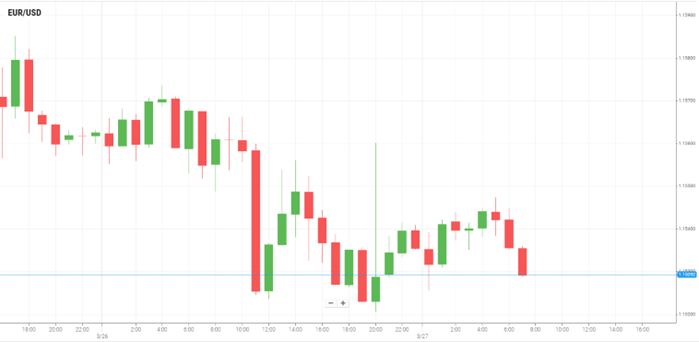
Gold prices edged higher during Thursday’s early European session, supported by a modest pullback in the US Dollar, though the broader upside remains constrained by expectations of tighter monetary policy.
The US Dollar came under slight pressure after US President Donald Trump announced a delay in planned strikes on Iran’s energy infrastructure, while extending the deadline for reopening the Strait of Hormuz to April 6. The move eased immediate market tensions, providing some support to the precious metal.
Despite this, gains in Gold appear limited as investors increasingly anticipate a more hawkish stance from major central banks. Persistent geopolitical risks continue to drive energy prices higher, reinforcing global inflation concerns and prompting expectations that interest rates will remain elevated for longer.
Mixed signals surrounding the US-Iran conflict continue to cloud market sentiment. While US officials have suggested that diplomatic progress may be possible, Iranian authorities have denied engaging in negotiations and dismissed the likelihood of any agreement. Reports of additional US troop deployments have further intensified concerns about a potential escalation.
These ongoing geopolitical uncertainties are likely to sustain demand for the US Dollar as a global reserve currency, limiting the scope for sustained gains in Gold prices.
Oil prices trimmed earlier gains on Thursday after US President Donald Trump announced a 10-day suspension of planned strikes on Iran’s energy infrastructure, while signaling that diplomatic efforts remain underway.
The decision helped ease immediate supply concerns, though uncertainty around the trajectory of the US-Iran conflict continues to drive volatility across energy markets.
Recent price action has been heavily influenced by disruptions in the Strait of Hormuz, a critical artery for global energy flows.
Market sentiment remains fragile as conflicting developments continue to emerge from the geopolitical front. Earlier in the week, oil prices declined after the United States proposed a 15-point peace framework aimed at ending hostilities. However, Iran has pushed back against the proposal, signaling limited progress toward a ceasefire.
In a potential goodwill gesture, Trump revealed that Iran had allowed 10 oil tankers to pass through the Strait of Hormuz without interference. The move offers temporary relief to global supply chains, as the waterway typically handles roughly one-fifth of the world’s oil and natural gas shipments.
With geopolitical risks unresolved and energy markets tightly balanced, oil prices are expected to remain highly sensitive to both diplomatic developments and supply dynamics. Investors are likely to monitor progress in US-Iran negotiations closely, as well as any further disruptions to key shipping routes.
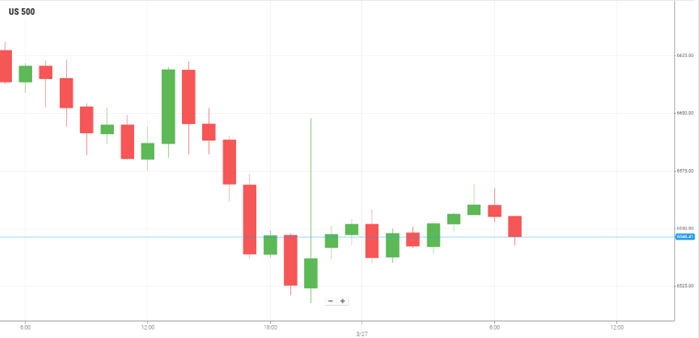
US equities ended Thursday’s session firmly in negative territory as renewed uncertainty for a potential US-Iran agreement unsettled investors, while rising oil prices added further pressure to risk assets.
Market sentiment deteriorated after US President Donald Trump signaled uncertainty over whether Washington would pursue a peace agreement with Iran, despite ongoing diplomatic efforts. While he later confirmed a 10-day extension to the suspension of US strikes on Iran’s energy infrastructure, mixed messaging continued to cloud the outlook for de-escalation.
Markets have adopted a highly reactive, headline-driven trading pattern, swinging between gains and losses as investors respond to conflicting developments to the Middle East conflict. Although optimism for a resolution has surfaced intermittently, inconsistent signals from both sides have undermined confidence.
Rising US Treasury yields also contributed to Thursday’s decline, with higher borrowing costs weighing on valuations and adding to broader market headwinds.
On the corporate front, technology stocks were among the biggest laggards. Memory-related companies came under renewed pressure following reports of a breakthrough by Google researchers that could reduce artificial intelligence-related memory demand.
Shares of Micron Technology, Western Digital, Seagate, and SanDisk declined sharply, with losses ranging between 6% and 11%. Meanwhile, Meta Platforms dropped 8% after court rulings held the company liable for harms linked to social media addiction among younger users.
With geopolitical uncertainty unresolved and energy prices elevated, markets are likely to remain sensitive to incoming headlines. Until clearer direction emerges on US-Iran relations, trading conditions are expected to stay volatile and driven more by geopolitical developments than underlying fundamentals.
The materials contained on this document should not in any way be construed, either explicitly or implicitly, directly or indirectly, as investment advice, recommendation or suggestion of an investment strategy with respect to a financial instrument, in any manner whatsoever. Any indication of past performance or simulated past performance included in this document is not a reliable indicator of future results. For the full disclaimer click here.
Join iFOREX to get an education package and start taking advantage of market opportunities.
 A beginner's e-book
 $5,000 practice demo account
 A 12-part video course
 Trusted partner
 Featured partner
 By
By 


